Dubai Restaurant Week: Inside 'HANU' with Chef Moon and his Korean food secrets
From ssam wraps to kimchi, Chef Moon makes Korean food feel personal and fun
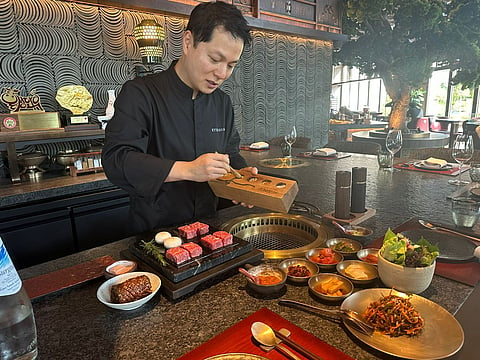
Dubai: There’s a moment at HANU when the smoke from the grill curls into the air, the meat crackles loudly enough to interrupt conversation, and Kyung Soo Moon casually reaches over to teach us how to build the perfect ssam.
"Just the right amount of sauce" he laughs, layering grilled meat inside lettuce and fragrant perilla leaves before topping it with ssamjang. “One bite only. Korean barbecue is supposed to be fun.”
And that’s exactly what lunch with Chef Moon felt like: less formal interview, more immersive Korean feast where stories arrived between sizzling cuts of beef, endless banchan, and lessons on fermentation, family recipes and why cabbage might secretly be Korea’s MVP ingredient.
The culinary director of HANU, who has also welcomed His Highness Sheikh Mohammed bin Rashid Al Maktoum, Vice President and Prime Minister of the UAE and Ruler of Dubai and Sheikh Hamdan bin Mohammed bin Rashid Al Maktoum, Crown Prince of Dubai, Deputy Prime Minister, Minister of Defence, and Chairman of the Executive Council of Dubai, to the restaurant, speaks about food with the kind of passion that makes every ingredient sound poetic.
Surprisingly, though, his favourite dish to eat isn’t Korean.
“My favourite dish is tabbouleh,” he says instantly. “I love the sourness of the lemon, the sweetness of the pomegranate, the different textures of the vegetables. Usually I eat one and then take another one home as takeaway.”
But when it comes to cooking, kimchi wins every time.
“I love making Korean kimchi because every household has a different recipe. Every mum makes it differently,” he explains while pointing out the various fermented dishes spread across the table. “Fermentation is good for digestion, for health, even skin. But here, we reduced the spice a little for the local palate.”
At HANU, kimchi is practically a full-scale operation. “Every week we make 100 kilos of kimchi,” he says proudly.
As he talks, he introduces us to different varieties, explaining the role fermentation plays in Korean culture and cuisine. One kimchi is sharper, another slightly sweet. Each bite tastes entirely different.
Then there’s his unexpected favourite ingredient: beetroot.
“Actually, I love beetroot,” he shares, grinning. “Korean cuisine traditionally doesn’t use it much, but I always try to incorporate it. It’s sweet, juicy, healthy and the texture is amazing. Even eating 100 grams every day can change your body.”
Still, when asked about the most important Korean ingredient, he doesn’t hesitate. “Cabbage,” he says immediately. “Kimchi, salads, rice dishes, it’s one of the most important ingredients in Korea.”
Some of Chef Moon’s fondest memories are rooted in childhood kitchens. He recalls watching his mother prepare elaborate bento lunch boxes for him as a child. “I was always curious,” he says. “That’s why I became a chef.”
Dubai, meanwhile, shaped him into a different kind of chef entirely.
“When I worked in Korea for 10 years, my experience was limited,” he says. “But Dubai is multicultural. You meet chefs from everywhere and learn different styles even while working in one place.”
That multicultural influence even shaped HANU’s identity, including its name. Chef Moon reveals he spent ages brainstorming names before landing on HANU, inspired by the Korean word for beef.
“I noticed many successful restaurants had four-letter names, Zuma, Nobu, Noma,” he says. “So I simplified it.”
For all his fine-dining success, though, one of his most treasured Dubai food memories happened in a humble restaurant in Karama around 15 years ago.
“After stamping my family’s visas, I was very hungry and randomly went into a lamb chop shop,” he recalls. “The lamb chops were so juicy and tender, even well done.”
He still visits weekly “Now the son runs it and recently opened another branch in Al Barsha. We became very close.” Then he laughs before joking: “If you say you know Chef Moon, maybe you'll get free food.”
Despite running celebrated restaurants, opening them never gets easier.
“I couldn’t sleep for three months,” he admits about the opening of SUSHISAMBA. “I was excited and nervous.” HANU, however, felt even more personal. “This is my heart,” he says quietly. “This restaurant is my culture, my home, my mother’s cooking.”
And perhaps that’s why dining there feels less like eating at a restaurant and more like being invited into someone’s story, one ssam, one kimchi, and one sizzling grill at a time.


