Click: Don't forget to buckle up children
Humans weren't designed to hurtle around in metal boxes at 120kph, especially little humans. Don’t play with their lives. Ensure you know everything about child car safety
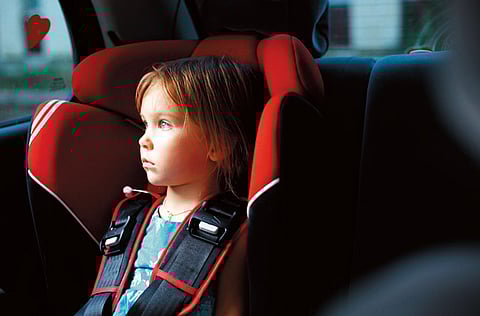
Imagine you’re cruising along Beach Road when a pedestrian steps out in front of your car in a moment of sheer oblivion; you swerve around this lucky fool, but collide with a parked Escalade, which is the automotive equivalent of an immovable object. Your beautiful car comes crashing to an abrupt and debilitating halt.
In that moment, one that you’ll replay over and over again in your mind’s eye, anything left unsecured inside the vehicle will keep surging forward after the car has stopped, including the passengers. This is the result of inertia, which is an object’s tendency to keep moving until something else works against this motion. In other words, the Escalade stopped your car, but what will stop you or your passengers? If you’re not wearing a seatbelt, then with a bit of luck, your body will be hurled against the airbag at roughly whatever speed you happened to be travelling. If you’re unlucky, you’ll sail through the windshield and hit whatever bits of concrete, asphalt or steel await you outside. Your brain will compress against your skull, your heart, lungs and kidneys will smash into each other or into bone. It’s not a pretty picture.
Seatbelts are designed to keep you in place in the event of an accident, spreading the force of impact across your ribcage and pelvis, and thereby increasing your chances of survival and avoiding injury by up to 50 per cent. The efficacy of these devices is not remotely in question, and car-related fatalities per capita are lower wherever seatbelt laws are enforced. They are, however, not precisely a one-size-fits-all affair, and offer less protection to small children. Instead, a specifically designed child car seat should be used, and one that is appropriate to your child’s size, weight and age. Look at it this way, you wouldn’t deny your child a visit to the doctor, and this is really the same thing; car seats are a form of preventive medicine.
Infant car seats
Infant safety seats are the easiest to spot, as they’re the smallest on offer, but make sure you check the specifications. Infant car seats accommodate babies weighing as much as nine to 12kg, or measuring up to 70 to 85cm in length (depending on the specific model). In theory, you could spring for a convertible safety seat at this point, which would accommodate your baby for longer. The equipment testing fanatics at Consumer Reports advise against this though, stating that “infant seats, by their design, tend to be more compact and secure infants better when compared to larger convertible models”. Convertible, in this case, just means accommodating babies from infancy and beyond through various adjustments.
Stick to the backseat
Starting with baby’s ride home from the hospital, he or she should travel in the back seat of the car, without exception. Carseat.org estimates that the risk of fatality is 30 per cent lower in the rear seat, which is all the reason anyone should need. Ever notice that your car has a front passenger airbag defeat switch? Forget it even exists, because even with the airbag off, it is still much safer for your little one’s seat to be installed in the rear of the car. Also important is the orientation of the car seat; both the US National Highway Traffic Safety Administration, and the Academy of Paediatrics recommend rear-facing car seats, up until two years of age. This is because babies have soft, very vulnerable necks, and rear-facing car seats protect them from snapping forward in a collision.
Toddlers/preschoolers
OK, so if you did opt for a convertible car seat, then you need to adjust it so it faces forward when your child meets the upper limit of its rear-facing specification (check your car seat’s literature to be certain). For a simpler solution, there are dedicated forward-facing car seats, simply called child seats, which are designed for children weighing about 8kg and up. Additionally, make sure that your child is able to support his/her head before making the switch. By this point, the baby is likely mobile, crawling (or walking) all over the place, keeping you constantly on your toes. If the fact that car seats save lives somehow isn’t compelling enough on its own, consider this; the safety seat is the only time you can strap your child down without raising eyebrows.
School-aged children
Booster seats are for older children who have outgrown their forward-facing child seats. Basically, booster seats reposition the child’s body so that it is positioned correctly against your car’s built-in, adult seatbelts. They’re used until the adult belts fit correctly (usually when a child reaches about 145cm in height and is between eight and 12 years of age).
Older children
Once your child graduates to the adult seatbelts, he/she should always use the lap and shoulder restraint, and should be consigned to the back seat until they reach at least 13 years of age. It may make you feel like a chauffeur to have them back there, but in fact, you basically are their chauffeur until they’re old enough to drive; a prospect that this new dad doesn’t even want to think about.
Once you select an age-appropriate car seat you’re not totally out of the woods yet; according to carseatsite.org “child safety seat installation error and misuse rates reach close to 95 per cent” in many regions.
Although not foolproof, the simplest solution can be found in Isofix base compatible car seats, which attach directly to Isofix anchor points available in most modern cars. The beauty of the Isofix solution is that once the base is installed correctly you can then detach the car seat with an easy quick release system.
Alternatively, you can simply connect most car seats using a standard shoulder harness seatbelt, but the process is a bit more complicated and therefore more error prone. The good news is that, when installed correctly, both methods offer equal measure of protection for your child.
For the dads out there, just make sure you set your male ego aside and read the directions; it’s guaranteed to be five minutes well spent.


