Beyond imagination
See how students from various universities in the region applied their imagination, passion and creativity to come up with gadgets to deal with some crucial issues facing the world.
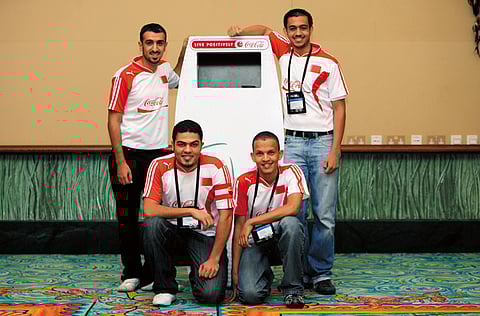
It may look like a simple cash point machine but it can give you a lot of things that money can't buy. All you need to do is feed it empty cans. For each ‘deposit' you make, you get points, which can be redeemed for gifts and vouchers.
And, perhaps more importantly, this smart invention helps boost your feel-good factor, because every time you use it you are making the world a better place in your own small way.
Designed and built by a small group of youths from the University of Bahrain, the prototype of this smart trash bin, called Cash Trash, was the winner of the regional finals for the Microsoft Imagine Cup. The finals are scheduled to be held in Poland in July.
The Cash Trash project
"The project is basically a smart trash bin,'' explains Mohammad Anwar Shaikhaldeen, who was part of the team named Genius Touch representing University of Bahrain which created the smart bin last year. (Shaikhaldeen dropped out of the team this year.) "The idea for a smart bin struck Ahmad Majdi, the team leader, when he once saw a lady dropping a trash bag just near the trash bin and not in the bin. He found the sight quite upsetting, and wondered if there way to motivate people to put their trash into the bin and not just near it.
"Majdi learnt about the Imagine Cup when Microsoft [represented by Lana Khalaf] visited our university's IT Symposium 2 last year. He had a potential idea and wanted to participate. In the process of developing his team he met me and, after learning about my technical skills, roped me in. I was initially hesitant because I had never worked in a development role before, let alone invented a device!
"But I realised that it would be a good opportunity to test my abilities and it looked like a promising idea. So I joined the team. We decided to make a device that gives people points for each can they drop into it. We limited ourselves to cans because with our budget that was the only thing we could programme the machine to detect.
"Detecting plastic or glass requires more sophisticated hardware and that would drive the price of the device up considerably. Also, aluminium is the biggest concern in the world of recycling and there's no one who doesn't drink cold drinks."The Cash Trash project won the regional finals last year but lost out in the final due to circumstances beyond the team's control: "The prototype got stalled in customs,'' recalls Shaikhaldeen, and so could not make it on time for the judging.
They were celebrated nonetheless for being the first Bahraini team to ever win the regional finals. The project held quite a lot of promise, which is why Majdi chose to enter the invention again this year. His persistence paid off: the team is once again in the finals.
Pride of the emiratesThis year, Dubai has something to celebrate too. Among the semi-final winners is a four-member team from the University of Wollongong in Dubai (UOWD). They developed a software model that assesses hearing levels using an application that can be downloaded to a mobile device.
"Hearing concerns of people are often overlooked,'' says Bhavik Salvi, one of the four students on the team. "If steps are taken early on, loss of hearing can be ruled out. We have had inputs from ENT specialist, Dr Rana Batterjee of American Hospital Dubai as we developed our application."The human ear can usually detect sounds within the range of 20Hz and 20,000Hz. However, the ability to hear the lowest decibel decreases with age. We can use this application to detect hearing loss at an early stage and collect statistics on hearing impairment in the UAE," said Salvi.
The team says that they are all very excited to be heading to Poland to participate in the finals.
Overcoming fears
Bahrain's Shaikhaldeen was in charge of the technical aspects of the Cash Trash device (both in terms of the software and hardware).
"Frankly, I was sceptical about my work because when you are deeply involved in making something you cannot help but see the flaws in your work. You keep pushing yourself to better it and improve something that may already be working well.
"The habit can become hard to break. During the course of the competition, as we progressed from one stage to the next, I learnt to tame my anxiety and fears and move on.''
The ideas that made it to the finals
Cash Trash is one of the four projects that were selected to represent the region in the global finals. Ten universities from across the Middle East participated in the regional finals - five from the UAE, one from Bahrain, two from Oman and two from Kuwait.
Each team was given 15 minutes to present their work to a panel of judges comprising senior members from the business and government sectors.
The fourth place went to the team from University of Wollongong, Dubai (UOWD) for their project ‘Ear-It'. The programme provides a low cost, easy-to-use mobile phone application to test a user's degree of hearing at several frequencies and pitch bands. It also prevents users from acquiring noise-induced hearing loss by generating pure white noise to cancel out the harmful noise in the surrounding environment.
The third runner-up was the team from University of Bahrain for their ‘Cash Trash' project. The project is currently on trial at various college campuses and malls in collaboration with the Bahrain Municipality.
Second place went to the team from Sultan Qaboos University, Oman, for their project ‘Show me the traffic'.
The ‘Show me the traffic' project is a web application that provides graphic information describing the level of traffic using Microsoft ‘Bing Maps'. The application relies on existing modes of traffic communication to notify commuters about traffic issues. It is also less expensive for the end-user.
First place in the regional finals was taken by the three-member team from the American University of Kuwait for their project ‘Multi-touch tutoring system'. This educational software programme uses markers and web-cams as methods for physically challenged people to interact with computers. The initial prototype was tested in Kuwaiti schools and includes lessons in English, Maths and Science.
A global competition
Now in its eighth year, the Imagine Cup has grown to be a truly global competition focused on finding solutions to real world issues. Last year, more than 300,000 students from 142 countries entered the Imagine Cup competition.
It is the premier student technology competition in the Middle East. This year about 9,000 students registered to participate. Of those who registered, only ten teams made it to the regional finals. The four finalists will advance to the world finals in Warsaw, Poland, from July 3-8, 2010.
"The Microsoft Imagine Cup is a year-long programme where participants compete through various levels of local, regional and online contests to go on and attend the worldwide finals," says Azza Al Shinnawy, Public Sector Education Lead at Microsoft Gulf.
"The intensity of the work brings the teams together and motivates them to give it their all. The bonds formed here often last well beyond the competition itself.
"With the competition, we empower students to use their abilities to make a positive impact on society. Students from the world over come together to show how technology can help make a difference in people's lives - in the way we think, work and communicate. They work in keeping with the eight Millennium Development Goals.
"These are universally-accepted human rights objectives that were agreed upon eight years ago by 189 nations around the world. A target date of 2015 was set to achieve them - we are now more than halfway towards it. Each year, students work to become part of the solution for these goals. New ideas are aired, new initiatives are launched and projects shouldered.
"We believe that education is the cornerstone of economic opportunity, so any efforts to help young people realise their full potential must begin here and now.
"Through this competition, we aim to inspire the next generation of technology and business leaders and innovate and stimulate local knowledge economies while having a profound and positive impact on society."
The World Cup of software
"The Imagine Cup is a student's chance to show the world what he can do. No matter which team comes up with the best solutions - the world wins," says Charbel Fakhoury, general manager at Microsoft Gulf.
"The world today is better place because some men took the courage to take their ideas beyond the drawing board and make their innovations a reality. All that we have achieved and are yet to achieve is the outcome of a vision."
The United Nations has outlined some of the biggest challenges in the world today in its Millennium Development Goals - ranging from reducing poverty and halting the spread of HIV/Aids to providing universal primary education.
The Imagine Cup challenges all programmers, designers and technologists to consider the UN's development goals as their inspiration when creating innovative software solutions.
"The Imagine Cup begins just as any other competition - with a burst of inspiration and a lot of hard work. But it has the potential to become a future software breakthrough, a future career or even a flourishing new industry. By applying their imagination, passion and creativity to technological innovations, young people can make a difference in the world today," says Fakhoury.
Life-changing moves
"Since working on Cash Trash for the first time last year, I have tackled many projects,'' says Shaikhaldeen. "So, yes, this was the spark that changed my life and I will always value it. But due to other work commitments, I have not been able to be on the team this year. I do wish them well and hope they come through as winners this time."
"Being on this project taught me a lot: it polished my presenting skills and [my ability to] market my work to both technical and non-technical audiences as we were practically hammered with presentation skills tutorials and tryouts!"
With one success came many more and today he is in the process of setting up his own company all thanks to the support of Microsoft and the experience and camaraderie of Imagine Cup 2009.
Indeed, life has changed for not just Shaikhaldeen but also for several other students who have taken part of the Imagine Cup.
Today, he and his partner, Aymen Al Ansari (who was also a student at UoB and a participant at the Imagine Cup) are one step closer to establishing their own company Advanced Technologies Software Developers. Speaking about his partnership with Al Ansari, Shaikhaldeen explains, "We studied at the same university and, coming from a common IT background, we bonded well.
"Lately, Shaikhaldeen and I have been going through extensive training on Microsoft Technologies," says Al Ansari, "And we are also forming a specialised company where we aim to utilise cutting edge technologies which represent both our specialities. The plan is to focus solely on our company as soon as we finish our training period in that company.''
At the moment, the company specialises in developing mainstream high-performance computing through graphic processing units and voice-enabled Windows or web applications.
"The first specialisation focuses on getting performance from as little hardware as possible. So, this should align with the Environmental Stability millennium goal," says Al Ansari.
"The second one is mainly used to create educational software for visually-impaired people, which falls under Universal Education goal.
"However, these technologies are not limited to these two goals: they can be aligned with any other goal as long as you know how to utilise them in a given field."
Do you know of an individual, a group of people, a company or an organisation that is striving to make this world a better place? Every responsible, selfless act, however small or big, makes a difference. Write to Friday and tell us who these people are and what they do. We will bring you their stories in our weekly series, Making A Difference. You can email us at friday@gulfnews.com or to the pages editor at araj@gulfnews.com


