Audi RS7 driven
The new 560-horsepower Audi RS7 is all eaten up by motor, and quite excellent at going straight. Fast...
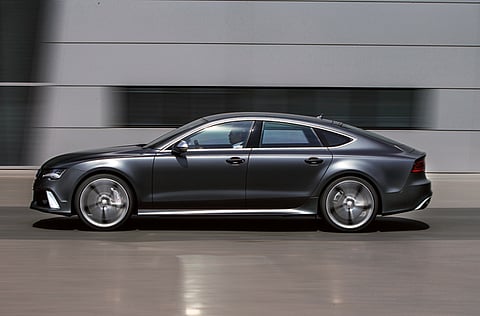
There was a lot of talk about figures during Audi’s presentation of the RS7 in Neckarsulm, Germany. Very impressive figures too, quite deserving of boastful amplification — 560 horsepower, 0-100kph in 3.9 seconds, 305kph top speed, 700Nm of torque, 9.8 litres per 100km…
If you had 560 horsepower, 700Nm and a top speed of 305kph you too would prance around, nose in the air, boasting. Mostly because you wouldn’t have much else to brag about other than your heady numbers. Maybe that’s why Audi’s clever marketing man took the stage to charm us with big figures. But he missed one, he missed the biggest one of all.
The weight balance of the new RS7 is almost 60:40 front to rear, and the car sends a maximum of 60 per cent of its torque to the rear wheels, which is nothing, for a 40:60 front to rear twist split. The wonky weight balance is because Audi’s mesmerisingly brilliant twin-turbocharged 4.0-litre V8 sits so far ahead of the front axle it has practically already arrived at your destination.
But will you remember any of your journey? Will the RS7 sear itself into your memory as a driving machine never to forget? Well, put it this way: I can’t even remember the colour of the car… Oh look, it was grey. OK.
Actually, recollecting the experience now, I do remember one facet of the RS7’s handling. On the fast jaunt across the German countryside when we finally did encounter a sharp corner, having been lulled by the quattro all-wheel-drive system into a false sense of security, we arrived at a hairpin much too fast and then understeered into a 17th century cathedral.
All this is, of course, because most Audis begin life with front-wheel-drive architectures and this causes all sorts of headaches for the engineers who are then given the unenviable task of beating AMG and M GmbH at the very game they created.
There’s a mechanical limited slip differential at the back with lateral torque distribution, as well as many aluminium suspension components plus a body made 20 per cent of aluminium — and still, dynamically it’s no Porsche Panamera.
The steering is typically Audi, which means it’s devoid of feel and immersion, but I have to admit the automaker is slowly getting its act together and this electromechanical system in the RS7 is noticeably improving. Steady on. With a 13.0:1 steering ratio the car is certainly quick in your hands; just don’t go trying to have a two-way conversation. Like I said, antisocial.
What an engine, though, right? The 4.0-litre twin-turbo is unquestionably my favourite mega-power German V8 of the moment, with full-fat buttery power delivery and torque out the wazoo. It revs to just short of 7,000rpm, which is pretty great for a big luxury, turbocharged car, but peak power is at 6,600rpm and you have all of the 700Nm from 1,750rpm.
The two turbos and their intercoolers sit high up on top of the engine and in the V of the two cylinder banks (I don’t imagine that’s good for lowering the centre of gravity and that weight distribution, but quattro GmbH people have actual university degrees, so…) meaning the exhaust side of the cylinder heads is on the inside and the intake on the outside for shorter gas journeys.
The interior is great, logical, comfortable, uncluttered, even spacious. But if you accept Audi’s invitation to optionally individualise your RS7 you could end up going horribly wrong with a vomit-inducing application of diamond-stitching and contrasting colours and materials. Rather save your money and go with whatever standard offerings Audi has in its brochure because tasteful professionals have already thought this through and come up with the best combinations, which all look beautiful. RS7 touches include badges, flat-bottomed three-spoke steering wheel, aluminium-look shift paddles and a shift-up warning light in the driver’s information display when you’re in manual mode.
If you want you can get a lot of gleaming carbon fibre all over the dash and trim, or choose from black lacquer, aluminium and wood. The seats are specific to the RS7 with increased side bolsters, embossed logos and pull-out cushions — you can really get comfortable in there for a long roadtrip, and you don’t have to leave anything at home since the boot offers 535 litres of capacity, which actually makes it vastly bigger than even the A8’s boot.
And it looks beautiful… provided you spec it deservingly. I mean who doesn’t like the A7 design? I remember taking a 420bhp S7 for a daytrip to Dibba earlier this year. Now that’s a car that does everything better than the RS7, except straight-line speed, but it’s honestly not lagging behind it uselessly either — they share the same 4.0-litre biturbo V8 engine. And every time I stepped out of that car I had to walk away craning my neck to get another look at it — in gleaming metallic blue with satin accents the design is as graceful as they come, making the Mercedes-Benz CLS and even the BMW 6 Series Gran Coupe look over-thought and forced out of the designers’ minds.
The A7 body style seems to have come naturally, but then the RS7 goes and tacks on a bunch of aggressive-looking pieces that, for me, clash with the car’s elegance. It’s OK though, I guess, because when you prod the throttle it’s all aggressiveness and it all comes together.
Personally I’d stay away from brash tones and black wheels (in fact I prefer the standard smaller wheels than the 21in rims on our tester) and try to keep the car as close to the A7’s original MO as possible.
But then again I’m not buying the RS7 — mostly Chinese and Americans are. And just as well, because I wouldn’t buy one anyway. That’s what the S7 is for.


