‘You don’t learn acting, you nourish it’
Romain Duris's offscreen persona — slight, puckish and animated
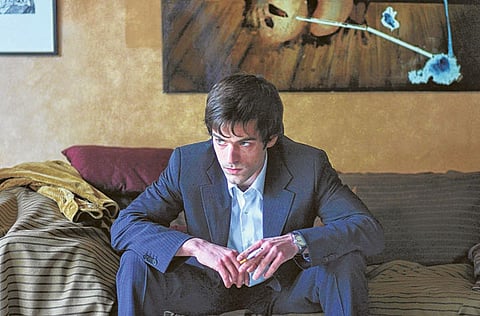
Romain Duris thinks a lot is explained by the fact that he is the youngest of three children. Growing up in Paris, he was, he says, always competing for the attention of his architect father and dancer mother. "That's why I make so much noise," he explains, smiling broadly and jiggling his legs like an energetic toddler. "I wanted them to know I existed." He laughs, then his voice rises and he makes a great show of thumping the café table in a parody of anger. "I needed them to know I was there!" And now? "I am still a child," he admits. "I have to keep playing."
It is no coincidence, he says, that in his native French and in English the verb "to play" or jouer is used when actors take on a part. And for the past six years, Duris, 37, has been playing his parts spectacularly well. His breakthrough role came in 2005 in The Beat That My Heart Skipped, directed by Jacques Audiard, in which Duris played the son of a violent slum landlord who is torn between his father's brutal criminal underworld and his own secret desire to be a concert pianist. The performance, which embodied both a quicksilver rage and an unexpected vulnerability, earned him a Csar for best actor and international plaudits.
Then, last year, Duris starred as an arch seducer in Heartbreaker alongside Vanessa Paradis. The romantic comedy went on to become the highest-grossing French film of 2010. He also stars in The Big Picture, in which he portrays a high-flying city lawyer who goes on the run after accidentally murdering his wife's lover — another role which requires both strength and fragility.
"I liked playing the guy who has been cheated on," Duris says. "He's a victim, but I wanted to play the weakness, the vexation of being wronged without his being too miserable or too passive."
It has taken him a while to get used to being recognised. His celebrity status was "shocking to me at the beginning. At school, I played the clown, I made people laugh on the metro and suddenly, when I became well known, I started having to pay attention to how I behaved and I didn't like that.
"Most people think I am very nice, they think I'm their friend, which is lucky, but it means you're never allowed to be in a bad mood. They take it personally. The worst is when you're on holiday with your family," he says (Duris has a 2-year-old son, Luigi, with his long-term partner, French actress Olivia Bonamy). "That sucks. But I can always go somewhere else." He grins. "Fame is OK. I hate it, but it's OK. I'm beginning to understand how I can be hidden. It's an attitude."
And it is true that, when we meet in a café in his neighbourhood of Paris, Duris is almost unrecognisable from his powerful on-screen presence. Partly this has to do with the fact that he seems to like wearing hats — he is already carrying a moped helmet when he arrives, with another leather cap pushed low over a springy mop of hair — but it is also that in person, he is slight and puckish, doing everything in a succession of quick, graceful movements. Yet in many of his films, he brings to his roles a real sense of tormented physicality.
"Yes, I'm aware of that. Before I film a movie, I look at how the character will move and walk." He sees this as being in the tradition of "the English acting technique. There is something more powerful than the French way — a way of filling yourself up with the idea you're about to express."
It is rather unexpected to hear a French actor praise the English way of doing things. Isn't French cinema renowned for being more thought-provoking than most? "Yes, but just because something is intellectual doesn't mean it's profound." And then, catching himself sounding pompous, he adds: "I don't know. Maybe tomorrow I will say the opposite."
But he takes his roles seriously. For The Beat That My Heart Skipped he insisted on learning the piano (as luck would have it, his older sister Caroline is a concert pianist and taught him). He denied himself sleep for much of the shoot, to better convey the character's manic edge. Does he get anxious preparing for films? "Yes, it's my secret. I am anxious about doing the right thing. Always."
He twists around in his chair, catching the waitress's attention by raising a delicate hand, the fingers incongruously weighed down with heavy silver rings in the shapes of skulls and snakes. Although he has mostly been speaking in French up to this point, he switches to self-consciously accented English to ask: "Can we 'av some keuh-fee?" The waitress giggles. Duris smiles, brown eyes softening. He seems to emit a magnetic forcefield of charm to all those who walk within two metres of him and is always quick to make himself look ridiculous. When I ask whether he regrets not doing a drama degree, he misunderstands me and thinks I'm suggesting he has never been to school. He puffs out his chest in a comic pose of Offence Being Taken. "I am eh-dewcated, you know," he says, still in English. "I 'av been to school."
Duris was an art student in the 1990s when a casting scout approached him on the street and asked him to audition for a film directed by Cedric Klapisch. At first, Duris turned it down (he protested with inimitable teenage style that he had already lined up a summer job delivering pizzas) but Klapisch persuaded him and Duris went on to star in 1994's Le pril jaune. Klapisch became his mentor.
"You don't learn acting, you nourish it," Duris says now. "I don't regret not going to drama school because I was very afraid of all the lessons. I'm allergic to technicality. The most important thing is life, the things you come across when you live it: the sadness, the happiness. The worst is emptiness."
He still paints, but "it's a question of motivation. When I was 18, I thought painting would be my reason to live, but then cinema took its place and I was very lazy and just put it to one side." He admires various artists — from Ingres to Van Gogh to Keith Haring — and describes his own canvases as "sexual work but in big landscapes".
It is a description that also rather neatly sums up the aesthetic of his latest film. The Big Picture, adapted from a Douglas Kennedy novel of the same name, sets the story of an extramarital affair against the striking scenic backdrops of moneyed suburban Paris and Montenegro.
As it happens, the French and their private peccadilloes have been much in the news of late. When Duris and I met, the former head of the International Monetary Fund, Dominique Strauss-Kahn, had spent some weeks under house arrest for his alleged sexual assault of a hotel chambermaid in New York. Do the French have a more relaxed attitude to sexual indiscretion than the rest of us?
"Not today, I don't think so. There are a lot fewer marriages, so people are more frank. With Dominique Strauss-Kahn, I was shocked by the proportions of the media coverage. Evidently, if Strauss-Kahn has done something, he should be punished, but the reaction was too much. These days, you say one thing out of place — you're drunk in a bar or you're being provocative at the Cannes film festival — and that's it. Before, people could say a lot of bullshit and it was allowed to pass. Now, no one lets it go."
Duris looks increasingly animated: eyes blazing, hair getting wilder with each expansive hand gesture. Why does he think our attitudes have changed? He shrugs. "There's a desire to behave well — this generation's reflex is to condemn. I don't know where that comes from, perhaps because we were too permissive in the past." He grins again, his face shifting from seriousness to ridiculousness in one fluid stroke.
The internet is one of the only modern appliances he allows in the house. He eschews the idea of television — "I don't like TV. I don't have the habit because I never had it as a child. It's boring" — and instead watches sport online. "I like watching tennis because it relaxes me. I think about nothing when I'm watching, apart from people running and serving and hitting. I adore that. It calms me."
As a child, he used to be an excellent skier. "I used to ski better than the people who lived in the villages by the slopes," he says, with a sudden bubbling over of enthusiasm. "I used to win prizes, yes!"
Professionally, however, he doesn't seem all that fussed about the idea of scooping awards. He is keen to carry on doing interesting, offbeat work — in his next film, Duris stars as a 1950s' insurance executive who enters his secretary for typing competitions — but has no plans as yet to make the transition to Hollywood.
"I've been receiving scripts but nothing interesting enough," he says, citing the Coen brothers, Woody Allen and Quentin Tarantino as directors he would most like to work with. "Often it's for supporting roles or often it's too close to a character I've already done. If I got to Hollywood, I don't want to go as the poor, little Frenchman. I have a need to create something, to play a real character."
"Play", of course, is the operative word.


