The swing between talents
Takeshi Kitano makes dark and violent films but is also an accomplished artist whose works resemble a children's funfair
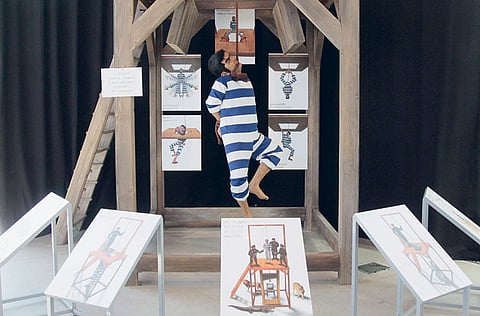
There is plenty of evidence that artists can make decent films — Steve McQueen, Sam Taylor Wood, Julian Schnabel to name a few — but it rarely works the other way around. Looking at Dennis Hopper's goatee-stroking conceptual works or Sylvester Stallone's attempts at abstract expressionism, you suspect they were misled into overestimating their talents by a coterie of star-struck sycophants. So when it was announced last year that Takeshi Kitano, Japan's foremost filmmaker, was holding an art exhibition in Paris, the alarm bells rang.
Over the last 15 years, Kitano has turned out a series of spare, violent, existential thrillers but increasingly his prime concern seems to be his own navel. His 2005 film Takeshis', a wilfully confusing essay exploring the many facets of Kitano's personality, was recently released in the United Kingdom. He followed that with the self-referential Glory to the Filmmaker, this time exploring the burden of being an important film director. Variety magazine's damning verdict? "Hailed as Kitano's 8, pic weighs in closer to 1."
And then there are the paintings. Anyone who has seen Hana-Bi, Kitano's film which won the Golden Lion at the 1997 Venice film festival, will be familiar with them: The film is full of the director's own artworks. At best, they are colourful, crafted examples of what you might call "the naive style"; at worst, they are the sort of amateurish doodles you might find at a flea market. Yet here he is in Paris, with carte blanche to take over the Fondation Cartier, a prestigious steel-and-glass culture outlet on the Left Bank.
Meanwhile, over at the Pompidou Centre, there is a parallel retrospective of Kitano's films; recently, France's minister of culture made him a Chevalier des Arts et des Lettres — the country's highest artistic accolade.
In fact, Kitano's takeover turns out not to be an exhibition at all; it is a children's funfair. Some of his paintings have been turned into giant transparencies and stuck on the glass walls; there are jokey installations and interactive exhibits making fun of art. The centrepiece is a clanking contraption like a steam locomotive, turned by a giant pair of disembodied feet in tatty woollen socks; at its prow, there is an ordinary sewing machine stitching a little piece of material. The might of industry is harnessed to make a pointless little decoration.
Another installation, The Japanese Imperial Army's Secret Files, consists of scale models of animals turned into weapons: a whale with an aircraft runway strapped to its back, an elephant with a gun attached to its trunk, that sort of thing.
There is a stall where participants can fire paintball guns at large cut-out dinosaurs and a machine that produces random Jackson Pollock-style paintings. There are strange chimera, animatronic puppets and scientific brainteasers. Far from being another journey into Kitano's psyche, it is generous, accessible, funny.
Far from the shark-like killer he often plays in his films, he is genial and expressive in person, verging on the cuddly. He is starting to look like the 63-year-old he is, even if his hair has blond highlights. "When people tell me I'm an artist, I say what? It's impossible for me to take the idea seriously. So I just wanted to have fun here. Psychologically, I'm still a 12-year-old boy."
The title of Kitano's exhibition is Gosse de Peintre, which you could translate either as "child of painting" or "painter's child". It is a reference not just to Kitano's juvenile side but also to the fact that his father was a painter and decorator.
In his autobiography, Kitano wrote of being embarrassed by his father's lowly trade and at having to help paint the houses of his classmates. He is now generally sceptical about contemporary or conceptual art, or indeed anything too theoretical.
He agreed to the exhibition because he had been making a film about art, recently released in France. Entitled Achilles and the Tortoise, it is a black comedy about a terminally self-absorbed artist who goes through every style in the book before realising, at the end of his life, that he is simply no good. Again, all the paintings featured in the film are by Kitano. He says he has no illusions about his own talents. "I paint for the sheer joy of painting," he says. "I have never sold any of my paintings. I'd rather give them to people for free."
To Japanese audiences, Kitano's populist mischief-making will be nothing new. To the West, he might be Takeshi Kitano, respected filmmaker and actor; back home, he is better known as "Beat Takeshi", ubiquitous television celebrity, Japan's answer to Chris Tarrant. Until recently Japanese audiences have largely ignored Kitano's films, which only found an audience when they were praised by European critics.
According to his producer, Masayuki Mori, who has known him for 30 years, Kitano's career is like a pendulum. "The more serious he gets in his films, the stronger he swings back to the other side and the more absurd and stupid his TV shows get. He really needs to do both to be him."
It probably says more about us than him that Europeans tend to prefer Kitano's dark, violent, mysterious side. But he is the first to observe that comedy often simply doesn't translate as well as "matters of life and death".
To Kitano, there is no great contradiction in his work, anyway. "Humour is like violence. They both come to you unexpectedly and the more unpredictable they both are, the better it gets. That's how it works. If somebody slips on a banana, it's funnier if it's someone high up, such as a king or an emperor, than if it's an ordinary man. So this demonic character is shared between comedy and violence. They both lurk in the most unpredictable moments."
Perhaps his Paris exhibition will finally fill in some of the gaps in Kitano's divided personality — except that the pendulum swings the other way there, too.
He might poke fun at art but painting clearly has a therapeutic, even spiritual dimension for him.
He took it up in 1994, while recovering from a serious motorcycle accident. He hit a crash barrier and suffered severe head injuries — the right side of his face still bears the scars. The way Kitano tells it, a piece of bone threatened to enter his brain.
"The surgeon said I might go crazy if they didn't operate. I thought, ‘Good. I might become a crazy painter — such as Picasso or Van Gogh!'" Those early paintings appear in Hana-Bi, as the work of a character who is coming to terms with being paralysed after a shooting incident.
Mori, the producer, later tells me Kitano has no memory of the crash and gets events mixed up. The surgeon did want to operate, but to restore facial movement on his right side. Kitano refused, preferring to accept his fate.
Death, violence and suicide are constant preoccupations in Kitano's work. In several of his films, Kitano's character kills himself in some way, or at least contemplates it; he has described his motorcycle accident as an "unconscious suicide attempt".
Kitano has also regularly committed career suicide, it seems, by making a wilfully unappealing comedy just as he is starting to get serious critical acclaim. Acknowledging this, he has referred to his recent films as part of an ongoing "creative destruction" of his career and it is difficult to tell whether he is joking or not.
Either way, that stage of his life is coming to an end, he says. His next film, Outrage, will return to more familiar yakuza thriller territory. "Psychologically and physically, during the last two or three films I've been going through the transition from being a middle-aged man to being an old man. It's been excruciating but I think I've survived it."
Does he feel reborn? "No. I feel ... fermented," he says with a laugh. With his restless intelligence, it is hard to imagine Kitano ever describing himself as settled but he seems to have struck a happy equilibrium — part wise old man, part 12-year-old child.


