The Devil Wears Prada 2 review: Timely take on fading newsroom power that can’t outshine the original
Miranda Priestly meets metrics and mass layoffs in a less effortless follow-up
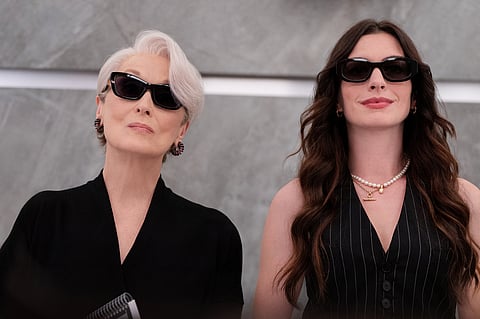
Dubai: The timing couldn’t have been more uncanny. With Amazon powerhouses Jeff Bezos and Lauren Sánchez stepping in as high-profile co-chairs of a major cultural fundraising event, you can’t help but wonder if the Met Gala has become more accessible or simply more corporate.
It feels like the kind of moment that signals a subtle shift away from the era defined by Anna Wintour, who famously inspired the iconic editor role Miranda Priestly from The Devil Wears Prada franchise.
Get updated faster and for FREE: Download the Gulf News app now - simply click here.
They say truth is stranger than fiction, and in this case with the glossy sequel, it plays out almost too neatly. What was once a rarefied world of Dolce & Gabbana polish now feels closer to a “Dolce & Karama” moment—and that’s not a slight on Dubai’s wonderfully vibrant neighbourhood, but a reflection of how access, aspiration, and influence have shifted.
That shift sits at the heart of The Devil Wears Prada 2.
Miranda Priestly is no longer the unshakeable force she once was. The formidable editor of Runway magazine now finds herself navigating a landscape that has moved on where digital dominance, clicks, and engagement metrics matter more than editorial instinct or storytelling. The power dynamic has quietly inverted, and there’s something telling about watching her almost forced to hang up her trench coat rather than theatrically throw it at a terrified assistant.
From an editorial standpoint, this lands with uncomfortable familiarity. Anyone working in fashion, lifestyle, or entertainment media will recognise the transition. It is no longer about authority or taste; it is about numbers. Editors fly economy. Corporate stakeholders who don’t fully understand media are calling the shots. You can cry into your silk pillows all you want, but it doesn’t change the reality.
Andy Sachs (Anne Hathaway), now a serious journalist, isn’t immune either. There’s a striking moment during an awards night when a collective beep announces mass layoffs over text. It feels dramatic, until you realise how close it sits to real-world scenarios.
There’s also a thread the film taps into that feels uncomfortably specific to newsroom dynamics. A senior editor pulling rank, swooping in to take over an opportunity you’ve worked towards is a familiar feeling, but you learn to take it in your stride.
Watching that unfold, I found myself laughing not because it was funny, but because of how precisely they got it right. As a journalist, it felt almost too familiar.
At the same time, that’s also where the film slightly loses its grip. It packages these moments a little too neatly. It’s smart, but also a bit too convenient. Real newsroom power plays aren’t always this clean or linear, and they certainly don’t resolve themselves with this kind of narrative ease. In reality, it’s messier, more layered, and often far less satisfying.
The film also touches on female rivalry and camaraderie without slipping into easy cattiness. Instead, it acknowledges a more grounded truth—that women often have to work twice as hard, only to find the rules shifting anyway.
Emily Blunt is brilliant here and arguably has more to do this time. She really sinks her teeth into the role. There’s one particularly cutting scene where Miranda tells her she will never be a visionary, only a vendor. Whether Miranda is right is almost beside the point; what lingers is the dismay and self-doubt that follows. It’s one of the film’s most honest moments.
Meryl Streep slips back into Miranda effortlessly, while Stanley Tucci remains the most reliable presence in the newsroom.
I loved the themes the film engages with. They are highly relevant, especially for anyone in media. This is a profession that is clearly fading unless you pivot or adapt, and the film recognises that.
But this is also where the familiar issues of a sequel begin to show.
The iconic gags and one-liners like “Are you wearing this?" feel less like sharp callbacks and more like repetition. There are chuckles, there’s nostalgia, but it often feels like the film is trying a little too hard to remind you of what worked the first time around.
A number of scenes feel like they are spoon-feeding audiences who may not remember (or are too emotionally attached to) the original The Devil Wears Prada. That film had a natural sharpness, a kind of effortless bite that this one doesn’t quite replicate.
Miranda Priestly herself hasn’t changed much, and perhaps that’s the point, but it also raises a question. In a more self-aware, diverse newsroom today, does her brand of authority feel slightly out of step? Has the world evolved faster than she has?
There is a lot to appreciate here, especially in how closely it mirrors the current media landscape. But it never quite lands with the same precision or emotional sharpness as the original.
In many ways, this no longer feels like a story about Prada alone.
It feels like a story about power shifting platforms and about legacy giving way to algorithms.
A Devil Wears Amazon moment, if you will.
And that lands harder than any couture reference ever could.


