On a political stage
For Syrian actor Duraid Lahham, his trade is a means to promote resistance awareness
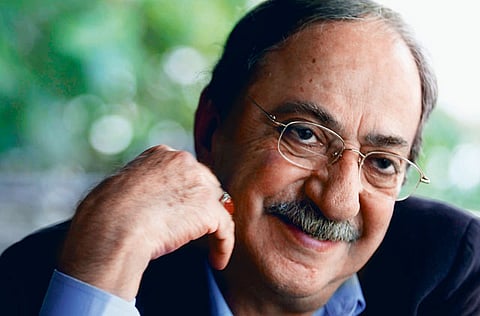
Throughout his 50-year career, Syrian actor and playwright Duraid Lahham delighted millions with his plays, films and drama series. But being one of the most popular Arab comedians does not mean Lahham takes the issues of his nation lightly.
"I am a tank of defeat," the 75-year-old actor said in an exclusive interview. "I've seen my nation defeated over and over again and I was a witness to the big conspiracy against it," he said.
The artiste, who saw many wars between the Arabs and Israel from 1948 to 2006, said he was not afraid of war anymore. "In fact, we reach a stage after so much tension that we want to get it over with," he said.
Lahham can see only one ray of hope in this situation, which is resistance, because until Israel was forced out of Lebanon in 2000, it was one defeat after another for Arabs.
"Resistance restored my faith that there is a future for this nation. It defeated Israel and reinstated our dignity and pride," he said. A small group of people managed to achieve a balance of power, or a balance of fear between us and this enemy, which entire armies could not achieve. They made us realise that if you have the will, you can achieve the impossible and not only did they have the will but they were willing to pay very dearly, because nothing is dearer than one's life," he said.
"Freedom fighters have the word ‘martyr' written on their clothes because they aspire to die for their nation and I believe we must honour them and stand by them, not conspire against them as some Arab countries do," he added.
However, this stand came at a price. Lahham, who was selected the Unicef's Goodwill Ambassador in the Middle East and North Africa in 1997, had to give up the title, along with the diplomatic passport, when he felt that his position contradicted his beliefs.
"I took my children and grandchildren on a trip to South Lebanon after the liberation and there I was approached by the media and was asked about the liberation of Lebanon and how it felt to be in South Lebanon, which was occupied by Israel.
"Of course, I expressed my happiness and pride in being the friend of resistance movements.
"My statement was carried by the media and a campaign was started against me. I was accused of supporting a terrorist organisation, which shows how hypocritical these judgments can be. It seems as if the United States and European countries had never resisted occupation, although history tells a different story. They consider resistance their right, but when it comes to us, it is labelled as terrorism," he added.
"It was made clear to me that I should stop, if I was to keep my position and diplomatic passport, but it was not something I was willing to do because my patriotic stands are not negotiable.
"I found out that there was absolutely no goodwill in what I was asked to do or in holding on to a title that forced me to act against my principles. I realised that I didn't need a diplomatic passport or a goodwill title to serve the children but doing anything against my beliefs was out of the question, so I kept the goodwill and gave them back my diplomatic passport," Lahham said.
Lahham's earlier works for television, such as Hammam Al Hana, Sah Al Noum and Maqaleb Ghawwar in the 1960s and early 1970s were a far cry from his plays later on.
His trademark fictional character, Ghawwar Al Tousheh, started off as a mischievous outlaw who would do anything to marry the girl he loved or find a lost amount of money.
He was supported by a group of actors who each had his own trademark character, including Nehad Qal'ee, Yaseen Baqoush and Naji Jabr.
However, all that was changed when he joined efforts with Syrian playwright and poet Mohammad Al Maghout to produce some of the best Arabic plays including Ghurbeh, Day'et Tishreen and Kasak Ya Watan. Looking back at his early days, Lahham admits that when he first started, it was art for art's sake for him, but that did not last long.
"After the Arabs were defeated by Israel in 1967, I felt that art should be in the service of the nation. It should have a role in spreading awareness and helping people understand what is going on, how the game is played, what cards are being exchanged under the tables and the difference between what is being announced and what is being done," he said.
"I believe there's a big conspiracy against our nation and as an artiste it is my concern to stand up to this in any way that I can, which made me realise that resistance is the only way and I mean resistance in all forms, not only by arms," he said.
"I tell the children I meet that they too can play an active part in resistance against our enemy by studying hard, getting the best possible education and working hard. Each one of us has a part to play if we want to alleviate this injustice we are suffering from," he said.
However, Lahham is not very optimistic about the future. "I'm not a fortune teller, but I strongly believe that an honest look at the present helps us foresee the future. In my play, Kasak Ya Watan, which debuted in 1979, we had a scene in which Ghawwar (the character played by Lahham) was selling his children.
"Ghawwar starts as an optimistic person, who is happy with his life despite poverty and is expecting a baby with his wife but when his wife delivers four babies, things take a turn for the worse.
"Ahlam, the daughter Ghawwar was so eager to have, dies of hunger and sickness and that is when his dreams die and he gives up hope. He offers his three other babies for sale before selling the medal his father had won as a hero.
"When the play was shown, people thought the scene of Ghawwar selling his children was too cruel and many believed it was impossible. But unfortunately, a year or two later, this started happening," he said.
"A few people even posted advertisements in newspapers to sell their children," he said. "This simply proves that a critical look at the past and present will give us an insight into the future and for me, this insight does not make me happy.
"I'm not optimistic at all about the future of my nation but I try to seek a ray of hope. Right now, I see hope in the fact that we have reached rock bottom and things could not get any worse. They could only get better. It is said that hope is a way of enjoying the future now. It may be a false hope but it is there."
In a gesture of solidarity with the Palestinian people, Lahham, along with his wife and other artistes from Syria and Egypt, visited Gaza in 2009.
He was the first Arab artiste to set foot in besieged Gaza after the destructive Israeli aggression of January 2009.
"I was invited by Palestinian director Saeed Al Bitar, who made a play called Women of Gaza and Ayoub's Patience. He asked me if I wanted to go and watch his play and I agreed, much to his surprise. Lahham said he wanted to visit the Palestinians of Gaza to show them that Arabs care about them and support them, and to be a witness to the destruction caused by the Israeli violence.
"On my way to Gaza, I was thinking that I'm going to visit the world's largest open-air jail, but when I entered Gaza and met its people, I found I had just crossed over to freedom.
"Their resistance gave them freedom, despite the big conspiracy to break their resilience. When I see them hold on to their land and refuse to leave Gaza no matter what, I know that they have the will to live despite all pressures against them. I just wonder how long they will manage to remain resilient under the circumstances," Lahham said.
Lahham was recently in Sharjah to read a book for children. He also hosted a television programme for children called A'alam Duraid (Duraid's World), which was criticised for introducing children to ideas and facts beyond their age, such as asking children if they knew how they came to life, which many deemed inappropriate.
However, the actor has a different view on that. To him, children should learn everything in a simple way, because it is better to learn the right information than to be misled by the various sources of false information.
Part of Lahham's efforts towards children include producing two films for them, Kafroun and Abaa Sighar (Young Parents) and a play titled Al Osfoura Al Sa'eeda (Happy Bird).
In Kafroun, a group of children co-star with Lahham, who plays the part of a friendly man falsely accused of murder. The children take it upon themselves to prove his innocence not just because they like him but because they believe that their friend could not have done such a thing.
Lahham was never far from the educational field since the actor, who holds a degree in chemistry, started his working life as a teacher.
"I believe in the family, because a strong family makes a strong nation. When we reach a certain age, we realise that the best part of our lives is behind us and our future, as a nation, lies in the hands of our children.
"This means that we must work hard to raise them well because they are the ones who will shape our future.
"What the Arab child needs most is a family. He needs parents who know the meaning of childhood and can understand him or her," he said.
"Most parents treat children not as little persons but as little things. They are not aware of how intelligent children are and they keep oppressing them and preventing them from speaking their minds, which causes the child to stop talking and with time lose interest. I advise parents to let their children speak and listen to them, because they need to explore their horizons and build bridges of friendship with their children."
Between his family and work, Lahham still finds time to support social causes he believes in, especially those concerning women and children.
Among these issues is the right of Syrian women to pass their citizenship on to children, which is facing opposition by many who believe that citizenship is like the family name and can only be taken from the father. Lahham does not agree.
"I always say that Syria is my second nation. My first was my mother's womb. This mother who bore me and nurtured me for many years is my first nation and she definitely has the right to pass her citizenship on to me," he said.
He goes on to wonder why there is such unfairness towards women, who convey language, ethics and patriotism to their children but are not allowed to actually pass on their nationality.
Another issue Lahham campaigns for affects hundreds of women every year, known as "crimes of honour".
"How can there be an honourable crime? How can a murder be committed for honour?" he wondered.
"If we want to incriminate an act, we have to prosecute all parties involved in this act without discrimination. But what happens is that women are the only ones prosecuted and punished, by their own families, when they are involved in an illegitimate relationship with a man," Lahham said.
"How can a murderer be let off just because he killed a woman whom he personally prosecuted and issued a judgment against? At least the judicial system should not be part of this crime and should not treat this murderer with leniency," he said.
"A murderer is a criminal and describing the crime as a crime of honour does not conceal the fact that a human being was killed mercilessly and the killer must be punished."


