Lupita Nyong’o’s Helen of Troy in The Odyssey: A woman blamed for a war men fought — and punished for surviving it
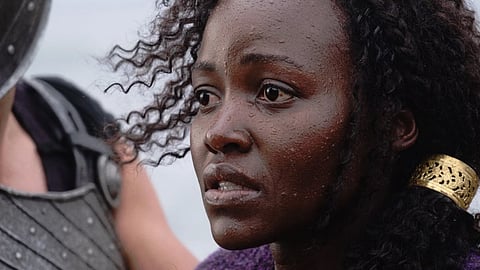
Helen’s rage simmers as Lupita portrays a broken, scorned woman presented like a trophy.
“Some things can be recovered. Some things can be restored. But some lost things, we seek forever.”
― Margaret George, Helen of Troy
In the 2004 film Troy, a stunning Diane Kruger escapes with Orlando Bloom’s Paris. The revelation itself to Eric Bana’s Hector takes place on the ship. A furious Hector reminds Paris of the values and morals their father instilled in them, warning that his decision could shake the very foundation of the peace treaty they were trying to forge.
“You’ll fight a war for this woman?”
Two men arguing, while the woman remains in the shadows.
Her curse is to watch: As is evident in his battle with Menelaus, when Paris, unable to fight the war he began, crawls to Eric Bana’s Hector, fearful of death. Menelaus spits at the dishonour and shouts at Helen, “You left me for him?”
Helen watches. There’s no time for disgust in her eyes.
However, If Diane Kruger's Helen is made to watch the consequences of the war, Lupita Nyong'o's Helen appears to carry its consequences on her body.
Yet, the little that we see does capture the rage and trauma of a broken woman who lost everything to a war she never meant to start.
She is seated resolutely, next to Menalaus. The disfigurement is a creative liberty Nolan takes with the character—one that can be read as a physical manifestation of the violence and trauma that have followed Helen through the myth. But why Nolan chose to make that violence physically visible on a woman who has already spent centuries being punished for the desires of others is worth pondering.
Helen’s rage is contained, and yet it simmers, with Lupita bringing forth a woman, scorned, and presented like a trophy.
The women who wait — and refuse to
It isn’t much, but it’s enough to convey a woman, jostled around men---waiting for them to decide her fate.
Helen, at least, is given a glimpse of an interior life. The women of The Odyssey occupy different positions in relation to the men who leave them behind. Penelope is sentenced to wait. Helen has nothing left to wait for. And Circe refuses to wait for men before destroying those who come to pillage and murder.
But that was also the beauty of the Greek deities and women: They were never meant to be flattened into one-dimensional figures whose only purpose was to elevate the men around them.They were cunning, deceptive, brilliant, as you would expect from the queens of their stature, who knew what they were up against. Penelope's loom is perhaps one of the clearest examples of this. She unravels at night what she weaves by day, delaying the suitors who insist she choose another husband.
The Helen, men created
And Helen, one of the most controversial figures, is also the most complicated of all.
She loses everything, and then must live long enough to see her losses every day.
It’s the recurring thread of all the Greek tragedies, and perhaps more so, for Helen, ‘the prize of antiquity’s bloodiest war’, because if a war is fought, it must be blamed on a woman.
And Helen’s tale has always been a terrifyingly beautiful one: An intelligent woman, who was also so beautiful that she had to wear a veil till she came of age.
The stories of Helen converge on one common thread: She was ‘won’ by Menalaus in a contest. And then the stories diverge, on whether she truly loved him, or if she cared for him dearly as a friend. Nevertheless, some versions like Margaret George’s retelling noted the friendship never blossomed into love, as she hoped it would. And just as she made peace with this unsettling notion, Paris of Troy entered her life.
But she isn’t free to love anyone. And if she is, the freedom comes at a searing price. She escapes with Paris to Troy, and the war begins, almost instantly. But in the most enduring versions of the story, she finally falls in love — the way she had always wanted to — and when she does, the earth shakes beneath her feet. It’s the story of passion that resides in another lifetime, if only Helen and Paris had been just two ordinary beings and not a queen and a prince of powers across the seas.
Paris dies, Troy is burnt, pillaged, and is just a heap of destroyed ruins, and she has to return to Sparta with Menelaus, where even her daughter Hermione scorns her.
History has never been kind to Helen
Judgement is often passed on Helen, as a woman who succumbed to her desires, and escaped with a man younger than her, rather than the idea of an unhappy, suffocated, emotionally scarred woman. In literary retellings, Helen is presented with more nuance, particularly in George’s version that is mixed with empathy and fiery admiration. The queen of Troy doesn’t exist in an exist plaintive periphery, even if she is forced to be an observer. She advises, and even guides and rescues during the burning of Troy. A clever woman woman is a dangerous one, and is never known for peace.
Helen has spent centuries being treated as an object of male desire, then punished for the consequences of that desire. Literature has tried to give her an interior life. Cinema, however, has often left her standing at the edge of her own story.
But perhaps Helen’s greatest tragedy is not that men fought a war over her. It is that even after the war ended, they continued to decide who she was.


