Christopher Nolan’s ‘The Odyssey’ reimagines Odysseus as a man haunted by guilt, not glory
A stripped-down epic where one broken divine law haunts every step home
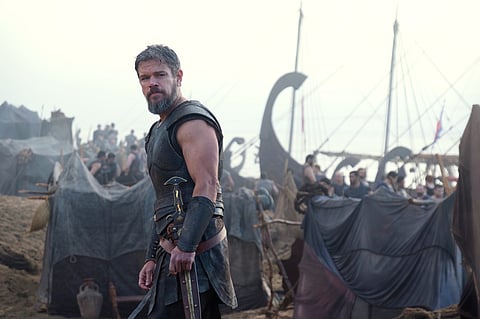
Dubai: Christopher Nolan's The Odyssey follows Greek king Odysseus on the long road home after Troy, a journey that should take weeks and instead swallows twenty years of his life. Nolan's version is stripped to the skeleton: a raw telling that even Odysseus himself does not fully recognize until the end. Hanging over almost every scene is one half-whispered idea, that somewhere on the way home, Odysseus broke Zeus's law, and whatever he did to survive the war has followed him home.
A rocky start, if you skipped the reading
The film opens mid-myth, mid-chant, mid-trick. Before you have settled into your seat, a chorus is chanting, "A face, a Greek, a war, a man, a god, a trick to break the lords of Troy," chanting a suitor then we move on to Sinon, a solider, played by Elliot Page, setting the Trojan Horse deception in motion, framed as a gift to Athena.
It is bold, and disorienting if you do not know your Trojan War. Nolan spends the rest of act one introducing Odysseus, Penelope, Telemachus and his mission, while that same idea of Zeus's law keeps surfacing, never explained, always felt. Stick with it, because once the pieces are in place, the film knows exactly what it wants to say.
It is less about the journey, more about the guilt
Every other adaptation of The Odyssey focuses on the adventure, the monsters, the islands. Nolan is more interested in what Odysseus did to survive them, and Zeus's law is how he makes you feel it. The law is simple: any stranger at your door deserves food, shelter and respect, because they could be a god testing you. Nolan has called it the Golden Rule, and in a world with no inns or maps, it was also just how people survived each other.
What makes it land so hard is the hypocrisy underneath. Odysseus and his men along with everyone else in the movie spend the film fearing this law, yet the war that sends him home began with someone breaking it first, Paris, taking Helen while a guest under Menelaus's roof, and ended with the Greeks breaking it worse. The Trojan Horse was presented as a peace offering, exactly the kind of gift the law depends on being sacred.
The Trojans extended the trust the law demands and were slaughtered for it, plundered by men who spend the rest of the film insisting they still fear the gods whose law they had just broken.
By the time Odysseus, still in disguise, tells Penelope he is "the man from the sea" who broke that law, the confession lands hard because you have already watched him break it once before, at Troy.
Fittingly, translations of the name "Odysseus" itself split between "victim of enmity" and "giver of enmity," and Nolan's film clearly leans toward the second.
Penelope gets the sharpest line in response. "I have been living in his ruin," she says, reframing his twenty years away as something she survived too, not just waited through.
A hopeful ending, not a punishing one
Given how much weight the film puts on that one broken law, you might expect Odysseus to be punished. Instead, the ending is gentle. Telemachus takes the throne, Odysseus is exiled, and Penelope goes with him, heading west to honour the men he lost. "Civilisations will rise again," he says, and that is how the film leaves him: not punished, but accountable.
The best scene in the film
If the law is the film's most patient trick, its best moment is more immediate. When Circe turns Odysseus's men into animals, Nolan holds on her hands as she grabs each man's face and remakes it: pulling his hair into ears, reaching into his mouth to drag his features out, pulling his nose out until it flattens and widens.
The gripes
Not every part earns that patience. Athena barely appears, and never shares a scene with Telemachus, despite a running detail where nearly everyone he meets seems to have her eyes.
Calypso is a bigger departure: here she admits to feeding Odysseus lotus flowers to make him forget, rather than the original myth, where she holds him captive under Zeus's orders and is furious at having to let him go. The film swaps her anger for something flatter, one of a few moments where it trades depth for efficiency. Not a grip at all for me but Telemachus supplies most of the lighter beats, and some of the funniest lines.
Between the patience it asks for early and the payoff it delivers, it should be clear where this lands. If you already love Greek mythology, Homer's original, or even Epic: The Musical, this is your film, a confident 10 out of 10.
Coming in cold, it demands more patience than most summer blockbusters. Either way, it is hard to argue with a film this ambitious landing this close to a perfect score. Nolan has done it once again.