Harry Potter turns 25: What the films changed from the books — 18 key differences (Peeves, we still miss you)
From missing ghosts to new dances: 18 ways the films rewrote Hogwarts
No Winky?
The second one is even more confusing, because the little house-elf was central to the plot.
But, well, when have book-to-film adaptations ever been faithful? Or, how can they be, with 700 pages to compress into a film? Sigh, the tough battle of being a fan.
Twenty-five years after the first Harry Potter film hit cinemas, some would find it hard to say where Rowling's original text ends and Steve Kloves' screenplay begins, and that's precisely the point. A tent dance nobody wrote became one of the most replayed scenes in the franchise. Dumbledore marching in and almost roughing up Harry for putting his name in the Goblet of Fire will never not be funny.
A Ministry official's entire storyline vanished so cleanly that half the fandom doesn't know he existed. A climactic duel fought almost entirely with words got a fistfight instead. None of this is betrayal, exactly, it's closer to a very confident act of ventriloquism, one story speaking fluently in another medium's voice. What follows are 18 of the clearest places where the seams show: what got cut, what got invented, and what got rewritten along the way.
1) Ludo Bagman vanishes entirely. In the books, Bagman is the Ministry's Head of Magical Games and Sports, the overly friendly ex-Quidditch star who commentates the Triwizard Tournament in Goblet of Fire. He's also deep in debt to a pack of goblins after years of bad gambling, and he's tangled up in the disappearance of Bertha Jorkins, the Ministry witch whose memories Voldemort extracts to help engineer his return. None of it survives the transition to film. There's no commentary, no goblin debt collectors, no Bertha Jorkins subplot, no bribery. The Triwizard Tournament simply runs itself under the supervision of faceless officials, and an entire flavour of the wizarding world's petty institutional corruption disappears along with him.
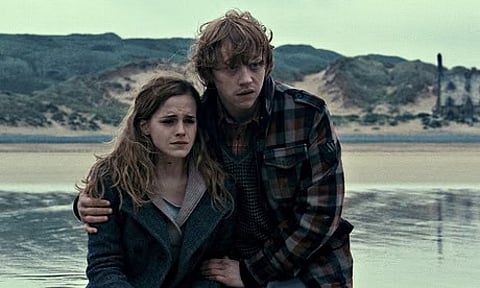
2) Harry-Hermione's consoling tent dance never happened in the Deathly Hallows book. Ask any fan for their favourite scene in the entire franchise, and there's a real chance they will name a moment that J.K. Rowling never wrote a single word of. In Deathly Hallows, screenwriter Steve Kloves invented an entirely new scene: Harry pulling a grieving, exhausted Hermione up to dance with him in their tent, Nick Cave's O Children playing on the wireless, purely to make her smile. It exists to solve a problem the book doesn't have on the page, a long, meandering camping stretch that needed one moment of stillness and tenderness between two platonic best friends. Rowling reportedly loved it; the actors reportedly found it mortifying to film. It has since become one of the most GIF'd, fan-vidded, and endlessly discussed moments in the whole saga.
3) The final duel got a body. The books resolve Voldemort's death almost entirely through dialogue. Harry stands in the Great Hall and calmly walks Voldemort through several pages of wandlore, who really disarmed whom, who the Elder Wand's true master actually is, before Voldemort's own curse rebounds and kills him where he stands. There is no physical struggle at all; Harry essentially wins by out-arguing his own murderer. The film understandably could not sustain a climax built on a monologue about wand ownership, so it invented an entirely new sequence: Harry and Voldemort chasing each other through a crumbling, burning Hogwarts, leaping between towers, grappling mid-fall, trading spells across the courtyard in a genuinely kinetic, physical confrontation before the final exchange. It gives Ralph Fiennes something to do with his body instead of standing still being lectured at, and it bears almost no resemblance to the book's climax beyond the outcome.
4) Nearly Headless Nick's Deathday Party never made it to screen. In Chamber of Secrets, an entire chapter is devoted to Harry, Ron, and Hermione attending the five-hundredth deathday celebration of Gryffindor's resident ghost, a gloriously miserable affair full of rotting food, mournful ghost music, and Nick's grief over never quite achieving proper "headlessness." It's one of the book's stranger, funnier detours, and it's cut from the film completely, along with most of the film's exploration of Hogwarts' ghost population as characters in their own right rather than background set dressing.
5) S.P.E.W. barely exists on film. Hermione's Society for the Promotion of Elfish Welfare runs as a genuine subplot across three books, complete with badges, membership fees, a newsletter, and Ron and Harry's good-natured exasperation at her crusading. It's meant to develop Hermione's sense of justice well before the wider wizarding world takes house-elf rights seriously. On screen, it barely registers, maybe a passing line here or there, meaning one of Hermione's more defining character threads simply doesn't exist for film-only audiences, and Dobby and Kreacher's arcs lose a the smidge political context underneath them.
6) The Burrow burns down, only in the movie. In Half-Blood Prince, the film adds a dramatic sequence where Death Eaters attack and set fire to the Weasley family home, forcing everyone to watch it burn. It's tense, it's visually striking, and it never happens in the book, where the Burrow survives completely intact through that entire volume. The scene was invented purely to raise the stakes and inject some visible Death Eater menace into a middle film that otherwise deals largely in slow-building dread and teenage romance rather than direct action.
7) Harry snaps the Elder Wand and throws it off a bridge. The film's ending gives Harry a small, decisive, visually satisfying gesture: Breaking the most powerful wand in the world in half and hurling the pieces away. It's a clean, symbolic full stop. The book has Harry make a much softer decision — he intends to repair his own damaged wand using the Elder Wand and then return the Elder Wand to Dumbledore's tomb, keeping it out of circulation rather than destroying it outright.
8) Percy Weasley's estrangement arc is almost entirely absent from the films. Across the books, Percy's ambition and blind loyalty to the Ministry drive a genuine rift with his family, culminating in him disowning them during the height of Voldemort's return denial. His eventual, humbled reconciliation, turning up to fight at Hogwarts and formally apologising to his father, is one of the more moving threads in the back half of the series. On film, most of this simply doesn't exist; Percy barely registers as a character at all beyond a handful of early appearances.
9) Marietta Edgecombe's "SNEAK" hex never makes it to screen. In Order of the Phoenix, Hermione jinxes the sign-up parchment for Dumbledore's Army so that anyone who betrays the group to Umbridge gets the word "SNEAK" branded across their face in angry purple pustules. It's a wonderfully vindictive, very Hermione piece of magical engineering, and when Marietta does exactly that, the consequences play out across several scenes in the book. The film skips the whole mechanism, and Marietta's betrayal loses its most memorable, and most darkly funny, payoff.
10) The Dursleys shrink with every film. In the books, the Dursleys remain a persistent, slow-burn presence throughout the entire series, Vernon's blustering, Petunia's resentment, and Dudley's oscillating cruelty and eventual, grudging humanity all get real page time even in the later volumes. On screen, they steadily evaporate after the first two or three films, reduced to brief cameos, meaning much of the series' running commentary on how ordinary prejudice and fear operate in the Muggle world quietly disappears along with them.
11) Dudley's silent thank-you to Harry is cut from the films. As the Dursleys flee their home in Deathly Hallows, the book includes a small, genuinely touching moment where Dudley, who has spent the entire series bullying Harry, pauses to acknowledge, however awkwardly, that Harry saved his life back in Order of the Phoenix. It's one of the clearest signals in the books that even the most unpleasant characters can grow. The film leaves it out entirely, and Dudley's arc ends on nothing but silence.
12) Kreacher's real backstory gets compressed. The book devotes real space to Kreacher's devotion to Regulus Black and the story of how Voldemort used and discarded him while testing the cave defences around a fake Horcrux, a story that directly explains how Harry's group eventually tracks down the real locket. The film keeps the barest skeleton of this, losing most of the emotional and logistical detail that makes Kreacher's eventual loyalty to Harry feel earned rather than convenient.
13) Neville's parents' fate gets far less room to breathe. The book slowly reveals, over multiple volumes, that Frank and Alice Longbottom were tortured into permanent insanity by Bellatrix Lestrange and her fellow Death Eaters, and gives Neville real space to process his relationship with parents who no longer recognise him. The film compresses this into a single hushed, visually poignant hospital scene, which lands emotionally but skips the slower, more devastating accumulation of detail the books allow.
14) Snape's death scene plays out very differently on film. The book stages it as grim, rushed, and almost clinical, Voldemort orders Nagini to kill Snape in the Shrieking Shack with barely a flicker of hesitation, treating him as a used tool rather than a person. The film restages the scene for maximum visual tragedy, lingering on Snape's final memories and framing his death with far more overt pathos and cinematic weight than the book's comparatively cold, businesslike original.
15) Extended Quidditch, generally, disappears. The early books devote real page time to full matches — tactics, commentary, injuries, and consequences that ripple into House rivalries and character relationships. By the later books and films alike, Quidditch recedes as the plot darkens, but the films accelerate that disappearance considerably, reducing what were once detailed set pieces to brief highlight reels or cutting matches altogether. The sport that once helped define Hogwarts life quietly vanishes from the back half of the saga almost entirely.
16) Peeves the Poltergeist doesn't exist in the films at all. In the books, Peeves is a genuine recurring nuisance, a gleefully destructive spirit who drops objects on students, sings mocking songs, and generally makes Hogwarts feel like a lived-in, chaotic place rather than a tidy film set. He's not just comic filler, either; he has real narrative moments, including helping drive Umbridge out of the castle at the end of Order of the Phoenix with a memorable send-off, and reportedly a small callback role during the Battle of Hogwarts in the books. None of it made the films. He was filmed once, in an early Philosopher's Stone screen test, and the footage was ultimately cut and never used, meaning Peeves is one of the few named, recurring book characters to be completely absent from all eight films.
17) Winky's entire arc gets cut down to almost nothing. In the book, Winky is Barty Crouch Sr.'s house-elf, freed against her will after being blamed for the Dark Mark incident at the Quidditch World Cup. Her subsequent spiral, the shame of freedom in elf culture, her drinking problem, and her uneasy new life in the Hogwarts kitchens alongside Dobby, is a genuinely sad, strange thread that also does real thematic work, reinforcing Hermione's S.P.E.W. storyline and giving house-elf culture actual emotional stakes rather than just comic relief. She also plays an immportant structural role in the book, since her devotion to Crouch Sr. is part of what keeps his secret hidden for so long. On screen she's almost entirely absent, meaning both her personal tragedy and her narrative function simply disappear, creating a dissonance between the film and the books.
18) Barty Crouch Sr.'s entire subplot gets flattened. In the book, Crouch Sr. is a far more developed figure, a rigid, ambitious Ministry official whose obsession with law and order led him to imprison his own son without trial, and whose subsequent cover-up of that son's escape (with Winky's help) drives a significant chunk of the Goblet of Fire mystery. His mental deterioration under the Imperius Curse, his desperate late-night escape to warn Dumbledore, and his death at his son's hands in the Forbidden Forest are all rendered with real detail on the page, tying together the Bagman gambling subplot, the Winky storyline, and the true identity of "Mad-Eye Moody" into one coherent thread. The film keeps the bare bones of the reveal, Crouch Jr. impersonating Moody, but strips out most of the surrounding machinery, so Crouch Sr. himself barely registers as a character despite being central to how the whole plot actually works.


