Green betrayal
Director Paul Greengrass' Iraq film was made out of a sense of affront and anger
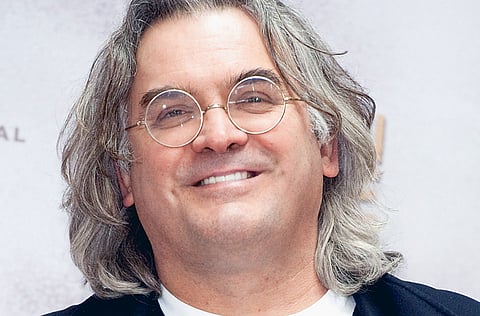
Paul Greengrass is a big man, but looks light on his feet, and is dressed casually in jeans, blue V-neck jumper and black trainers — as if for action. You probably wouldn't pick a fight with him.
In truth, there is nothing remotely sinister about Greengrass. You could say he is one of the good guys.
The 55-year-old Englishman's success in Hollywood has been all the more surprising for the fact that he has hung on to his political principles. Equally remarkable is the way that trademark Greengrass style has lent itself to both rigorous factual dramas and far-fetched popcorn movies. Bloody Sunday, his stripped-down account of the 1972 Northern Ireland shootings, and United 93, his tense chronicle of the 9/11 plane hijacking, brought him acclaim and awards. His two Bourne films, on the other hand, raked in more than $700 million (Dh2.57 billion) at the box office, and still won awards. His non-fiction works have the urgency of action thrillers while the Bourne films were shot through with real post-9/11 paranoias — waterboarding, black ops, global surveillance.
‘I don't start with a story'
His new film, Green Zone, has been described, not inaccurately, as "Bourne goes to Iraq". As such, it interweaves those two discrete strands of Greengrass' work to produce a movie that is both real-world political commentary and thrilling action ride. As you would expect, the Greengrass style is in full effect: shaky camerawork, adrenalised pace; and Matt Damon charging into danger accompanied by, yes, lots of frenzied drumming. But Damon is not an amnesiac spy here, he's a good soldier searching for weapons of mass destruction in the immediate aftermath of the 2003 invasion.
"I don't really start with a story; I start with the area I want to be in," says Greengrass, explaining the movie's genesis. "It was summer 2004, and I was thinking about 9/11 on the one hand and the war in Iraq, which was less than a year old, on the other. Those twin events are what are driving our politics and our culture, and that was the headwind that was making the Bourne films lift. So I wanted to make a film about the real world that was begetting those Bourne feelings, a film that basically asks that audience to step behind that curtain."
Damon's journey in the film mirrors Greengrass' own. In real life, Damon, one of Hollywood's most vocal liberals, had been against the Iraq war from the outset, but Greengrass was not initially opposed to it. "I didn't like going to war. It was obviously deeply uncomfortable and problematic, but I remember when that big march happened [London, February 2003], I said I wasn't going on it because I'd listened to Tony Blair and, in the end, I believed him. He obviously knows stuff that we don't know, I thought. Well, how wrong was I?"
That sense of betrayal sent Greengrass on an intensive fact-finding mission. He has read all the key books and reports and interviews on Iraq — Bob Woodward, Seymour Hersh, James Risen, Thomas Ricks, and particularly Imperial Life In The Emerald City, by Washington Post correspondent Rajiv Chandrasekaran. Chandrasekaran's book meticulously details the almost comical levels of incompetence, ignorance and infighting that went on within the Green Zone, the coalition's secured Baghdad enclave. Despite being a work of fiction it closely follows the reality.
"I thought at one point about doing a very small, austere film. But then I thought, if I'm going to make a film about Iraq, I'm going to see if I can bring that Bourne audience with me. They're mostly young people — the same people who are going to go off and fight that war, and also the audience that are vehemently opposing it.
"Most of all this is the core of it, really — it was a film made out of my sense of affront and anger. I wanted to say, ‘I know what you did.' And that statement has immeasurably more power if it's made to a broad audience in the vernacular of popular genre cinema."
Good terms
So what's going on with Bourne? Universal asked Greengrass to make another Bourne film, and he agreed at least to help develop one. "I felt like I ought to, because I know how important it is to them," he says. But he abruptly withdrew from the project last December. According to some reports, he was displeased to discover the studio was developing a "parallel" script behind his back.
Greengrass denies this, and says he remains on good terms with the studio, but Damon has also said no to any future Bourne films, and the franchise is currently on ice. "I didn't feel the fire in the belly that you need to spend 18 months, 20 hours a day, seven days a week, to make a Bourne film. There were other films I wanted to make. And also, I felt these have been four interlinked films about the Bush years [his two Bournes, alongside United 93 and Green Zone]. I felt I didn't have anything more to say, the same way I did after Bloody Sunday. I want to say new things."
He is rumoured to be doing a film about the Vietnam war, and doesn't rule out a return to documentary and TV work, but he is keeping his mouth shut for the moment. "Funnily enough, I had a meeting [recently] in LA where they asked me to do a big children's movie," he teases. It's an enticing prospect: images of Harry Potter going rogue and waterboarding Voldemort spring to mind. "It's not going to happen, though," he laughs.
"But it could be that kind of thing. That's what you have to do to stay ahead. It keeps you younger."


