Divalicious: What makes a diva in 2010?
One has the voice, the other personality. Does it ever come in one package?
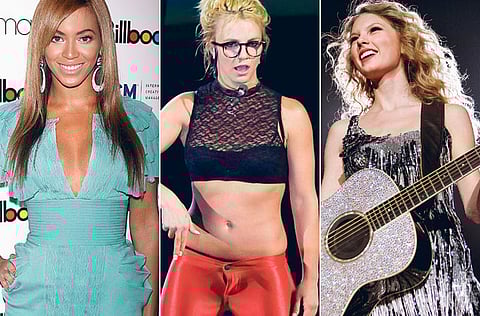
Everyone knows that Taylor Swift can't sing. The teen star might hold the zeitgeist in her pink satin clutch, but she's regularly criticised for her live vocal performances, which tend towards wild notes and shortness of breath. Her turns onstage at the recent Country Music Association Awards had critics pulling out descriptions like "shaky", "a train wreck" and "wobbly as a newborn colt".
It's nothing new for a young female singer to take slaps for her lack of chops. Remember Madonna's early days or, really, most of Janet Jackson's career? What's different about Swift is that her vocal problems actually play into her strengths.
Ridiculously precocious as a writer, accessibly adorable when it comes to image, Swift benefits from having a flaw. Pretty but gangly, she's like a Disney heroine before the kiss makes her a real princess; her pitch problems enhance the sense that she's a work in progress. Swift's little voice drives adults crazy especially country-music lovers, who decry her as inauthentic but for the daughters and mothers who are her target audience, it shows she's as real as they are, with room to grow.
Well-groomed
Swift's case contrasts informatively with that of another young, huge-selling female musician. Leona Lewis, whose second album, Echo, was released in November, had the most popular single of 2008 with Bleeding Love, a long drink of heartache built around her sumptuously sombre vocal lines. A gorgeous 23-year-old Londoner groomed to perfection by Idolmaker Simon Cowell, Lewis has a voice like the young Whitney Houston's massive and sleek, athletic yet ethereal, with a tone that bespeaks the sublime.
But Lewis has a problem too. Her critics perceive her as hollow, inexpressive — all voice and no personality. Unlike Houston and Mariah Carey, whose marital, chemical and/or psychiatric crises lent them the aura of the real, Lewis seems determined to remain sane and a little bit distant in her devotion to her craft.
Lewis is a lousy tabloid diva, and as a singer, she doesn't wobble. While her seriousness lends her a certain marketable elegance, it can make her seem more like a product than a person. Echo modernises her sound by taking it to the dancefloor, but its centre remains still. While the legions who buy it will admire its "dignity" and "class", its impact remains elusive.
The female stars who have come to dominate pop in the past decade all express some aspect of the tension between the Perfect Personality and Perfect Voice neatly summed up by Swift in her megahit You Belong With Me as "she's cheer captain and I'm on the bleachers" impervious beauty versus touchable, vulnerable charm.
The need to reconcile the cheer captain and the bleacher-sitter within is complicated by what technology has done to the way women relate, both to each other and to men.
And as these changes took place, American popular music reconnected with its feminine side. But mainstream's flavour came from dance music, revitalised R&B, amateur hours like American Idol, teen pop and other female-friendly forms. The tension between natural beauty and cultivated charm, big voices and small but smart ones, became a central subject of pop.
We can go back to the end of the last decade to understand how this particular story has played out in this one. The year 1999 saw the debuts of Britney Spears and Christina Aguilera, and the release of The Writing's on the Wall, the breakthrough album for Beyoncé, then the primary member of Destiny's Child.
Physically, all three women worked variations on the classic bombshell persona, foregrounding their sexuality in ways that played into fantasies that men have long enjoyed and women, however reluctantly, have adopted. Spears and Aguilera were hot ingénues and Beyoncé was a Glamazon in training. But their singing told a different story.
Voices, personalities
It's hard to remember now, given all her personal ups and downs and her transformation into a sonic android, but Spears started out in the role Taylor Swift now occupies. Her voice was cute, flawed and highly individual.
Aguilera had the Perfect Voice, giant in her tiny body. And Beyoncé was a Personality with a Voice in training. An often inaccurate singer in Destiny's Child, she developed her chops along with her image, both growing more formidable with each recording and tour.
The mainstream stars since these ladies set the standard have played variations on the earlier themes.
Susan Boyle, the singing-contest Cinderella whose debut album is dominating global charts, is the prime example. The stout, middle-age singer is the kind of woman who should have only personality going for her. When she opened her mouth on Britain's Got Talent to reveal a voice brimming with a golden glow, people's bewilderment soon gave way to delight, not because she seemed to have worked hard to become so good but because she didn't: Boyle was a natural beauty in disguise.
Norah Jones, meanwhile, found record-breaking success with a sound that felt like the easiest form of grace; she possesses a Perfect Voice of an earlier vintage, best represented by the hugely influential but nearly forgotten 1980s star Sade. Jones' gently phrased but irresistibly seductive 2002 debut, Come Away With Me, became the 10th biggest-selling album of the decade.
She's tinkered heavily with her formula on The Fall, a break-up album that greets freedom with a clatter of drums and electric guitars. The Fall is more first step than giant leap, and Jones can't turn off the loveliness of her tone — but sometimes even reverse make-overs take time, and she's made a start.
Fashion-forward
Then there's Rihanna, who recently released her fourth album, Rated R. The 21-year-old Barbadian might be at the first apex of her career, but she doesn't have the luxury of time. Given her start by the rapping record man Jay-Z, she immediately registered as a younger Beyoncé, acting out the same struggle to find a voice that would suit her tough, perfect, fashion-forward image. She was often accused of being little more than a gold-plated coat hanger upon which her male producers hung their own dreams.
Then, in February, her boyfriend at that time, Chris Brown, assaulted her. Nothing reads as more intimate, or makes a woman seem more vulnerable, than a mug shot of her bruised face splashed across the gossip sites. Until recently, Rihanna's response to the violation of her privacy was silence; she continued to appear in public, dressed in her armour of couture, but granted few interviews.
Real vs perfect voice
Rated R is Rihanna's artistic statement on the incident, and it shows her working to strike a balance between the openness of a "real" voice and the self-protection offered by a perfect one. Russian Roulette, its first single, shocked many listeners; its depiction of love as a deadly game played by peers seemed, to some, to be a case of the victim defiantly blaming herself.
But the song also can be interpreted in light of that shifting and always complicated feminine ideal. If it's a confession, it's a very sneaky one, one that also implicates the listener. For all its melodrama, Russian Roulette reminds us that actual women — even pop stars — are never perfect. They make mistakes, take risks and learn hard lessons, sometimes not as soon as they would like.
Trying to find herself within everyone else's version of perfect, Rihanna is giving us a picture of imperfection that's worth considering.


