Beyond the big names: 10 underrated anime series you can finish in a weekend
From Charlotte to Durarara, ten complete series that never got the audience they deserved
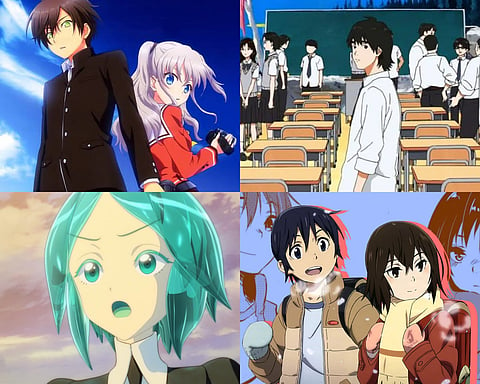
Dubai: Every few months the same handful of shows get recommended to anyone who says they want to get into anime. The classics have earned their place, but a second tier of series never quite broke through, either because they aired opposite something bigger or because their marketing sold them as the wrong kind of show.
These ten are mostly short, all complete, and none of them will ask you for a 200-episode commitment.
1. Charlotte (2015)
Thirteen episodes, and it opens as a high school show about teenagers with limited, flawed superpowers. Yu Otosaka can possess another person's body for five seconds. Nao Tomori can turn invisible, but only to one person at a time.
Nao recruits Yu into a student council that tracks down other ability users before they are found by people who want to experiment on them. The premise shifts substantially around the one-third mark, and the back half moves at a noticeably faster pace than the opening episodes.
Written by Jun Maeda, who also wrote Angel Beats and Clannad.
2. Durarara!! (2010)
Mikado Ryugamine moves to Ikebukuro at the invitation of a childhood friend, having been told the district is dangerous and that there is one rule: do not get involved with the wrong people.
He gets involved with all of them. A headless motorcyclist searching Tokyo for her stolen head. A bartender-suited brawler who throws vending machines. An information broker who manipulates the people around him for his own amusement. A colour gang whose members do not know who is giving them orders.
The story loops back on itself, replaying the same events from a different character's perspective, so a minor moment in episode three becomes the centre of episode nine. The full structure becomes apparent around the fourth episode.
3. Erased (2016)
Satoru Fujinuma is a struggling manga artist in his late twenties with an involuntary ability he calls Revival, which sends him back a few minutes in time immediately before something bad happens, forcing him to work out what and prevent it.
After a death in his family, the ability triggers on a scale it never has before and sends him back eighteen years, to 1988, into his own ten-year-old body. He has weeks rather than minutes, and a series of child abductions in his home town that he now knows the outcome of.
Twelve episodes, adapted from Kei Sanbe's manga, split between the 1988 timeline and the present day.
4. Planetes (2003)
Set in 2075, when commercial spaceflight is routine and the orbit around Earth has filled with decades of abandoned satellites, discarded panels and loose bolts travelling fast enough to destroy a spacecraft.
The story follows the debris section of a large aerospace company, the least glamorous department in the building, whose job is to collect that junk before it kills anyone. Ai Tanabe joins as a new recruit, all idealism and no experience. Her partner Hachimaki has been doing the work for years and wants his own ship, a goal everyone around him treats as unrealistic.
Across 26 episodes it moves from workplace comedy into heavier material, taking in corporate politics, the gap between spacefaring nations and everyone else, and the physical toll of the job.
5. Sonny Boy (2021)
A school and everyone inside it drifts out of reality. The students develop powers and set about working out the rules of wherever they now are.
Twelve episodes. The most bizarre anime in the list yet the one that will stick with you the longest. The series offers no exposition and leaves most of its rules unexplained, which accounts for both its small audience and its cult following.
6. Odd Taxi (2021)
A walrus drives a taxi in Tokyo. His passengers are all animals. A girl has gone missing, and his fares keep turning out to be connected to her disappearance.
It aired the same season as several louder shows and drew a modest audience on release. It is dialogue-driven rather than visually elaborate, and the central mystery resolves fully within the 13-episode run.
7. Ping Pong the Animation (2014)
Masaaki Yuasa adapting Taiyo Matsumoto's manga about competitive table tennis. The art is scratchy and unconventional, yet nostalgic.
Eleven episodes following two childhood friends through the competitive circuit, built around questions of talent and its limits.
8. Land of the Lustrous (2017)
Immortal gem people defend themselves against beings who harvest them for decoration. The youngest and most brittle of them is assigned to compile an encyclopaedia, having been judged unfit to fight.
Fully CG, at a point when the technique was uncommon in television anime, and widely noted at the time for the quality of its CG work. Underneath the premise is a story about a body being taken apart and replaced piece by piece.
9. Bakuman (2010)
Moritaka Mashiro is a middle school student with a talent for drawing and a dead uncle who was a manga artist, which has put him off the profession entirely. His classmate Akito Takagi, who writes, talks him into a partnership anyway.
What follows is a procedural about the manga industry rather than a story about creative inspiration. Serialisation meetings, editors, weekly reader surveys that determine whether a series lives or dies, rival artists, deadlines and the physical cost of drawing to a weekly schedule.
Three seasons, 75 episodes in total, from the writer and artist behind Death Note.
10. Heroman (2010)
Joey Jones is an orphaned boy living in a fictional American city, working at a diner and scraping by. He finds a discarded toy robot, repairs it, and a lightning strike transforms it into a giant machine that responds to his commands.
Shortly afterwards an alien species invades, and Joey and the robot become the city's defence.
Twenty-six episodes, created by Stan Lee in collaboration with Studio Bones, which gives it an unusual hybrid of American superhero structure and Japanese mecha convention.