Poetry has a special place in Emiratis’ hearts, says Salha Obaid Gabesh
More young Emirati writers sharing their literary works through social media, says Salha Obaid Gabesh
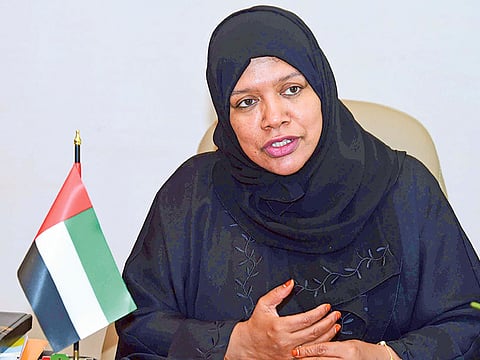
Sharjah: The UAE society’s love for poetry is eternal, said Salha Obaid Gabesh, renowned Emirati poet, novelist and children’s writer. Poetry and recitation are rooted in the early history of the UAE and in the passage of time they have and will endure as an art form that is close to every Emirati’s heart, including the youth, she said.
Her experience of being in the world of literature for over a decade and having published many literary works has only helped to entrench this belief in her. Poetry, said Gabesh, continues to hold immense appeal despite the popular belief that this is the age of the novel. People still want to hear poetry, whether classical or Nabati, because of the deep meaning each word in a poem holds.
Her own love for poetry was born when she was a student at school. “It is a person’s love for the Arabic language that initiates the urge to write, read and hear poetry,” said Gabesh, who is a cultural counsellor for the Supreme Council of Family Affairs in Sharjah and a teacher of Islamic and Arabic Studies.
“I focused on writing poetry in classical Arabic and published my first book — a collection of poems I wrote in university — in 1992.”
The early manifestations of her literary leanings and love for the Arabic language encouraged her to begin writing short stories and novels, before moving on to poetry.
Over the next decade, Gabesh published three collections of poems, one of which was published in Cairo. Her published works range from short stories to novels about women’s issues.
While it is true that novel continues to be a reigning artistic expression and “publishing houses are more interested to print novels because they have a higher demand and appeal to a wider audience”, poetry, said Gabesh, is no less popular. “To this day, a number of people with different backgrounds gather at poetry evenings across the UAE to listen to poetry being recited in classical Arabic or Nabati.
“Currently, we find that poetry that can be sung, especially works that speak about patriotism or romance, are becoming more popular than other forms of poems in print,” she said.
Nabati poetry, she added, holds a special place in the hearts of many people in the UAE since the 1950s. Nabati, a style popular in the Arabian Peninsula, was adopted by many poets due to its ability to appeal to everyone. The local accent and the basic grammar it uses is what makes it easily understood.
“[Nabati] was also our source of [knowing] how life was in the past. It documented the words used and lifestyle adopted in the past. It is a big part of our heritage,” said Gabesh.
From the past to the present, the dominant themes in Arab poetry have run the gamut of romance, emotions about life and family ties or a sense of belonging to a place due to being born there, she informed.
“We find many patriotic poems written in the UAE today in the Nabati style, especially to mark significant events. [Today], there are more poets and young writers who are choosing to write Nabati poetry in the UAE. Usually, these poets have more influence on and are closer to the people because they write in the idiom that Emiratis speak. Also, a lot of what the Nabati poets are writing is also being put to tune and sung.”
Gabesh points to an interesting synergy between technology and tradition in which young Emiratis begin with expressing their thoughts on social media and make the transition to poetry writing to express thoughts on life. These can be short or longer means of expressions.
The digital age, Gabesh said, has witnessed a surge of new writers sharing their literary works [through social media] and moving on to get their works published, despite their relatively young body of experience.
“In the Arab world, a lot of writers take to writing as a hobby even as they pursue careers. We write because it’s something that comes from within us and it’s part of our culture.”
Gabesh, who plays an active role in the Emirates Writers Association, says she recently began to focus on writing children’s books in Arabic, which she believes is not an easy task, knowing that children have access to many other sources of entertainment and knowledge. So far, she has published ten children’s books with stories that are closer to reality than fantasy and topics that are derived from their own culture including the events around them.
“I believe our children need more writers with enough experience to write for them. It is not a simple task to write for children, the writer needs to have the cultural background and knowledge in order to be able to spark the child’s interest,” she said.


