Music for the eyes
An artist's rendition of the passion and spirituality of Umm Kalthoum
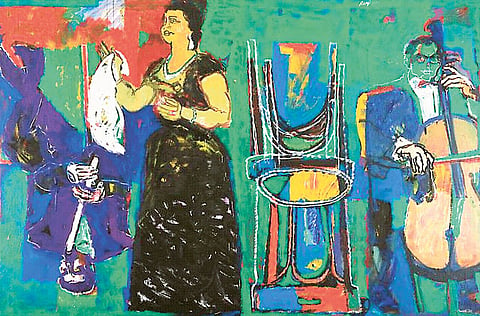
Well-known Syrian artist and art writer Assad Arabi has been living in France for more than four decades and has experimented with various contemporary styles and subjects. But in his latest work, the septuagenarian turns to a popular subject in Arab art — iconic Egyptian singer Umm Kalthoum. Titled Nostalgia, the series takes you back to a time of cultural renaissance in the Arab world. It expresses the artist's love for Arab culture and his longing for a bygone era when gifted artistes took Arab music to great heights.
Arabi's expressionist paintings depict the legendary diva performing on stage. Her larger-than-life persona is defined by her glamorous gowns, bouffant hairstyle and the signature white handkerchief in her hand. With his strong lines and vibrant colours, the artist captures her charismatic personality, the range of her powerful voice and the spirituality of her soul.
But the paintings are not just about Kalthoum. The musicians who accompanied her on stage and were part of her inner circle appear as a strong presence around her. Most prominent among these is Mohammad Al Qasabji, the composer and famous oud player. Through this group of eminent performers, Arabi tries to convey the talent, passion and combined effort that went into making the sublime music.
"Umm Kalthoum was a gifted singer. But she became a legend because she collaborated with the best musicians, composers and poets such as Al Qasabji, Ryad Sunbati, Mohammad Abduh Salih and Ahmad Rami. Together they took Arab music to a level that has not been surpassed till today. I wanted to recreate the environment that helped Kalthoum to grow and evolve and create music that continues to enchant the world even today. These people are enduring symbols of an Arab cultural renaissance. I chose to paint them because I believe that it is very important to remind today's Westernised generation of Arabs about the beauty and depth of our culture and to inspire them to take it to even greater heights. This series is a tribute not only to Umm Kalthoum but to an entire era of great cultural achievement," Arabi says.
The artist has done extensive research on Kalthoum's life and music, and his compositions include references to the words of her songs and to key incidents in her story. An empty bamboo chair and an oud placed upside down appear often in the paintings. These allude to the fact that, after Al Qasabji's death, Kalthoum always left his chair on stage empty with his inverted oud placed on it. And later in her career, she herself used an identical bamboo chair.
"This empty chair represents all the great musicians who came before them and whose legacy must not be forgotten," he says.
While painting, the artist likes to move around his canvas, resulting in the chair and some musicians often appearing upside down. He sees this as a comment on the state of Arab music and culture today. "Mindless aping of Western culture has turned our cultural scene topsy turvy. Today's youth must educate themselves and delve deep into our cultural traditions to be able to turn things around and fill these empty chairs," he says.
Kalthoum was the voice of change and a modern woman who urged Arab women to stand up for their rights. In the context of the present uprisings in the region, Arabi's choice of subject seems politically relevant. But he denies any political connotations.
"My work is never political. I began this series over a year ago and my aim was to translate Kalthoum's songs into paintings so that people can listen to her music with their eyes and feel her spirituality. But, after the uprisings, I have become convinced of the need to remind people of what has been achieved in the past and what needs to be done today to preserve our culture."
Jyoti Kalsi is an arts-enthusiast based in Dubai.
Nostalgia will be on at Ayyam Gallery, Dubai, until October 27.


