Art imitating life
Roman Polanski's The Ghost Writer draws on real-life events and people, including the director's own travails
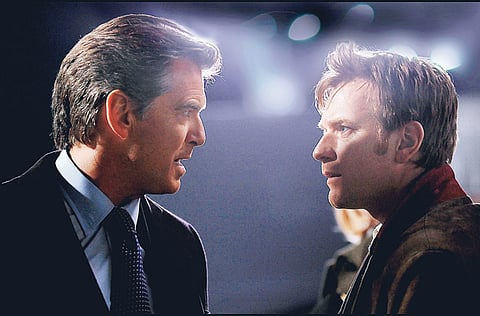
As Pierce Brosnan and Ewan McGregor describe it, there was no need for the cast of Roman Polanski's The Ghost Writer to have long, philosophical discussions about the movie's creepy real-life parallels.
It wasn't necessary, for example, to dissect Brosnan's character, a hazily sinister British ex-prime minister who's a dead ringer for Tony Blair, or to over-analyse his seething, neurotic wife, played by Olivia Williams as a cross between Cherie Blair and Lady Macbeth. It was all pretty obvious and pretty amusing.
Nor did the film's director have to belabour the eerie prescience of Robert Harris' novel, the movie's source material, in forecasting the ugly political fallout from the Iraq war torture scandals.
Of course, it did help that the director is a well-known connoisseur of grim ironies and bizarre happenstance, even when it occurs at his own expense. This septuagenarian French-Polish auteur, according to his actors, on set fully lived up to his reputation as an obsessive craftsman, a master architect of paranoid dreamscapes, and a benevolent control freak who repays his colleagues' allegiance and hard labour by helping them attain their best.
"I'm working with Polanski, I've seen everything the man's done, I know the dark controversy around his life," Brosnan recalled.
"And yet he was right there. And once you know that the man works at a very high frequency, and you know that the set is his, and the camera is his, and you are his, then you have a great time."
None of Polanski's films has more brazenly connected his world view to contemporary politics than The Ghost Writer, a taut psychological drama wrapped inside a thriller with black-comic elements. And few have been more tantalising — some might say "brash" — in hinting at biographical connections between the film's story line and the checkered circumstances of the director's own life.
Yet however haunted the movie is by Polanski's personal demons, the principal actors found the director to be as supportive and personable as he is notoriously demanding.
"He doesn't care how long a scene is, he doesn't care how long it takes you. He pushes you to make it real," said McGregor.
"He's a taskmaster, and he can put the fear of God into you if you're not prepared, if you don't know what you're doing as an actor," Brosnan said. "It was amazing watching him work. The camera is his alchemy chest, and the viewfinder is his kind of wand, and it's always there."
Dramatically plausible
The movie's premise, involving a fateful collision of politics, celebrity and media, is of a conspiratorially minded bent so severe and dramatically plausible as to make John le Carre read like Winnie-the-Pooh.
Its linchpin is the title character played by McGregor, a cynical hack and Everybloke who has landed a blockbuster contract to pen the memoirs of the controversial former PM Adam Lang (Brosnan). Lang, a vain, charming, born actor, is living in exile in the US, on a remote, sublimely bleak New England island to avoid being sued in Britain for his alleged complicity in the mistreatment of prisoners in the "war on terror".
(Reader, a pause is suggested here to reflect on the similar shadings of Polanski's own existence.)
McGregor said he immediately "got a handle" on his jaded, Fleet Street-hardened character and relished his impertinent humour. "There is mischief in him, for sure, and a lot of that comes from Polanski, because he is a mischievous chap himself," he said.
The ghost and the British former first couple create a classic Polanskian dramatic triad all by themselves, locked together in their claustrophobic isolation.
But they're not the only ones rattling around the Langs' swanky-spooky seaside home, which Williams describes as a "mausoleum of Modernism". The lip-smacking supporting cast includes Lang's curvaceous personal assistant (Kim Cattrall), an enigmatic Harvard professor (Tom Wilkinson) and a mysterious neighbour played by Eli Wallach, popping up in a brief scene in his best wild-eyed mode, hissing cryptic pronouncements like a refugee from a lunatic asylum or a Harold Pinter play.
Brosnan said that Polanski had given him six photos of Blair, including one that depicted the prime minister with what the actor described as a "clenched-teeth, chipmunk-style, little-boy-lost-in-the-woods, ‘I didn't do it, I didn't do it'" expression. That helped Brosnan shore up his decision to play Lang as "a tragic, lost, broken man".
Williams acknowledged that her initial encounters with Polanski's directing style could be a bit nerve-racking.
Williams suggested that it was a too-rare pleasure to perform in a movie where the emotional and thematic currents are cleverly hidden in plain sight rather than announced with flashing neon. "I have a problem with a lot of modern scripts because people say what they're feeling all the time," she said.
"The age of therapy has kind of killed subtext."
Don't miss it
The Ghost Writer is currently showing in cinemas across the UAE.
Sign up for the Daily Briefing
Get the latest news and updates straight to your inbox


