PlayBook makes BlackBerry cool
The new tablet raises the bar among its competitors, the Galaxy Tab and Streak 7
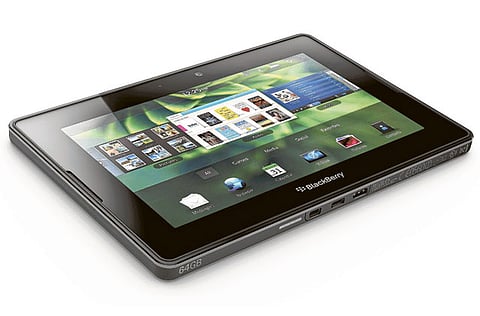
San Francisco : It's the PlayBook tablet, and for Research In Motion Ltd (Rim) the stakes could hardly be greater. With market share for its pioneering smartphones falling, the company desperately needs the PlayBook to be a success.
The PlayBook, which arrives in stores next Tuesday, is initially available only with a wi-fi connection. It's priced the same as the wi-fi-only models of Apple Inc's iPad 2: $499 (Dh,1832.53) for 16 gigabytes of storage; $599 for 32 GB and $699 for 64 GB.
It really, though, shouldn't be compared to the iPad, whose bigger screen makes it better for watching movies and web-surfing, but is also 40 per cent heavier.
Raising the bar
The PlayBook's true competitors are the likes of Samsung Electronics Co's Galaxy Tab and Dell Inc's Streak 7, in a category that might be considered pocket-sized as long as you've got good-sized pockets. In that realm, the BlackBerry instantly raises the bar.
Like those competitors, the PlayBook is compact enough to be held in one hand. It's roughly the size of a half-sheet of paper and weighs about 15 ounces (0.425kg). Along its top edge are a too-small power button and media-playback controls; the bottom includes a micro-USB connection and an HDMI video port.
The display measures seven inches diagonally with a 1024 x 600 resolution, the same as the Galaxy Tab and much better than the Streak. Unlike the iPad 2, the PlayBook runs videos that use Adobe Systems Inc's Flash technology. Its cameras are also better than the iPad's: three megapixels facing front and five megapixels facing rear, and it's capable of capturing video in full high-definition.
Rim says it expects the PlayBook battery to provide eight to ten hours of use. While the Galaxy and Streak use a version of Google Inc's Android software that was designed for mobile phones, the PlayBook uses a new operating system called the BlackBerry Tablet OS. It's fast and easy — once I got used to the unusual fact that the border as well as the screen is touch-sensitive.
The main drawback is that the PlayBook feels unfinished. A number of critical features and applications, while promised, aren't yet available.
For starters, there's currently no software for accessing all your e-mail, calendars or contacts in one place. Rim says it will be available in the summer; in the meantime you can expect to be doing a lot of logging into websites to access your personal information.
Perhaps the most important missing feature, which won't show up until later in the year, is software that Rim says will allow the PlayBook to run a limited selection from the vast universe of Android wireless-phone applications.
The mobile marketplace is increasingly a battle of app-fueled ecosystems, and while RIM says the PlayBook is launching with about 3,000 apps, offering Android compatibility hedges the risk that developers won't continue to write for it if the tablet isn't an immediate hit.

