Gains from the Indian rupee's fall
With the currency plunging to record lows Indians in the Gulf can benefit — here's how
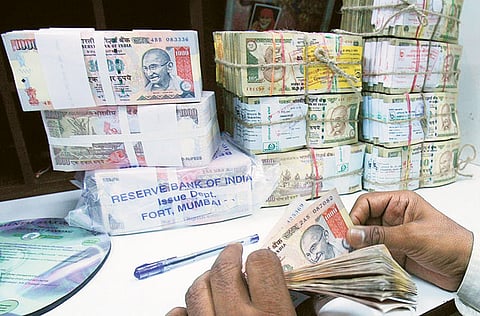
Dubai: The rupee slumping to a new low against the dollar this week has been a sudden bonanza for a large number of Indian expatriates waiting to invest back home. Expectations from forex experts suggest a weaker and volatile rupee in the short term, with further slide to levels of Rs55 to a dollar not being ruled out.
Many of the UAE's non-resident Indians (NRI) were taking out personal loans or cash advances through their credit cards to remit money to India as the rupee touched Rs52.54 against the US dollar on Tuesday before noon. That meant an exchange rate of Rs14.30 for a dirham at that time of day.
"To borrow and remit money even at this juncture is not advisable at all," said Krishnan Ramachandran, chief executive, Barjeel Geojit Securities, Dubai. "The borrowing cost will certainly wipe out the gains to a great extent; many a time it will be a losing proposition. The gains, if any, can at best be marginal."
For instance, Ramachandran said, if one were to remit at an exchange rate of Rs52 borrowing at 8.50 per cent per annum, taking into account the interest cost incurred for this, the effective realisation will be Rs49.45 when the loan repayment is over.
With millions of rupees remitted, it's time to look at the entire gamut of investment options — from the almost risk free bank fixed deposits to riskier equities, real estate, gold and futures.
Equities
With the rupee's depreciation in the past month, Indian markets have also taken a hit. The Sensex and Nifty indices have dropped close to seven per cent. This has made stocks cheaper and ripe for picking for those who have a medium- to long-term investment horizon. From a medium-term perspective, both the market valuation and the recent weakening of the rupee make India an interesting investment destination, said R. Rajagopal, head advisory/senior vice president of investments, Kotak Mahindra (UK) Limited. The markets are currently cheap in Indian rupee terms as well, he added.
The Nifty was trading at a P/B (price to book value) ratio of 3.66 in August 2009 and currently it's trading at 2.82. Midcaps are relatively cheaper, trading at a P/B ratio of 1.59, down from 2.10 in August 2009.
However it is questionable to invest in Indians stocks with borrowed money.
"Ideally one should avoid investing with borrowed funds unless one is confident the market has bottomed out," said Anil Rego, chief executive of Right Horizons, an investment and wealth advisory firm based in Bengaluru. "I would [advise to] wait before actually taking this route. I expect markets to continue to be volatile for sometime."
Mumbai-based Gaurang Shah, assistant vice-president at Geojit BNP Paribas, agrees. "Equities have become cheap but they may become cheaper as we move ahead as I don't expect any substantial bounce back anytime soon. Any pullback on higher level will be met with selling pressure."
In such an environment the way to invest is in a staggered manner, also known as dollar cost averaging, say fund managers and advisers.
For people who wants to take some additional risk (considering the rupee has depreciated and the markets have dropped), they could invest 25 per cent to 50 per cent of their total investible capital now, said Rego.
"The same can ideally be invested in a systematic basis over the next six to nine months through weekly systematic investments. This will help average out on volatility in the rupee as well. If markets take another tumble then one can move to balanced funds," he said.
Rego expects the markets to continue to be volatile over the next three to six months. He suggested to look at defensive sectors like FMCG (fast moving consumer goods) and pharmaceuticals. Technology is also one option but would carefully watch if global economy goes into a downturn and companies start cutting down on costs and thus IT budgets. "I would have a large cap bias over the next few months." In the fund space, he recommended diversified equity mtual funds especially through a regular investment.
Once there are signs of bottoming out, Rego advises to look at stocks of capital goods, infrastructure, metals and financials.
For Shah, investing 25 to 30 per cent of the portfolio in frontline stocks in a phased manner is a sensible thing to do. If there is a further correction of five to ten per cent, he said, "you can add another 25 to 30 per cent of such frontline stocks". His top picks include Axis Bank, ONGC, Tata Steel, Larsen and Toubro, Bharti Air Tel and Mahindra and Mahindra.
Shah said investors should keep in mind that with parliamentary proceedings being continuously stalled in India, disappointing second-quarter earnings and the question mark over the Eurozone-US recovery, equities will dither in terms of earnings or return on investment for another quarter or two.
Real estate
Real estate is another asset that non-resident Indians with substantial cash should seriously consider, according to both Shah and Rego.
"The valuations are low, new projects have been launched to cater to the mid-tier segment and in case of a larger downturn, real estate normally sees much lower falls than equity," Rego said.
But Shah said buyers need to be "very, very" specific about the location and asset quality and need to do a detailed study or know someone who is trustworthy in real estate investment. "You could possibly get 15 to 20 per cent return depending on the location of the asset."
Preferred locations, according to Shah, continue to be the metros such as Mumbai, Delhi, Kolkata, Chennai, and Tier-2 cities, where you can get a decent return on your investment, such as Nasik, Baroda and Ahmedabad. He does not include the National Capital Region (NCR) cities of Noida and Gurgaon because there's huge supply but no demand, in addition to issues such as land acquisition problems.
Gold
Gold, a favourite of Indians, is also recommended. Shah recommends 25 to 30 per cent of a portfolio in gold.
"This makes a very good hedge in terms of an asset class. And some of the reports which I have been reading suggest that by March 2012, gold price could be anywhere between $2,000 (Dh7,346) to $2,200 an ounce. Gold is a must."
But Rego is a bit more cautious, suggesting that investing in gold should also be done in a phased manner. "This [asset] may do well in case of a larger market downturn."
Fixed income instruments
Fixed income opportunities could be in various forms. The high yield coupled with a historically weak rupee present investors with an enticing option to enter the Indian debt space unhedged and solicit gains from any rupee appreciation, said Kotak Mahindra's Rajagopal.
"Bonds and [bank] fixed deposits are offering all-time-high rates. An alternate to this option which is tax efficient fixed maturity plans, will provide returns in-line with bank deposits," said Rego. Rupee fixed deposits could earn an interest rate of about 9 to 9.5 per cent and corporate bonds between 9 and 13 per cent, depending on credit rating of company. Maturity period of bonds vary, anywhere between one and ten years. Fixed maturity plans are likely to give 9 to 9.5 per cent afterdeducting expenses, with tenures of one to two years, Rego added.
Bank fixed deposits, Shah said, are "absolutely risk free and secured instruments" under the Reserve Bank of India guidelines.
The RBI's announcement on Wednesday should also cheer up NRIs. It increased the interest rate on new non-resident external rupee (NRE) term deposits by 100 basis points and on Foreign Currency Non-Resident (B) deposits by 25 basis points.
Forward and Futures contracts
How about enjoying today's rupee rate even after one or two years? There are host of banks offering forward contract schemes as an advantage plan for non residents' FCNR/NRE account. A forward contract agreement is entered between the bank and the account holder wherein the bank agrees to buy foreign currency (FCNR(b)/NRE maturity proceeds) from the holder at a pre-agreed rate. Depending on the currency market rates, the account holder would earn a premium and thereby a higher effective yield on his deposit.
However, as Ramachandran pointed out, the cost charges may be uneconomical and, also, you may not always be able to cancel the contract. There may also be a penalty for cancelling the contract. This investment option is not for everyone. One needs to foresee the downside which can be gauged by understanding the macroeconomic scenario, understanding the risks underlying the scheme and then deploying funds, said Rego. "Individual investors should avoid such options."
While the forward exchange cover route offered by the banks is one way to mitigate the currency risk, it is not the best option especially in these times of uncertainty and volatility, according to Ramachandran.
The alternative will be to look at the currency futures market for NRIs, he said.
The DGCX (Dubai Gold and Commodities Exchange) offers an Indian rupee futures contract, which, incidentally, is the only rupee/dollar contract tradable outside of India and available to NRIs.
Despite the near term weakness, the outlook for the year ahead isn't that grim and the rupee may get stronger, says Pradeep Unni, senior analyst at Richcomm Global, a commodities and currency brokerage in Dubai. The rupee futures contract locks in the currency exchange rate at the current rate so that anyone who sends money to India for the next year continues to enjoy the Indian rupee conversion rate prevailing today even if the rupee strengthens to 46-48 say in June 2012.
"Each contract of the DGCX gives you the exposure to Rs2 million and by using this futures contract it will be possible to ride the rupee-dollar trend," said Ramachandran.
The rupee should be bought whenever the currency is at its weakest level, said Unni. "The interesting point is that one can roll over the contracts any number of times."
The currency futures market is a good option and has its own inherent risks, according to Ramachandran. "But if you are not trying to speculate, it's a good way to hedge your existing deposits. You should constantly monitor and shuffle your positions. It is important you speak to your financial adviser before a change of position or strategy."
NRI finances
- 20%: returns possible in India's real estate sector
- 25%: of portfolio advised in selective Indian stocks
- 9%: interest offered by Indian banks on fixed deposits


