China-to-US container bookings surge nearly 300% after tariff pause
Surge follows announcement by Beijing and Washington to halt most tariffs for 90 days
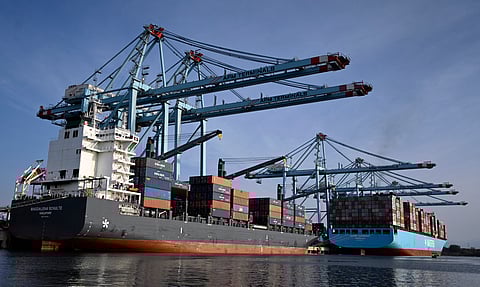
Container bookings from China to the United States have skyrocketed nearly 300%, following a temporary pause in tariffs between the world’s two largest economies.
The surge comes in the wake of a joint announcement by Beijing and Washington to halt most tariffs for 90 days, easing pressure on global shipping.
According to container-tracking firm Vizion, the seven-day average of container bookings from China to the U.S. jumped to 21,530 twenty-foot equivalent units (TEUs) — up from just 5,709 TEUs the previous week ending May 5. That marks an extraordinary 277% increase.
“This dramatic rise reflects a rush to ship goods before any new tariffs kick in after the 90-day window,” said Ben Tracy, Vizion’s vice-president, in an online statement on Wednesday.
The pause in tariffs has sparked expectations of an earlier-than-usual peak shipping season, as companies scramble to move inventory before the tariff freeze potentially expires in August.
“With the new deadline looming, we’re likely to see a front-loading of shipments, leading to an early start — and potentially an early fade — of the ocean freight peak season this year,” said international freight booking platform Freightos in its weekly report.
Break in tensions
Shipping companies have welcomed the break in trade tensions. Maersk, one of the world’s largest maritime firms, reported a noticeable uptick in bookings across its trans-Pacific routes since the announcement.
“Since the agreement was announced, we have seen an increase in bookings for our trans-Pacific services,” the company said on Tuesday.
With global trade still navigating an uncertain environment, the temporary tariff relief has offered a brief window of stability — and a rush of activity — across Pacific shipping lanes.
Uncertainty
Last week, A.P. Moller-Maersk A/S, the Danish container giant, lowered its forecast for the global transport market rattled by Donald Trump’s trade war.
Maersk set a new outlook for 2025 market development, ranging from a 1% contraction to a growth rate of 4%, according to a statement on Thursday, citing “increased macroeconomic and geopolitical uncertainty.” The forecast compares with growth of “around 4%” predicted back in February.
So far, the trade war “is mostly a US-China issue, the rest of the world continues unabated,” Chief Executive Officer Vincent Clerc said in an interview on Bloomberg TV.
Still, the tariffs have “already taken a bite” out of the container market in April and volumes in China-US trade have dropped “30% to 40% in both directions as the trade war heats up,” he said, noting that Maersk is less exposed than other shipping lines, because it’s biggest trade route is Asia to Europe.
Maersk, which controls about 14% of the world’s container fleet and operates 60 ports, is among the global companies hit by Trump’s protectionist shift, which is upending decades of progress in free trade. Still, the company has also said that it expects a transport boost in Europe as the continent, led by Germany, speeds up investments — including in defense.
“The outlook for global container demand over the remainder of the year remains highly uncertain, shaped by a rapidly evolving trade policy landscape and increasing recession risks in the US,” Maersk said. The second quarter is still set to see growth “particularly if shippers capitalize on the 90-day pause of reciprocal tariffs by frontloading shipments and building inventories.”
Disruption
Container-line profits have been boosted by the Red Sea crisis, which has now lasted almost 18 months, because companies taking the longer diversion route south of Africa eases some of the vessel overcapacity in the industry.
The disruption in the Red Sea is expected to continue throughout the rest of the year, the Danish company said on Thursday. In February Maersk had indicated that would mean hitting the high end of its 2025 profit outlook.
In the latter part of the year, the global transport market faces two scenarios: a growing risk of demand contraction or the possibility that trade rebounds if tariffs are rolled back, Maersk said. It expects to grow in line with the market.
Maersk still projects 2025 underlying earnings before interest, tax, depreciation and amortisation in a range of $6 billion to $9 billion.
In the first quarter, earnings increased from the prior year, topping analyst estimates. Growth was driven by higher freight rates and cost control, and supported by higher volumes, Maersk said.


