Europe's defence firms unite to build missile interceptor amid rising security threats
5 defence firms join forces to develop Europe's first exo-atmospheric interceptor system
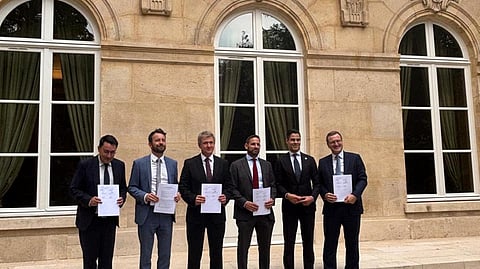
Dubai: Europe has taken a step towards building its own upper-layer missile defence system, with five leading defence companies signing an agreement to jointly develop an interceptor designed to stop long-range ballistic missiles before they re-enter the Earth's atmosphere.
The project, called Bliksem EXO, was announced in Paris on Monday during the inaugural meeting of the anti-ballistic coalition at the French Ministry for Europe and Foreign Affairs.
The Letter of Intent was signed by Airbus Defence and Space, Destinus, MBDA Deutschland, Safran Electronics and Defense, and Thales. The multinational partnership aims to design, test and eventually manufacture the interceptor system.
The signing took place in the presence of Dutch Prime Minister Rob Jetten.
Designed to intercept missiles in space
According to a joint statement, the Bliksem EXO is being designed to destroy medium- and intermediate-range ballistic missiles while they are still travelling above the Earth's atmosphere.
"This mission complements, rather than competes with, existing and planned European lower-layer capabilities."
"Together, these systems form a layered European missile defence: terminal and theatre systems below, Bliksem EXO above the atmosphere. The programme is designed for full interoperability with NATO Integrated Air and Missile Defence (IAMD) and to strengthen the European Sky Shield Initiative (ESSI) by addressing the currently missing upper layer," explained the statement.
According to the consortium, the interceptor is being developed to counter medium- and intermediate-range ballistic missiles, including newer threats such as Russia's Oreshnik-class missile systems.
The system is intended to intercept threats during the midcourse phase of flight using a hit-to-kill approach, meaning it destroys a missile through direct impact rather than using an explosive warhead.
"Today, Ukraine and nine European countries, and multiple European defence companies, launched the anti-ballistic coalition," said Dutch Prime Minister Rob Jetten.
He added: "Bliksem EXO is one of the industrial pillars of this initiative... It brings together leading European defence companies and draws on Ukraine's unique operational experience."
Also Read: EDGE launches 'EDGE Europe' in Paris
Five companies share responsibilities
Each company will take responsibility for a different part of the system.
Destinus will lead the consortium and oversee system integration, including the exo-atmospheric kill vehicle.
MBDA Deutschland will develop the interceptor booster, launcher and canister.
Safran Electronics & Defense will provide the guidance, navigation and seeker technologies.
Airbus Defence and Space will develop the command-and-control and battle management systems.
Thales will supply the radar and sensor network used to detect and track incoming threats.
Destinus Chief Executive Officer Mikhail Kokorich said Europe already has "strong lower-layer missile defences" but "still lacks a sovereign European upper layer against medium- and intermediate-range ballistic missiles."
Engineering work starts next month
The companies plan to sign a binding consortium agreement within three months. Engineering work is expected to begin in August 2026, with the consortium aiming to conduct its first space-based test of the interceptor's exo-atmospheric kill vehicle in 2027.
The consortium also said the programme will incorporate lessons drawn from Ukraine's experience in defending against large-scale missile and drone attacks, subject to export controls, security requirements and government approvals.
The Letter of Intent itself does not commit governments or companies to purchasing or funding the system, with future work remaining subject to national and European regulatory approvals.
The announcement follows Monday's launch in Paris of the Integrated Anti-Ballistic Missile Coalition, in which European leaders pledged to jointly develop a lower-cost alternative to the U.S.-made Patriot air defence system as Ukraine struggles to counter intensified Russian ballistic missile attacks.
Ukraine and nine European countries, including the UK, Germany and France, have agreed to work together on a joint missile defence programme to strengthen Europe's protection against ballistic missile threats. The initiative will draw on Ukraine's experience defending against Russian missile attacks since Moscow's full-scale invasion in 2022.
"Our goal is to build a shared ballistic missile defence capability for Europe," the 10 countries said in a joint statement released as Ukrainian President Volodymyr Zelenskyy met European leaders in Paris.


