What we know about the US-Venezuela oil agreement
Critics warn of ‘new colonialism’ as Washington gains majority stake in fields
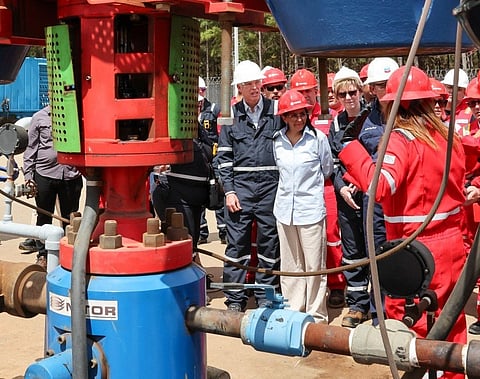
The agreement granting the United States control over about one-fifth of Venezuela's oil reserves rests on vague terms that raise questions about how it will be implemented.
Here is what we know so far about the deal:
Billions of barrels
US President Donald Trump on Friday said his administration has "secured majority US control of more than 65 BILLION BARRELS of proven Oil Reserves in Venezuela, at no cost to the American Taxpayer."
This represents about 20 percent of Venezuela's massive reserves, which are the largest in the world.
That could be a major boost for US reserves.


The subsoil of the United States holds 46 billion barrels of oil, according to the US Energy Information Administration.
But experts are skeptical that Venezuelan production will surge in the short term.
Venezuela's interim president, Delcy Rodriguez, said that the agreement would span 25 years.
According to her, it covers 17 oil fields and will bring her country more than $100 billion in investment, as well as approximately $19 for every barrel produced.
Get it: Fast, verified news for FREE ... download the Gulf News app — simply click here
New colonialism?
Rodriguez governs under intense US pressure. She took power after the American ouster and capture of former authoritarian leader Nicolas Maduro in a military raid in January.
She maintains that "Venezuela retains ownership and sovereignty over its resources."
But for Rafael Ramirez, the former head of Venezuela's state-owned oil company (PDVSA), the deal is "opening the doors to a new form of US colonialism."
In a post on X, he described it as "an agreement behind the country's back, clearly unconstitutional, that cedes control of the territory and the oil to a foreign power."
Several media outlets have reported that Washington is expected to receive 55 percent of the output from the newly created joint venture.
In an editorial, the Wall Street Journal said the deal "looks less like a normal commercial transaction than it does the famous scene of US businessmen meeting with the Cuban strongman in 'The Godfather Part II'."
That's a reference to a sequence in the famed movie where mobsters and businessmen meet with pre-revolution Cuban president, Fulgencio Batista.
Uncertainties
Trump has insisted that the agreement will not cost the US taxpayer anything but has not explained how it would be structured nor provided a clear timeline.
Speaking Monday, the US president asserted "it's going to go fast" without getting into specifics.
"One of the things I want to do with all of that oil that we now have, I want to fill up the strategic reserves, and we'll get that done fairly quickly," he said.
The US strategic reserve is at its lowest level in over 40 years, following drawdowns by Trump and his predecessor Joe Biden to mitigate the impact of conflicts in Ukraine and the Middle East.
Francesco Sassi, a researcher specializing in energy geopolitics at the think tank RIE, said US government involvement in such an agreement was unprecedented.
He noted that unlike China, Russia or Venezuela, the United States does not have a state-run oil company, instead relying on private firms to develop oil projects.
Trump predicted the deal would lower fuel costs for Americans -- costs that have surged due to the war in the Middle East -- but experts remain more cautious, saying any impact at the gas pump would take considerable time to materialize.
What do oil companies say?
Oil distributors and refiners are set to meet with Trump on Tuesday to discuss pump prices, according to the White House, which could be another chance for Trump to encourage them to help revive Venezuela's oil and gas industry.
Major US oil companies did not respond to AFP request for comment, but with the exception of Chevron, which has retained a presence in the country, companies have been reluctant thus far to re-engage in the Latin American country.
That is due to the massive investments required to repair Venezuelan infrastructure and because of past expropriation of assets by Caracas under its authoritarian governments.
The country's oil production is hovering around 1.2 million barrels per day. That was up 30 percent since January, but still far below the three million barrels of a quarter-century ago.
There's another concern about the unconventional agreement.
"It's hard to discern whether this deal will remain in force after Trump or will it get modified or perhaps cancelled in the future," said Andy Lipow, an analyst at Lipow Oil Associates.


