US-Venezuela oil deal redraws global energy power
The pact tests sovereignty, energy security and the limits of state-backed investment
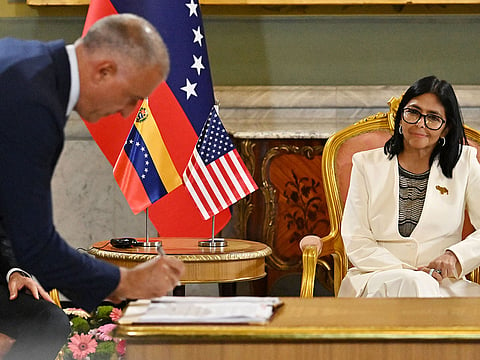
The US-Venezuela oil agreement matters for reasons extending far beyond the 65 billion barrels covered by it. The deal could change how governments secure foreign resources, blur the boundary between state power and private business, and accelerate Venezuela’s move away from OPEC.
Its structure is unusual. Venezuela has granted North American Blue Energy Partners (NABEP) 100-year rights over 17 oilfields. NABEP has committed to invest $100 billion in infrastructure needed to revive production.
The Pentagon’s Office of Strategic Capital will receive a 35 per cent stake in NABEP’s corporate parent at no cost to the US government. The State Department can buy 20 per cent of production at cost and will hold first-refusal rights over the remainder.
Washington can veto board appointments, while most directors must be US citizens. Its agreement with NABEP will operate under US law and the jurisdiction of US courts.
NABEP is the mechanism through which the deal operates. The larger development is that the US government has secured ownership, purchasing rights and corporate influence over a significant part of another country’s main industry.
Energy security before cheaper petrol
US President Donald Trump has presented the agreement as a way to increase oil supply and eventually lower petrol prices. Yet its strongest immediate benefit for Washington is energy security rather than cheaper fuel.
The guaranteed purchasing rights could provide oil for the Strategic Petroleum Reserve, the military and other sensitive uses. Venezuelan crude can also reach the US without passing through the Strait of Hormuz or the Red Sea. This gives it added strategic value while the Iran war restricts Gulf shipments. None of this means motorists will receive quick relief.
Venezuela’s production has fallen sharply from its historical peak after years of sanctions, underinvestment and domestic disruption. Raising output requires new wells, reliable electricity, repaired pipelines, storage facilities and functioning export infrastructure.
Much of Venezuela’s oil is heavy crude that needs suitable refining capacity. The White House’s talks with US refiners show that gaining access to oilfields is only one part of the task. The crude must still be processed into petrol, diesel, asphalt and other products.
Trump has acknowledged that prices will not fall immediately. Asked about suggestions that the effect could take years, he said: “If it was two years, you know, that’s a short period of time.”
Two years may represent rapid progress for a large oil project. It offers little help to consumers paying higher fuel prices now.
Sovereignty beyond legal ownership
Venezuela’s acting President Delcy Rodríguez says the agreement preserves the country’s sovereignty over its natural resources. Legally, the oil beneath the ground may remain Venezuelan property.
Yet sovereignty is not measured by ownership alone. It also concerns who influences production, purchasing, corporate appointments and the commercial terms under which resources reach the market.
The US government will own part of the company operating the fields, buy a guaranteed share of output at cost and hold priority rights over the remainder. It will also have veto power over board appointments.
These provisions give Washington extensive influence over the commercial use of 65 billion barrels, equal to about a fifth of Venezuela’s OPEC-reported crude reserves.
The 100-year duration deepens the issue. These concessions will outlast today’s leaders and several future governments in both countries. A commitment of that length requires a legal and political foundation strong enough to survive changes in power.
That durability is not assured. US lawmakers have requested more information about the agreement, including the legal authority for Pentagon participation. A future Venezuelan administration could also review concessions granted by the current interim government.
Political uncertainty has commercial consequences. Oil developments require large investments supported by long contracts. Companies will hesitate to commit capital if a later government could challenge their operating rights or payment arrangements.
State enters marketplace
Governments have always influenced energy through sanctions, diplomacy, regulation and strategic reserves. This agreement goes further by making the US government a direct participant in a foreign oil company.
That creates potential tension between public policy and commercial interest. Washington will remain the sanctions authority and a central diplomatic actor in Venezuela while holding an economic interest in one producer.
Other companies may question whether they can compete on equal terms with a business backed by the Pentagon and State Department. This matters because Venezuela needs several investors, not one, to rebuild production at the scale being discussed.
NABEP’s $100 billion commitment is substantial, but it is not money already deployed. The company must secure capital, acquire equipment and complete projects over several years.
If the arrangement attracts wider investment, Venezuela could recover output and government revenue. If its preferential structure makes rival operators more cautious, rebuilding may fall short of its headline ambitions.
OPEC faces another test
Venezuela helped found OPEC in 1960 but now produces far below its former levels. It is currently exempt from the organisation’s production limits because of that decline.
Caracas is considering leaving OPEC, although no final decision has been announced. An exit would have limited immediate effect on supply, but it could remove the possibility of future quotas restricting Venezuela as production recovers.
That would suit both governments. Venezuela could pursue maximum output, while Washington would gain access to more crude outside the OPEC production system.
The agreement’s importance therefore extends beyond its promised barrels. It brings foreign policy, military interests and commercial ownership together in one energy arrangement.
If successful, it could offer other governments a model for securing oil, gas and strategic minerals abroad. Its fate will depend on whether political authority, private capital and national sovereignty can remain aligned across a 100-year commitment.


