Faster, cheaper electric buses hit 60% of new units: How Europe leads the way
More and more utilities are proving just how far battery-driven heavy equipment has gone
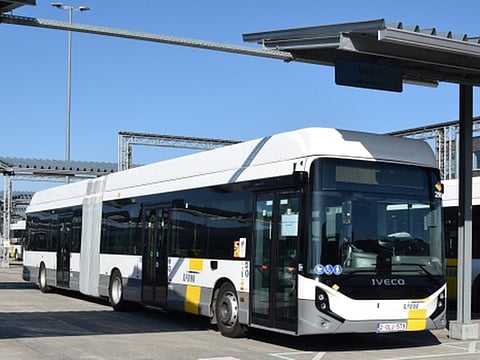
Europe’s city buses have crossed what's considered a decisive tipping point.
EU buses just went electric almost overnight — 60% of new city buses are now zero-emission (ZE) — from just 12% in 2019.
In 2025, 60% of all new EU city buses sold were zero-emission — 56% battery-electric and 4% fuel-cell — up from just 12% in 2019.
From pilot project to mainstream
Electric buses are no longer a pilot project in the continent also known as the birthplace of Western civilisation — they are fast becoming the default, or mainstream.
In 2025, more than 11,000 electric units entered service across the European continent.
11,607: Number of electric bus units rolled out across Europe 2025, a 48% jump from 2024
Bigger buses, longer routes
The transition is changing the shape of buses themselves.
Cities are increasingly adopting 24-metre articulated electric buses designed for Bus Rapid Transit corridors, allowing higher passenger capacity without tailpipe emissions.
This is particularly visible in projects in Paris, where electric BRT lines are expanding.
At the same time, operators are pushing electric buses beyond dense city cores into intercity and airport operations — proof that range, charging, and reliability concerns that once slowed adoption are rapidly being resolved.
Major players
The surge reflects a decisive policy push by cities racing to achieve fully electrified bus fleets by 2028 to 2030.
Manufacturers, meanwhile, are scaling production to meet orders that now outpace diesel in many markets.
Major builders such as MAN Truck & Bus and BYD Europe have expanded capacity as demand accelerates, while Mercedes-Benz retains a solid foothold with a 12% market share.
The numbers behind the shift
The growth in electric bus registrations, a a 48% jump from the previous year, signals a structural transition away from diesel rather than incremental adoption.
At the same time, several smaller markets moved fastest, hitting 100%.
100%: Bulgaria, Denmark, Estonia, Latvia, and Slovenia recorded 100% zero-emission sales for all new city buses in 2025—meaning every new unit ordered was electric.
Among the most visible models on European streets are the Irizar iE Bus, MAN Lion’s City E, and Volvo 8900 Electric, now common in fleets from Scandinavia to Southern Europe.
The Netherlands hit 99.5% zero-emission (ZE) sales since 2021 and EU diesel bus sales halved to 7% last year.
Fixed-route buses with depot charging have proven viable for battery-electric tech, turning policy mandates like the Clean Vehicles Directive into real-world success.
Every year since 2020, battery-electric models have dominated sales growth, while hybrids fell to 9% and gas-powered buses were slashed to 7%.
The Clean Vehicles Directive set modest 2021-2025 targets (13.5% to 22.5% ZE depending on country).
5-year average reaches 40% sales
Ten countries recorded 90-100% ZE in 2025: led by the Netherlands (99.5%), with Bulgaria, Denmark, Estonia, Latvia and Slovenia hitting 100%.
Even large markets performed strongly: UK 75%, Italy 67%, Spain 56%, Germany 50%.
Role of policy
Policy played a key role towards electrification of European public transport buses: Cities with full-electrification targets forced suppliers to scale; and depot-based charging proved cheaper and simpler than expected.
The result: quieter streets, cleaner air and lower long-term operating costs for transit agencies and clipping exposure to oil price spike. The implications stretch far beyond city limits.
Buses turn over faster than cars, so the fleet-wide shift will cut urban transport emissions quickly.
Investment, supply chain ramped up
With ZE buses now the clear market leader, manufacturers are accelerating investment and supply chains are maturing.
Analysts say 100% ZE city-bus sales could arrive by 2028 — seven years ahead of the 2035 target.
Europe has shown that heavy-duty electrification is not a distant dream but a proven, accelerating reality.
Tipping point for urban transport
What began as environmental compliance is now operational strategy.
In general, electric buses offer lower running costs, quieter streets, and cleaner air — advantages that compound at scale in dense cities.
With procurement cycles now favouring battery-electric by default, Europe’s bus fleets are approaching a tipping point where diesel is no longer the norm but the exception.
Regional momentum (2025–2027)
United Kingdom now leads major European markets, with around 75% of new city buses delivered in 2025 being electric.
In Finland, operator Nobina secured contracts to deploy 69 electric buses in Helsinki starting 2027.
Germany is electrifying specialised fleets, with Munich Airport transitioning to a 74-vehicle electric apron bus fleet.
In France, transport authority Île-de-France Mobilités has launched a new 30-bus electric BRT line serving the Paris region.
Ecosystem
Zero-emission buses, grid-scale batteries, wind, solar, EVs and e-trucks form a symbiotic ecosystem.
As the war over oil grinds, more clean-tech projects are coming online in the EU, and the zero-emission ecosystem itself keeps improving with longer-duration and improved battery chemistry.
As the war exposes the world's vulnerability to oil trade chokepoints, the EU bus mandate has helped insulate the continent's public transport sector, enabling the the continent to transition towards a renewable economy.
The oil price shocks of March 2026, only accelerated the drive towards zero-energy transport.


