Exxon, Chevron's $26.5 billion windfall: Why Trump is angry — and Americans fume as petrol prices remain sky-high
Trump’s $2.25 gas demand clashes with wartime energy shocks and market realities
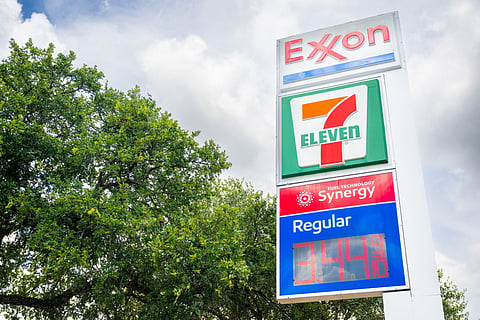
Exxon Mobil and Chevron just delivered a powerful snapshot of the strange economics of the Iran war: the same global energy shock that has squeezed American drivers has produced a spectacular windfall for major US oil companies.
Exxon Mobil and Chevron together earned about $26.5 billion in net income in the second quarter, as war-driven disruptions pushed up crude prices and, even more importantly, tightened supplies of refined gasoline and diesel.
Chevron reported a record $12.2 billion profit, while Exxon earned $14.5 billion, roughly double its year-earlier result and its strongest quarterly profit since the oil-price surge that followed Russia's invasion of Ukraine.
That combination — pain at the pump and record profits in the oil patch — is precisely why President Donald Trump is angry.
Why Trump is upset
Trump's argument is straightforward: If oil prices have fallen sharply from their wartime highs, gasoline prices should be falling much faster.
He has repeatedly demanded gasoline prices of around $2.25 a gallon, while the national average is around $4.10-$4.11.
In June, Trump accused major oil companies of failing to pass lower crude costs on to consumers and ordered the Justice Department to investigate potential price gouging. Exxon and Chevron were among the companies he named.
The administration's concern is not entirely political rhetoric. The Justice Department and Federal Trade Commission have formally warned petroleum companies that they are monitoring the market for possible antitrust violations, including manipulation and collusion that could contribute to high gasoline prices.
But there is a crucial complication: Gasoline is not crude oil.
And that distinction helps explain why a fall in crude prices does not automatically produce an equivalent fall at the pump.
World is short of refined fuel
The Iran war initially sent crude prices soaring because of disruptions to oil production and shipping through the Strait of Hormuz.
But the market shock has increasingly moved downstream — from crude oil to refined petroleum products.
Refineries turn crude into gasoline, diesel, jet fuel and other products.
When refineries go offline or supplies become constrained, gasoline and diesel can remain expensive even if crude prices subsequently fall.
That is what Exxon executives have been pointing to.
The company has said the bigger constraint is increasingly the availability of petroleum products rather than simply the price of crude.
The second-quarter numbers illustrate the point.
Chevron's refining profit exploded to about $4.9 billion, from just $737 million a year earlier.
Exxon's refining business earned about $5.5 billion, compared with a $1.3 billion loss in the first quarter.
In other words, the companies were not merely making money by pumping more crude out of the ground.
They were also benefiting from tight refining markets and strong margins on the products Americans actually put into their cars.
The Iran-war effect
The energy shock has several layers.
First: crude supply.
The war disrupted production in the Gulf and severely reduced tanker traffic through the Strait of Hormuz, one of the world's most important energy chokepoints.
Second: refining capacity.
Middle Eastern refinery disruptions compounded existing losses elsewhere, including reduced Russian refining capacity.
Third: global competition for fuel.
China's reluctance to release more refined products for export further tightened the international market.
Fourth: inventories.
When inventories fall, refiners and wholesalers have less cushion against further disruptions.
That combination can produce a counterintuitive result:
Crude prices can fall while gasoline remains expensive.
The two markets are connected, but they do not move in perfect lockstep.
And then there is Exxon and Chevron
Both companies have also been producing enormous quantities of oil.
Chevron's global production reached roughly 4 million barrels of oil equivalent per day, helped by its acquisition of Hess. U.S. production reached a record roughly 2 million barrels per day.
Exxon produced about 4.5 million barrels of oil equivalent per day, with production in the Permian Basin also hitting a record.
Their refineries were operating close to capacity.
That matters because it undermines the simplest version of the price-gouging argument.
The companies are not necessarily making record profits because they are deliberately withholding oil.
They are making money because they are producing and refining at scale while selling into a market where supply has been disrupted and prices are high.
That distinction is likely to become central to the Justice Department investigation.
$2.25 gasoline: A misleading benchmark
Trump's $2.25 target sounds attractive to any driver.
But there is a historical catch.
Gasoline last averaged around that level during the COVID-19 pandemic, when much of the global economy was effectively shut down.
Americans drove dramatically less.
Air travel collapsed, actories closed, oil demand plunged, crude prices crashed.
Trying to recreate $2.25 gasoline under normal economic conditions is therefore not simply a matter of ordering oil companies to cut their margins.
A $2.25 pump price is associated with an extraordinary collapse in energy demand — not a normal, healthy oil market.
That does not mean gasoline companies cannot be investigated for illegal price manipulation.
It means that the president's desired price and the economics required to produce it are two different questions.
Why Americans are angry
For consumers, the debate over refining margins and crude benchmarks can seem academic.
The driver sees only one number: the price on the pump.
And the political danger for Trump is that gasoline is unusually visible. Americans see the price several times a week, and the cost affects commuting, vacations, trucking and virtually every product transported by road.
Polling shows just how politically sensitive the issue has become.
81% of Americans disapprove of Trump's handling of fuel prices
A May Marquette Law School national poll found that only 19% of Americans approved of Trump's handling of gasoline prices, while 81% disapproved. Among Republicans, approval was 38%; among independents it was only 6%.
An April Quinnipiac poll found that 65% of voters blamed Trump at least somewhat for the recent rise in gasoline prices, although Republicans were much less likely than Democrats to do so.
And a June Reuters/Ipsos poll found Trump's overall approval at 35%, near his term low, while most Americans expected gasoline prices to continue rising amid the Iran war.
More recently, a CNN/SSRS poll reported that 74% of Americans said rising gas prices linked to the Iran conflict were causing hardship, while Trump's overall approval had fallen to 34%.
The political message is clear: Americans may understand that a war can raise oil prices.
They are less forgiving when they see oil companies reporting tens of billions of dollars in profits at the same time.
'Big Oil' optics are terrible
This is the political contradiction confronting Trump. He has long positioned himself as a champion of American oil and gas production.
His administration wants more domestic energy production, fewer regulatory constraints and greater energy independence.
But now the companies benefiting from the energy market he supports are reporting enormous profits while households are struggling with higher fuel costs.
That gives Trump an uncomfortable choice.
He can defend the free-market system and argue that oil companies are responding to legitimate supply shortages.
Or he can pressure the companies to lower prices, risking accusations that the administration is interfering with market pricing.
Trump has chosen the latter — at least rhetorically. And the stakes are rising as the 2026 midterm elections approach.
Could Trump ban oil exports?
The administration has not ruled out stronger intervention, including restrictions on U.S. oil exports.
That would be a dramatic escalation.
The argument for an export restriction is intuitive:
If American oil is being produced in America, why not keep more of it at home and lower American gasoline prices?
The problem is that the US oil market is deeply integrated into the global market.
Refineries are configured to process particular types of crude. US producers may export one type of crude while importing another better suited to domestic refineries.
Chevron has warned that restricting exports could discourage investment and eventually reduce supply, potentially making the price problem worse rather than better.
That is the central dilemma: A policy designed to force prices down today could reduce production and investment tomorrow.


