A new chapter in going green
A residential school in India is cooking up sustainability and innovation by tapping into solar energy
The thought of cooking 3,000 meals a day for hungry, growing boys is a daunting one and enough to make even the coolest of chefs break out in a sweat.
Healthy appetites need to be satisfied to promote optimum learning in a school environment – but when the school is actually an orphanage for destitute boys and money is a major concern, savings have to be found through whatever means possible without causing further hardship to the students.
Thanks to a new green initiative, however, Raja, the head cook at the Ramakrishna Mission Students Home in Chennai, India, manages to put a smile on the face of each of the 700 pupils four times a day with the nourishing meals he prepares.
Raja cooks 120kg of rice every mealtime – a huge amount made simple by the new solar steam cooking system supported through a partnership between the United Nations Development Programme (UNDP) and India’s Ministry of New and Renewable Energy.
He and his team cook four times a day and are reliant on steam for much of the preparation.
Until recently the kitchen used only liquified petroleum gas (LPG). But the hike in gas prices meant they had to spend Rs80,000 (Dh4,320) more every month. This sharp increase in the cost of fuel led the Ramakrishna Home to think of alternative energy sources to save money. Initially, it turned to a wood gas stove but this was inefficient and unsustainable in the long run.
Then two years ago, the 109-year-old charitable institution invested in a solar heating system that could fuel its kitchens, replacing fossil fuel with a clean, alternative source of energy captured from the sun.
‘Since its installation, the Mission has been able to halve its consumption of LPG, reducing expenditure by about $8,000 (Dh28,000) every year,’ says Chandra Sekaran, who is in charge of the project at the Mission.
‘We have considerably reduced dependence on fossil fuels and there’s no pollution.
‘We have also been able to expose our students to environment-friendly technology, something very important for the future of the world.’ The system they selected uses solar energy to convert water into steam. That, in turn, is piped from an ‘accumulator’ or storage tank, into the kitchen, reducing cooking time.
The accumulator is key to the efficiency of the Mission’s cooking capabilities – it allows for unused steam to be stored in a large insulated storage tank as high pressure hot water.
Heat is therefore available for cooking at any time.
The system functions silently, spews neither noxious diesel fumes nor choking smoke, and takes up very little space.
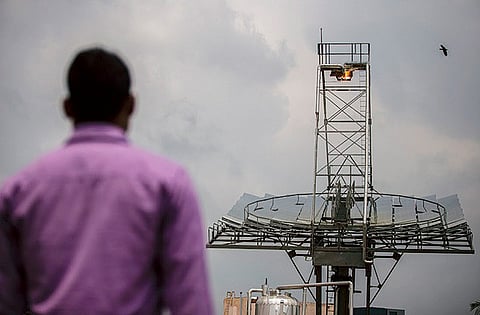
The system uses solar-grade mirrors as reflectors. They are arranged in such a way that their focal point is always fixed on a receiver (solar boiler).
The receiver also moves with the dish. Reflectors in the dish are permanently fixed so that there is no chance of focus misalignment between the mirrors and receiver. This helps to harvest the maximum amount of solar energy without human intervention.
‘There is an average fuel saving of 25kg to 30kg of LPG on a clear sunny day,’ says Chandra.
Frequent cleaning of the reflector mirrors increases the steam output. The cleaning is done by two volunteers every two days.
Another upside to the new technology is that the chefs have reported the kitchen is relatively cooler to work in, says Chandra.
‘The savings we have made with this system are used for our students’ education and maintenance.’
The school’s renewable energy use saw it accredited as a Green School with Platinum rating by the Indian Green Building Council of the Confederation of Indian Industry – a rating that recognises global leadership in the field.
The Mission provides its 700 orphaned and impoverished students with free education, food and accommodation.
Most of the students are from remote rural areas. They live in the Students Home and study at the educational facilities from school age through to diploma level.
Started in 2012 and financed by the Global Environment Facility, the solar steam cooking project promotes the use of concentrated solar heating technology in a range of industries, commercial establishments, religious, and philanthropic institutions.
It aims to promote and develop a viable and strong market for solar concentrators in order to reduce or replace the use of conventional fuels that degrade the environment.
‘We are looking to see how we can utilise green technology in other areas of the school,’ says Chandra.
‘While saving money, it is also imparting a strong message to our students.’


![The Council seeks to maintain secure and efficient operations across every stage of petroleum products trading, including storage, transport, distribution and supply. [Illustrative image]](http://media.assettype.com/gulfnews%2Fimport%2F2022%2F10%2F14%2FStorage-tanks-for-crude-oil--gasoline--diesel--and-other-refined-petroleum-products_183d434aa39_large.jpg?w=320&auto=format%2Ccompress&fit=max)