US banks return to sound health
JP Morgan, Wells Fargo lead dividend and share buyback announcements
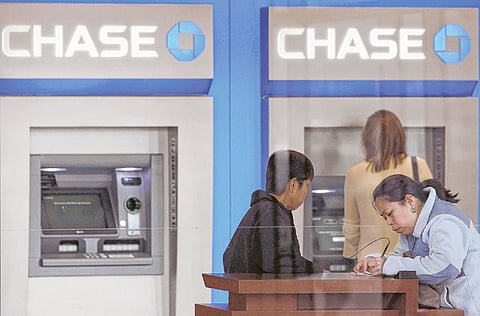
New York: US bank investors may be rewarded with an extra $22 billion annually after government tests showed the industry has regained enough strength to boost dividends and share buybacks.
JPMorgan Chase & Co., Wells Fargo & Co. and Goldman Sachs Group Inc. were among six lenders that disclosed more than $16.2 billion in share buybacks and $5.4 billion of annualised dividend increases on Friday, according to data compiled by Bloomberg. The banks made their announcements after learning they passed a Federal Reserve review of their financial health.
"This is a real signal by the Federal Reserve to tell the world that the US banking system is back," said Gerard Cassidy, an analyst at RBC Capital Markets. "We are going to see, in our view, over the next three years, a dramatic increase in the dividends."
Regulators are allowing banks to begin restoring dividends that were cut in early 2009 during the financial crisis, when investors and analysts were speculating some banks might need to be nationalized. Losses tied to home mortgages, commercial real estate and business lending drained capital, leading to more than 300 failures.
The Fed had demanded 19 of the biggest lenders undergo stress tests before they could consider actions that would reward shareholders by dipping into capital. The process was formally completed yesterday, and within hours, banks began announcing their plans.
Repurchase
JPMorgan said it may repurchase $15 billion in shares and boosted the payout rate to a level equal to $3 billion in additional annual payments, while Wells Fargo said shareholders could receive as much as $7.7 billion. Goldman Sachs said it will buy back $5 billion of preferred stock sold to Warren Buffett's Berkshire Hathaway Inc. during the financial crisis and may raise its dividend or repurchase common stock.
The six banks that raised payouts and approved share buybacks took more than $64 billion in bailout funds during the financial crisis.
The total increase in payments to shareholders announced yesterday was calculated by adding the value of the share buybacks plus dividend increases. Dividends were annualised over four quarters and multiplied by the number of outstanding shares, which were reduced to account for the total stock buybacks. The value of the shares repurchased was pegged to the closing price on March 17.
The figure doesn't include $7 billion in authorized share buybacks that JPMorgan said it won't complete before year-end, or Goldman Sachs's repurchase of Buffett's stake. Berkshire, which still holds warrants to buy the bank's stock, has made about $3.7 billion, including paper profits, from the 2008 investment.
The KBW Bank Index of 24 companies advanced 1.1 per cent in New York. Wells Fargo climbed 1.5 per cent to $31.83. New York-based JPMorgan jumped 2.7 per cent to $45.74 and Goldman Sachs rose 2.7 per cent to $159.96
JPMorgan, the second-largest US bank by assets, raised its quarterly payout to 25 cents a share from 5 cents and said $8 billion in shares may be repurchased in 2011. San Francisco- based Wells Fargo authorised the repurchase of 200 million shares, or $6.3 billion based on yesterday's closing share price, and a special dividend of 7 cents a share, which will raise the first-quarter payout to 12 cents.
The Fed told banks in November to consider conservative payouts that would still allow for a significant build-up of capital. Firms are "generally expected" to limit 2011 dividends to 30 per cent of expected earnings, the Fed said yesterday.
"The very cautious approach speaks to the tightrope which the Fed knows it is walking on," said Karen Shaw Petrou, managing partner at Federal Financial Analytics in Washington, whose clients include the largest U.S. banks. The banking system remains fragile and lenders still need capital to meet new international standards, she said. "But if they don't start paying dividends, they will never attract investors and they will never recapitalise."
The Fed stress test assumed a 28 per cent drop in the "Dow Jones Total Stock Market Index" between December 31 and the end of this year - an average quarterly decline of 6.9 per cent — followed by a 59 per cent rally through December 31, 2013, which amounts to a 7.3 per cent advance per three-month period.
That compares with the average quarterly retreat of 15 per cent and gain of 7.4 per cent by the Standard & Poor's 500 Index during bear and bull markets, respectively, since 1962, according to data compiled by Kevin Pleines and Cleveland Rueckert, analysts at Westport, Connecticut-based Birinyi Associates Inc. During the slumps that began in 2000 and 2007, losses averaged 4.8 per cent and 10 per cent a quarter, they said.
Banks were also asked what would happen if the jobless rate, now at 8.9 per cent, rose as high as 11 per cent.
The tests should have been more severe to allow the Fed to identify which specific banks would present big risks to the overall financial system, said Matthew Richardson, a finance professor at New York University's Stern School of Business.
"You need to know which banks are going to be a problem" in a severe economic slump that also involves tighter market liquidity, Richardson said. "I would have preferred an environment where they put the system through hell again."
Richardson helped devise a model at NYU with Nobel Prize-winning economist Robert Engle that ranks companies in terms of systemic risk and the volatility of their market capital. "Systemic risk has increased, not decreased," said Mark Williams, a former Fed bank examiner who is now an executive-in- residence at Boston University's School of Management. "It is too early to allow these dividends to go out."
Tarp payments
While not all the banks were cleared to raise dividends, the Fed allowed some to take steps toward repaying the Troubled Asset Relief Programme (Tarp), the $700 billion (Dh2.57 trillion) federal bailout fund.
SunTrust Banks Inc. sold $1.04 billion in common stock and said it will sell $1 billion in debt as the Atlanta-based company seeks to repay $4.85 billion to taxpayers.
KeyCorp, the second-biggest bank in Ohio, said it raised $625 million in stock and will issue debt to help repay $2.5 billion to Tarp. A 2-cent increase in the dividend to 3 cents per quarter drew no Fed objection, said KeyCorp, which plans to vote on the payout in May. "We're moving away from the micromanagement of major banks by the supervisors and slowly turning it back over to the board of directors," said Ernest "Ernie" Patrikis, a partner at White & Case and a former general counsel and first vice president for the Federal Reserve Bank of New York, in a phone interview.


