The other side of Africa
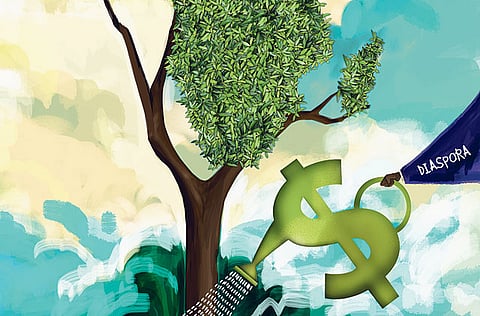
Among the many things that help the continent sustain economic growth, Remittances from the diaspora are the most significant contributing factor
There is something dismally familiar about the tide of news reports concerning Africa's increased suffering more poverty, malnutrition, civil strife, and death in the face of the recent global financial crisis. Almost everywhere, the media translates academic conclusions into graphic illustrations of brutality and despair in places such as Guinea and the Democratic Republic of Congo.
But there is another, woefully under-reported, side to the story. African countries that were locked out of international capital markets for most of the past five decades have largely been spared the twin woes of financial turmoil and economic downturn. The continent's economies experienced a slowdown, but not a recession. Indeed, according to McKinsey & Company, Africa was the third-largest contributor to global growth in 2009, after China and India.
Moreover, several African countries have received ratings from credit agencies, which have opened up global financial centres to them. In some cases, these ratings have proved equivalent to or higher than those of countries such as Turkey or Argentina. Stock exchanges are being established across the continent.
Furthermore, countries such as China, India, and Brazil have provided a platform for increased exports and the inception of a model of cooperation based on trade, investment and technology transfer rather than "aid."
Growth
China-Africa trade alone increased from $10 billion (Dh36.7 billion) in 2000 to $107 billion in 2008, and billions of dollars are being invested in oil production, mining, transportation, electricity generation and transmission, telecommunications, and other infrastructure.
These developments have combined to improve African countries' macro-economic performance dramatically. Inflation has been halved since the '90s, and foreign-exchange reserves have increased 30 per cent. Public finances showed a 2.8 per cent GDP surplus in 2008, compared to a 1.4 per cent GDP deficit in 2000-2005.
Savings rates are between 10 per cent and 20 per cent, and external debt has decreased from 110 per cent of GDP in 2005 to 21 per cent in 2008. Since 2000, sub-Saharan African countries have achieved economic growth of 5-7 per cent.
Many factors have contributed to this upturn. Emerging-market demand has pushed up commodity prices. Urbanisation has given rise to a dynamic informal sector. Improved governance, higher food production, increased inter-regional trade, debt cancellation, better use of official development assistance (ODA), and thriving telecommunications and housing markets have helped as well.
But transfers from the African diaspora stand out as the most significant contributing factor. A study commissioned by the Rome-based International Fund for Agricultural Development indicates that more than 30 million individuals living outside their countries of origin contribute more than $40 billion annually in remittances to their families and communities back home.
For sub-Saharan African countries, remittances increased from $3.1 billion in 1995 to $18.5 billion in 2007, according to the World Bank, representing between 9 per cent and 24 per cent of GDP and 80-750 per cent of ODA.
Migrants' remittance behaviour is essentially dictated by the regulatory environment and the quality in terms of speed, cost, security, and accessibility of products and services offered by banks, money-transfer companies, micro-finance institutions, and informal operators. In this respect, there are three different strategies in place in Africa.
Anglophone
The Anglophone strategy focuses on freeing up the remittance market by encouraging competition, relaxing regulatory constraints for non-bank operators, offering financial incentives, encouraging technical and financial innovation, and stimulating collaboration among market players. This approach, also adopted by Italy, contributes to reducing costs and increasing the overall volume of funds for beneficiaries.
The Hispanic approach emphasises migrants' involvement in banking by offering a range of banking services in both the country of origin and the host country, products of specific interest to migrants, and low commissions on foreign transfers. This approach, widely developed by Morocco and the Portuguese-speaking world, is epitomised by the zero-commission policy initiated by the Spanish bank Santander and its Moroccan counterpart, Attijariwafa Bank.
Francophone
Finally, the Francophone approach relies on two types of monopoly. The first is enjoyed by Western Union, which controls up to 90 per cent of the total formal transfer volume within Africa's 16-member Franc Zone. Western Union charges fees as high as 25 per cent on transfers to these countries, compared to an average global benchmark of 5 per cent, and has required that Franc-Zone countries sign exclusivity agreements, thereby preventing foreign-exchange bureaux, post offices, and micro-finance institutions from carrying out money transfers.
The second monopoly is exercised in the banking sector. France has a veto within the boards of directors of the Franc Zone's two central banks, while two French commercial banks, BNP-Paribas and Société Générale, exercise a quasi-monopoly on lending programmes, mainly centred on short-term trade fin-ancing and the needs of governments, public and private companies, and the elite. All other local banks have adopted the same approach, severely restricting access to financial services for households and entrepreneurs.
Despite the increasing importance of remittances from Italy, Spain, and the US the largest share in absolute terms still originates from France. There is thus a real need in the Franc Zone for a financing institution that would convert migrant remittances into productive investments, thereby generating jobs and wealth, and that would broaden access to banking services, mortgages, insurance products, pension plans, and technical assistance.
Official statistics for 2009 are likely to show that migrants' remittances fell sharply, as the global recession severely eroded job opportunities abroad. That makes it all the more important that African countries, many of which have built a strong groundwork for sustainable growth, have a financial system in place that can leverage remittances effectively as the global economy recovers.
Sanou Mbaye, a former member of the senior management team of the African Development Bank, is a Senegalese banker and the author of L'Afrique au secours de l'Afrique (Africa to the Rescue of Africa).


