
Why Jenga remains a family favourite, and what the 2025 edition brings to the table
From family game nights to new digital challenges, Jenga keeps the fun going
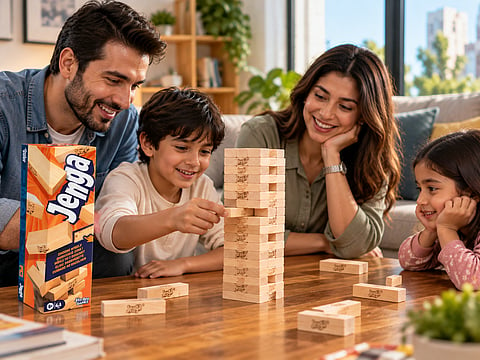
Some games never really leave the family cupboard, and Jenga is one of them. While much of our entertainment now happens through phones, tablets and television screens, a simple tower of wooden blocks can still bring everyone around the same table. There is something familiar about the nervous laughter, careful movements and inevitable crash that follows someone's overly confident turn. Hasbro's 2025 edition keeps everything people remember about Jenga while introducing a few optional ways to play. At its heart, though, the appeal remains unchanged: it's an easy game that brings people together without asking much of them.
A game that needs very little introduction
There is a good chance most people have played Jenga at least once, perhaps at a birthday party, during a family holiday or on a quiet weekend at home. Even those who haven't played can understand the idea within minutes. You build a tower of wooden blocks, carefully remove one at a time and place it on top, hoping your move isn't the one that brings everything down.
Created by Leslie Scott, Jenga grew out of a wooden block stacking game her family played in Ghana during the 1970s. Hasbro's 2025 edition stays close to the original, with 54 hardwood blocks arranged into 18 layers of three. Players take turns removing blocks and stacking them on top, using only one hand at a time. The last player to complete a successful turn before the tower collapses wins.
Recommended for ages six and above, the game can be played alone or with others, making it easy to introduce at family gatherings.
Why Jenga still brings people together
Part of Jenga's charm is that it doesn't demand much preparation. Someone can start building the tower while others finish their conversations, and before long, people naturally gather around to watch.
It's often the smallest moments that make the game entertaining. A player gently pushes a block, notices the tower moving and immediately changes their mind. Someone else insists a particular block is safe, only for the entire structure to start leaning. Then comes the silence as everyone waits to see what happens next.
These moments are difficult to predict, which is why the game remains enjoyable even after several rounds. Every move changes the tower, and each player must deal with whatever the previous person has left behind.
Jenga also brings different generations into the same activity. Children can understand the rules, parents can join without preparation, and grandparents don't need to learn an unfamiliar game system. Everyone faces the same challenge, regardless of age or experience. And unlike some competitive games, losing a round often becomes the funniest part. The blocks fall, everyone laughs, and someone starts rebuilding the tower.
What's different about the 2025 edition?
The biggest addition to Hasbro's 2025 edition is an optional web app that introduces new challenges to the traditional game. The wooden tower and basic rules remain unchanged, but players can use a phone or tablet to access different ways of taking their turns.
According to Hasbro, the free web app includes a virtual die with challenges such as removing a block using only your thumbs, completing a move within a time limit or stacking two blocks instead of one. Other variations encourage teamwork or involve another player in the turn.
These additions can make familiar game nights feel a little different, particularly for families who have played the original many times. A timed challenge might make a careful player act faster, while a team round gives everyone another reason to participate.
Interestingly, the digital feature doesn't turn Jenga into a screen-based game. The phone simply introduces a challenge before attention returns to the tower. And for families who prefer a completely screen-free evening, the traditional game works just as it always has.
An easy addition to family evenings in the UAE
In the UAE, where warmer months often mean spending more time indoors, Jenga fits naturally into family routines. It doesn't require much space or preparation. A stable dining table or coffee table is usually enough to get started.
It can be brought out after dinner when relatives are visiting, during a weekend gathering with friends or on an evening when everyone wants a break from television. Because the rules are simple, people can join the next round without needing to catch up on what happened earlier.
Families can also adapt the game to suit the gathering. Younger children might enjoy playing alongside a parent, while older players can introduce the optional challenges or organise friendly competitions. Larger groups can take turns in teams, discussing which block to remove next.
There is something refreshing about an activity that doesn't need a lengthy explanation before the fun begins. Sometimes, a familiar game and a few willing players are all an evening needs.
Gulf News earns a commission on purchases made through links in this article, at no extra cost to you. Our editorial team selects products independently.


