Iran-backed militias get Sept. 30 deadline to disarm: What to know
Baghdad gives pro-Iran armed groups in Iraq until September 30 to disarm
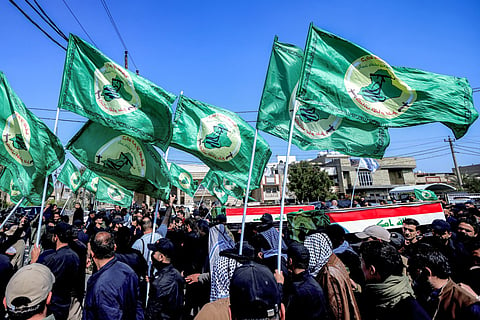
Baghdad: Iraq’s government has ordered pro-Iran armed groups to disarm by September 30 or face legal consequences, tying the deadline to the scheduled end of the US-led international coalition’s mission against the Daesh (Islamic State) group.
At least four groups are among the most influential Iran-aligned armed factions operating in Iraq.
While all are broadly part of what Iran calls the "Axis of Resistance", they differ significantly in their relationship with Tehran, military roles, political influence, and willingness to integrate into the Iraqi state.
Most are affiliated, formally or informally, with Iraq's Popular Mobilisation Forces (PMF), an umbrella organization created in 2014 to fight ISIS that later became part of Iraq's official security apparatus, although many factions continue to maintain independent command structures.
Some of the groups targeted US facilities in Iraq during the Middle East war sparked by Israeli-American strikes against Iran in late February.
Ultimatum from Baghdad
Government spokesman Haidar Al-Aboudi announced the ultimatum Monday during a weekly press briefing.
He said all relevant armed groups had been notified that Sept. 30 marks the cutoff, after which “all weapons outside the state framework will be subject to legal redress.”


The move comes as new Prime Minister Ali Al-Zaidi prepares for a visit to the United States and amid reported US pressure on Baghdad to assert greater control over weapons and reduce the influence of Iran-aligned factions.
Gropus under PMF
Many of these groups operate under the Popular Mobilisation Forces (PMF), an umbrella of mostly Shiite militias formalised as part of Iraq’s state security apparatus after the fight against Daesh.
Some factions have maintained significant autonomy, parallel command structures and ties to Iran, occasionally clashing with US forces or complicating Baghdad’s foreign policy.
Successive Iraqi governments have sought fuller integration or disarmament, but progress has been slow.
Winding down
The September 30 deadline aligns with the planned wind-down of the US-led coalition’s presence in Iraq as Washington is exerting pressure on Baghdad to ensure the factions turn in their weapons.
Officials have long argued that the continued foreign military footprint provides a pretext for some groups to retain independent arms.
Some Iran-backed factions, such as Asaib Ahl al-Haq and Kataib Imam Ali, have signaled willingness to integrate or place weapons under state control.
Others, including Kataib Hezbollah and Harakat Hezbollah Al-Nujaba, have expressed resistance, as per the Washington Institute.
State Sovereignty
The announcement reflects ongoing efforts by Al-Zaidi’s government to consolidate state sovereignty while balancing relations with Washington and Tehran.
Implementation will likely face political and security challenges given the factions’ entrenched roles in Iraqi politics and the economy.
Following are the key Iran-backed factions in Iraq [precise manpower figures are disputed because most groups operate through multiple brigades and reserve networks]
#1. Asaib Ahl al-Haq (AAH)
Founded: 2005-2006
AAH emerged after splitting from Jaish al-Mahdi, the militia loyal to Muqtada al-Sadr. According to the Washington Institute, the split was encouraged by Iran's Islamic Revolutionary Guard Corps Qods Force (IRGC-QF) and Lebanese Hezbollah to intensify attacks against U.S. forces following the 2003 Iraq War.
Characteristics
One of Iraq's largest Shiite militias.
Maintains both armed and political wings.
Operates the PMF's 41st, 42nd and 43rd Brigades.
Has representation in Iraq's parliament through the al-Sadiqoun political bloc.
Sometimes acts independently despite close Iranian ties.
#2. Kataib Hezbollah (KH)
Founded: 2007
Widely regarded by security analysts as Iran's premier Iraqi proxy, KH evolved from IRGC-backed "special groups" fighting US forces after the Iraq invasion.
The Washington Institute describes KH as effectively functioning as a branch of the IRGC-Qods Force, with extensive military, intelligence and missile capabilities. The United States designated KH a Foreign Terrorist Organization and Specially Designated Global Terrorist entity in 2009.
Characteristics
Considered the strongest military faction inside the PMF.
Possesses rockets, drones and precision-guided weapons.
Maintains influence over PMF intelligence and missile units.
Focuses primarily on military operations rather than electoral politics.
Has repeatedly targeted U.S. forces in Iraq and Syria.
#3. Kataib al-Imam Ali (KIA)
Founded: June 2014
KIA was established as the armed wing of the Islamic Movement of Iraq during ISIS's rapid advance across Iraq.
Unlike KH, analysts say KIA has increasingly emphasized commercial enterprises and political influence while maintaining armed capabilities.
The Washington Institute notes the group has close links with Lebanese Hezbollah and has facilitated attacks against U.S. forces while expanding its economic networks.
Characteristics
Smaller military footprint than KH or AAH.
Strong commercial and business interests.
Participated in operations against ISIS.
Accused of involvement in suppressing anti-government protests in Iraq.
Active in both Iraq and Syria.
#4. Harakat Hezbollah al-Nujaba (HaN)
Founded: 2013
Founded by Akram al-Kaabi after leaving AAH, Nujaba became one of Iran's principal expeditionary forces during the Syrian civil war.
The Washington Institute describes it as one of the most ideologically committed components of Iran's regional "Axis of Resistance."
Unlike AAH, whose focus is largely Iraqi politics, Nujaba has concentrated heavily on regional military operations, particularly in Syria alongside Iranian and Syrian government forces.
Characteristics
Strong emphasis on cross-border military campaigns.
Operated extensively in Syria.
Closely aligned with Iranian regional strategy.
Frequently issues threats against Israel and US forces.
Plays a leading role in the "Islamic Resistance in Iraq."
Common characteristics
Despite organisational differences, these factions generally share several features:
Ideological alignment with Iran's concept of the "Axis of Resistance."
Relationships with the IRGC-Qods Force, though varying in closeness.
Membership or affiliation with the PMF umbrella organisation.
Experience fighting ISIS after 2014.
Combined military, political and social service structures.
Access to rockets, drones and other advanced weaponry.
Differences
The groups have recently diverged over Iraq's efforts to consolidate all weapons under state control.
Asaib Ahl al-Haq and Kataib al-Imam Ali announced they would begin transferring their weapons and fighters to Iraqi state authorities as part of Prime Minister Ali al-Zaidi's effort to strengthen government control over armed groups.
Kataib Hezbollah rejected full disarmament, saying it would continue what it calls "resistance work," although it expressed willingness to coordinate with the PMF.
Harakat Hezbollah al-Nujaba likewise opposed surrendering its weapons, linking the issue to Iraq's sovereignty and the continued presence of foreign troops.
These differing positions highlight growing tensions within Iraq's Iran-aligned armed network. Some factions appear willing to integrate more fully into state institutions, while others continue to prioritise their role as components of Iran's broader regional security architecture.


