A salve on scars
Maiti Nepal, an NGO that works to put an end to woman trafficking in the country, has save
Ten years of imprisonment and Rs50,000 fine," pronounced the judge in the verdict handed down to Bir Bahadur, 60, in a court in Nepal last July. Bir Bahadur was also asked to pay compensation of Rs25,000 [Dh1,787] to S. Kumari, a young woman who escaped an ordeal that can be described as any woman's worst nightmare.
Kumari was 15 and studying in Class VIII in 2007 when she, after an argument with her parents, left her home with a friend.
"I moved to Kathmandu to get a job and continue my studies," Kumari says. That is where she met Bahadur, while shopping at the market one day.
"He got friendly with me, and when I mentioned to him that I was looking for a job, he tried to assure me by saying that I was like his daughter. He even paid for the slippers I purchased."
When Bahadur promised her a job in his company, Kumari accompanied him home. On the bus journey, she got down to buy a bottle of water. The shopkeeper, noticing her in the company of an older man, sensed that something was amiss and informed the police. This timely intervention saved Kumari from falling into the clutches of the large nexus of the trade in women that is rampant in many parts of Nepal. She then found shelter in the transit home of Maiti Nepal, an NGO that works to put an end to trafficking of women.
Babita's tale is no different. Brought up by her maternal uncle, this 18-year-old left home when he beat her up for neglecting her studies. Upon reaching Kathmandu she befriended Raju, who found her a job as a maid. It was only when she was asked to entertain guests with sexual favours that the truth hit her. Subsequently ill-treated and coerced into prostitution, Babita managed to escape after four months. On the way, a kind truck driver helped her and brought her to Maiti Nepal.
Recently, a group of girls ages 9 to 14 were intercepted by the police at Nagdunga, the main entry and exit point to Kathmandu valley. They had been lured by an agent with the prospect of job opportunities in a restaurant but were saved in the nick of time. Today they attend school at Maiti Nepal and will soon be trained in vocational skills as well.
For many girls such as Kumari and Babita, Maiti Nepal offers a refuge where their wounds, physical and emotional, are healed before they begin life anew.
"Maiti" in Nepalese refers to a woman's parental home, where she lives until she is married. After marriage, it is this home that she longs to visit during festive occasions, or to recover after giving birth. Maiti Nepal lives up to this image of a retreat where a woman finds love and security.
Nestled in the lap of the breathtaking Himalayas is the Hindu kingdom of Nepal, bordered on the north by the People's Republic of China and on the south, east and west by India.
Like several other Asian countries, the position of women here is defined by a patriarchal society. Driven by poverty and illiteracy, women are exploited in the money-making flesh-trade racket that thrives along the porous Indo-Nepal border. Beguiled by promises of employment and a glorious future painted by agents and pimps, many naïve Nepalese women are sold to brothels in India.
According to Maiti Nepal, an estimated 20,000 women every year are trafficked from Nepal. Only a few lucky ones such as Kumari manage to escape its clutches. Some fall for the bait but find their way out of this quagmire, but not before they have been subjected to demeaning and nightmarish treatment by pimps and clients. The not-so-lucky ones succumb to a life of physical and mental torture, many becoming HIV victims and then literally being left to die.
Fighting against this tide is a lone crusader, Anuradha Koirala, the silver lining in an otherwise dark cloud hovering over the Himalayan kingdom. Honoured with the CNN Hero award in 2010 for her exemplary and brave work in rescuing girls from being trafficked across the border, this former teacher had not planned life this way.
The daughter of Colonel Pratap Singh Gurung and Laxmi Gurung, Koirala grew up in a home that considered service to humanity the best form of religion. During her schooling at Saint Joseph's Convent in Kalimpong, West Bengal, she was inspired by the ideals of Mother Teresa. After marriage, Koirala moved to Nepal, where she worked as an English teacher in schools in Kathmandu and Biratnagar.
Looking back on these years, she says: "After the restoration of democracy in 1990, people started talking about human rights, women's rights and child rights. The changed political scenario created a conducive environment for NGOs and civil society organisations to emerge. The condition of young Nepalese girls, women and children was worse at that time. They were backward in all sectors. Nepalese children were deprived of education and opportunities. Girls and women were being trafficked for sexual exploitation. But there were few organisations working to better the situation."
Little did Koirala realise that her daily visits to Pashupathinath temple then would become a defining moment in her life.
"Every day I witnessed the plight of women beggars, many survivors of domestic violence," Koirala recalls. "I asked them, ‘Will you work instead of begging?' And they said, ‘Yes.' So I started pavement shops for eight women."
Providing shelter to their children was Koirala's next step.
"There were eight of them between the ages of 4 and 6, and they were not getting enough care as their mothers were not earning enough. The women requested me to look after their children, and I agreed," she says. "Today most of these children are living abroad in Germany, Denmark and Sweden."
When Maiti Nepal was officially registered in 1993, Koirala was 44.
"Initially, it was difficult to manage everything on the salary of a teacher, but thanks to the help of some well-wishers, relatives and friends, I was able to continue my work."
"The first grant I received was from Unicef. With that money, I conducted awareness programmes in some areas of Nepal notorious for woman trafficking, mainly in the rural parts, and they were well appreciated."
From a shelter for eight children, Maiti Nepal has grown to include 400 children who attend school. "They are mostly orphans and hail from economically disadvantaged and marginalised communities," Koirala said.
In its fight for the protection of women, Maiti Nepal has branched out into several arms. This includes setting up transit homes in high-risk areas, where rescued girls and women are sheltered until safe passage home is arranged.
Pashupathinagar, with its open border, has been identified as one such area by the Ministry of Women, Children and Social Welfare. The location of Nagdhunga, a town southwest of Kathmandu, has also been recognised as crucial, being the only point of entry and exit to the capital. Strategically located, it became the ideal place for Maiti Nepal to set up an information and vigilance booth in 2001, which is now manned by an eight-member team of women, all survivors of sex-trafficking, who assist the police in recognising potential perpetrators travelling with guileless victims. The booth also acts as a centre for spreading awareness.
In her efforts to better the situation of Nepalese women, Maiti also collaborates with NGOs in India. "We have a regional network called ATSEC [Action Against Trafficking and Social Exploitation of Children] which includes not only the SAARC region but also a country as far off as Afghanistan," Koirala says.
Does she get any support from the Indian government? "While the Indian government doesn't support Maiti Nepal's work financially, they do give plenty of moral support," Koirala said.
At Tribhuvan International Airport in Kathmandu, Maiti Nepal has set up a help desk to keep an eye on women travelling to the Gulf countries.
Another arm of Maiti Nepal is the Prevention Homes set up in areas where women are most vulnerable to trafficking. In these centres, women whose sisters or aunts have been victims receive counselling and non-formal education, besides learning income-generating skills.
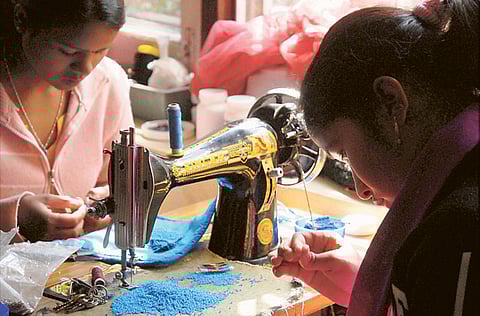
"Rescued girls are physically and emotionally scarred. They lack self-esteem and it takes them a while to reintegrate into society. We run two rehabilitation homes, one in Kathmandu and the other in Itahari. Besides receiving non-formal education, these women also undergo vocational training in knitting, sewing and jewellery-making for income generation. Women are also encouraged to set up their own enterprises and become self-reliant. Some of these girls have even remarried," Koirala said.
The legal arm of Maiti Nepal works from Kathmandu to ensure justice is done to the rescued women and girls. So far, Maiti Nepal has helped convict 496 traffickers.
"The judiciary hands down verdicts quicker now, which has made conviction an easier task," Koirala said.
Sonja Jeevan Kendra is a medical clinic serving the residents. And there are two hospices for survivors suffering from illness, including HIV and Aids. Some of them are emotionally scarred and even have to undergo psychotherapy. The Teresa Academy, started in 1998, provides education to children.
A new project titled NAANI (a term of endearment for girls in Nepalese) comprises young women posted in the vulnerable districts of Makwanpur, Nuwakot, Nawalparasi and Kavrepalanchowk. Trained at Maiti Nepal, these girls will work with the community at the grassroots level to raise awareness about this burning issue.
While hand-crafted products made by survivors generate revenue for the NGO, there are other sources of income as well, such as a guesthouse for tourists in Kathmandu, managed by rescued girls. Maiti Nepal also helps arrange treks, with accommodation available at the guesthouse. On the anvil are also plans to generate funds through corporate business activities.
But can Maiti Nepal be managed as efficiently in Koirala's absence? "While I am still proactive in the organisation, my staff, who have been with me since the beginning, form the second generation of leadership at Maiti Nepal," Koirala says.
"They are well experienced and capable of running Maiti Nepal even in my absence. I think I have paved the road for the second-generation leadership and the only thing they have to learn now is to walk properly."
About receiving government help, she says, "Truly speaking, we have not received any financial help from the Nepal government so far. However, we have got enough support from the Home Ministry, the Ministry of Women, Children and Social Welfare and the judicial system."
"Undoubtedly, this has been a formidable journey, hard and challenging," remembers the 61-year-old good samaritan.
"But there have been many times when I have felt discouraged. It is my faith in God that has kept me going. I believe service to mankind is service to God. I continued my work. I took awareness programmes to villages. Yes, there were bureaucratic problems, but I took them in my stride, considering them minor hurdles. Gradually, people became aware of us and our work. Most of them believed that Maiti Nepal was doing a good job. They welcomed us with open arms. "
"My girls feel fortunate," Koirala continued. "They were abandoned by their families and had nowhere to go. They feel being here is like being in their mother's home. For me the bond that I share with them is the driving force that spurs me on in my work."
Mythily Ramachandran is a writer based in Chennai, India.
Sign up for the Daily Briefing
Get the latest news and updates straight to your inbox


