Former peace negotiator comes home to Yaffa
Sha’ath shares fond memories of his early childhood in Yaffa before his family was forced to flee
Yaffa, 1948 areas: Though he has returned to the city of his childhood before, the former top peace negotiator for the Palestinians, Nabeel Sha’ath, said he had not seen his boyhood house in 20 years.
So he got a little lost, wandering about the ancient Mediterranean port, reminiscing about the scent of jasmine blossoms and salty air. “Smell it?” he asked, and stopped to breathe a memory.
“Maybe this way?” said the 77-year-old former adviser to Palestine Liberation Organization leader Yasser Arafat and the first minister of foreign affairs for the Palestinian Authority. “Just around the corner, I think.”
On Friday, as on each May 15, Palestinians commemorated “Nakba Day” - translated as “the catastrophe” - which marks the mass exodus of indigenous Palestinians from British Palestine during the war and upheaval that attended the birth of the State of Israel in 1948.
About 700,000 Palestinians either fled or were forced to flee, according to historians, and began lives of exile in a vast diaspora, even as Zionist newcomers celebrated the miracle of their return to biblical lands, to independence and safety in the aftermath of the Holocaust.
It is not news that the decades-long Israel-Palestinian conflict and the dueling narratives of 1948 remain unresolved. But the Nakba commemorations gave Sha’ath an excuse to take a walking tour through old Yaffa, now an Israeli city, trailed by a clutch of journalists wielding cameras and microphones.
It was a homecoming, sweet and bitter, but Sha’ath mostly smiled and appeared to enjoy the sunny day.
He seemed resigned to the idea that peace negotiations with the Israelis under the new government of Prime Minister Benjamin Netanyahu are a non-starter. “The worst government ever,” he said. “Never going to happen.”
On the eve of his election in March, Netanyahu vowed that there would never be a sovereign Palestinian state on his watch. He later said he meant the time isn’t right for peace talks now.
When Sha’ath and other Palestinians speak of Israel and the Nakba, they sometimes seem to go on autopilot, rehashing a script of well-known grievances, including the “right of return” for Palestinians who want to return to Israel. Sha’ath said he believes very much in that right, but on this day in Yaffa, he seemed more interested in looking for landmarks, excitedly pointing out storefronts, mosques and parks he remembered.
His father was the headmaster of a prominent secondary school for boys in this seaside city, Sha’ath explained, and so the family lived in a columnated two-story home with a lush garden and a fish pond.
There were orange groves at the edge of town, grassy medians and horse-drawn trolleys. The Al Hamra movie theatre was a virtual palace for him, he said, with its marble floors and miles of carpet, where he watched first-run movies from Cairo starring the Palestinian movie star Badr Lama. “My hero,” Sha’ath said.
The 1937 landmark theatre is now a Scientology centre.
“I was 8 years old when we left Yaffa for Alexandria,” in Egypt in 1947, Sha’ath said. His father had gotten in trouble not with the emerging Jewish state but with the British Mandate authorities, who accused him of fomenting unrest against the empire. A year later, in 1948, some 100,000 Palestinians fled Yaffa _many by sea,most never to return.
Yaffa was known then as “a city of foreigners, a multicultural city, an international city,” Sha’ath recalled. He spent his own life as an itinerant diplomat and scholar in Alexandria, Cairo, Philadelphia, Beirut, Gaza City and, now, Ramallah in the West Bank.
He stopped at the blue doors of the Tabeetha School, founded in 1863 by Scottish missionaries.
“This is where I went to school until I was 8 years old. It was Christians, Jews and Muslims all together, sitting side by side, boys and girls,” Sha’ath said. The security guard allowed him to step inside for a peek.
Today, the school is as diverse than ever, with 330 pupils of 40 different nationalities.
Sha’ath looked around at the old apartment houses and single-family villas, with their Arabesque touches and thick stone walls. “It is exactly the same!” he said.
But, of course, it is not. The imposing building that once housed the French lyce down the block is being renovated and offered as “Luxury Condominiums.”
Sha’ath turned down Nuzha Avenue, which was renamed Yerushalayim Avenue by the Israelis. An Arab Israeli on a bicycle recognized him and stopped to offer greetings. Yaffa today is about two-thirds Jewish and one-third Arab; the city is being rapidly gentrified and absorbed as a beach town of hip, entrepreneurial Tel Aviv.
As he walked toward his childhood home, Sha’ath recalled his years as a diplomat. He served as a Palestinian negotiator at eight major talks - Camp David and Wye River, among others - and across the table from teams sent by five Israeli prime ministers. Once or twice, he said, he felt a peace deal between Israel and the Palestinians was within reach, only to see it recede.
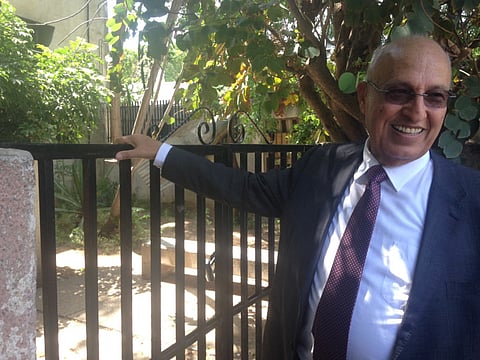
When he finally reached his old home, Sha’ath stood at the gate of a crumbling mansion. The first time he was allowed to return to see the house - with a military escort in 1994 - he said he wept on the sidewalk. Today he was beaming.
Years ago, the Israelis had allowed the house to be converted into a residential treatment centre for drug addicts. Now the place is in such sad disrepair that it is too dangerous to enter.
A security guard said the house was falling down - and mentioned that it was probably for sale.
The reporters asked Sha’ath if he wanted to make an offer, come full circle, come home? He didn’t seem very interested.


