Why Thailand and Cambodia are fighting again — and what’s behind the border conflict?
A collapsed ceasefire, disputed colonial-era maps and rising nationalism fuel clashes
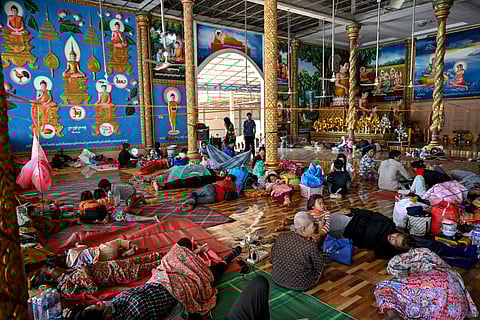
Dubai: A 150-day ceasefire between Thailand and Cambodia has collapsed into the region’s worst border fighting in years, reviving a century-old territorial dispute that neither diplomacy nor military power has fully resolved.
The latest clashes — which have now left at least 10 people dead and forced over 140,000 civilians to flee — include Thai airstrikes, artillery fire and Cambodian accusations of fresh landmines.
They erupted just months after a Trump-backed peace agreement promised de-mining, withdrawal of heavy weapons and prisoner releases along the 800-km frontier.
None of those commitments were fully implemented. The crisis, rooted in colonial-era maps, competing temple claims and unresolved International Court of Justice rulings, has been inflamed by nationalism and online propaganda. With fighting spreading to new border sectors at the peak of the tourism season, experts warn that without real demarcation and neutral monitoring, Southeast Asia’s longest-running territorial grievance will continue sliding back into violence.
Here are the latest developments and their impact:
What’s going on now
On December 8, 2025, tensions flared as Royal Thai Army launched airstrikes along the border with Cambodia, following a clash that killed a Thai soldier — the heaviest fighting since the July ceasefire.
The clash came soon after a fragile truce, brokered in part by Donald Trump (with mediation help from Malaysia), collapsed.
Both militaries accuse the other of provoking the violence: Thailand says Cambodia laid land-mines and fired first; Cambodia denies the charge and claims Thai airstrikes targeted civilians.
The renewed fighting triggered massive disruption: Hundreds of thousands of civilians evacuated, border crossings shut down, and trade — tourism included — under severe risk.
Why this dispute keeps resurfacing — a long and complicated history
Colonial maps and conflicting claims
The root of the conflict lies in a 1907 map drawn when Cambodia was part of French Indochina. That map tried to define the border for both the then-Siam (Thailand) and French Cambodia.
Thailand later challenged the map’s accuracy, arguing that the border should follow natural watershed lines (e.g. the Dangrek Mountains), not the colonial-era drawing.
The contested heritage of historic temples
Key flashpoints include ancient Hindu/Khmer-era temples like Preah Vihear Temple and nearby border sites such as Ta Muen Thom Temple or hills like Phnom Trap / Phu Makuea. These sites hold cultural and national significance for both countries.
In 1962, the International Court of Justice (ICJ) awarded sovereignty over Preah Vihear to Cambodia — a decision reaffirmed in 2013. But the verdict didn’t neatly demarcate surrounding territory, leaving many buffer zones undefined and disputed.
Nationalism, political narratives, and shifting power
Since the early 2000s, border claims (especially over temples) have been periodically resurrected by nationalistic and political forces in both countries. Skirmishes from 2008–2011 were largely driven by such sentiment.
Contemporary political turbulence — internal rivalries, shifting alliances, domestic instability — makes border disputes easy leverage for governments to rally support through nationalist rhetoric. The Diplomat+2IISS+2
Why the July–December 2025 flare-up happened
Ceasefire breakdown: The July 2025 ceasefire, though brokered internationally, remained fragile. Neither side fully implemented agreed terms like de-mining, withdrawal of heavy weapons, or release of detained soldiers — creating persistent mistrust.
Landmines and mutual accusations: Recent landmine incidents injured Thai troops, which Bangkok blamed on Phnom Penh — Cambodia denied involvement. This triggered Thailand’s return to heavy-handed response including airstrikes.
Strategic and symbolic stakes: Control over border highlands, historical temples and border villages offers strategic depth — not just territory but national pride. Losing them is politically and militarily costly for both governments.
Wider impact: Economics, diplomacy & regional stability
Mass displacement & humanitarian crisis: Thousands of civilians from border communities have been evacuated multiple times this year, undermining local livelihoods and creating refugee-like instability.
Economic disruption: The disruption of cross-border trade, agriculture, tourism and local commerce — border regions depend heavily on these — threatens growth, particularly for Cambodia’s already fragile economy.
Geopolitical strain: The conflict complicates regional dynamics: alliances, regional trade, foreign investment, and diplomatic ties — especially as global powers like the US and China jockey for influence in Southeast Asia.
Cultural and heritage risk: Ancient temples and historical sites — shared heritage of Southeast Asia — now risk damage or abandonment. That undercuts long-term tourism potential and erodes cultural identity for border communities.
Why peace remains elusive — and what needs to be done
Unresolved demarcation: The border is still not fully demarcated even after decades of treaties and agreements, so any flashpoint can erupt into violence.
Nationalism over compromise: For many political leaders on both sides, conceding territory — even small buffer zones — can be seen as a betrayal of national identity, making diplomatic compromise politically risky.
Lack of trust and verification: Past ceasefires failed because neither side trusted the other to honour commitments — especially on disarmament, de-mining, prisoner release, and border monitoring.
Need for sustained international and regional mediation: Experts argue that only a combination of neutral third-party oversight (e.g. via ASEAN, UN) and joint heritage-based border commissions can address the root causes — not just military or political fixes.


