Pakistan tense on showdown fears
Newspapers highlight unease as army and chief justice try to allay worries
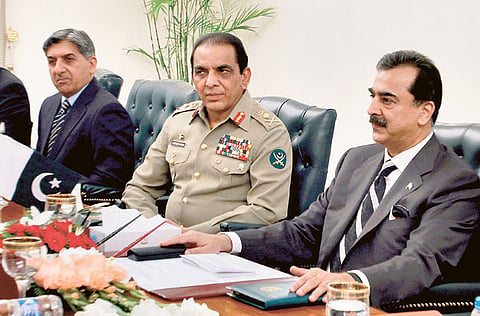
Islamabad: Pakistan's powerful military pledged on Friday to continue supporting democracy, reiterating it was not planning a takeover as tensions grew over a controversial memo alleging an army plot to seize power.
At the same time, President Asif Ali Zardari's spokesman said Zardari had resumed duties after returning from medical treatment in Dubai and has no intention of leaving over the scandal, which has raised tensions and undermined the already deeply unpopular president.
An army statement quoted military chief General Ashfaq Kayani as telling troops the military will continue to support democracy in Pakistan and that any talk the army was planning to take over was "speculation".
Many Pakistanis wonder whether Zardari can survive the crisis, and speculation has been growing the powerful generals will try to oust him somehow. The tension is a worrying sign for the region and for Pakistan's uneasy relationship with its key ally, the United States.
The United States wants political stability in Pakistan so that Islamabad can help fight militancy and aid Western efforts to stabilise Afghanistan.
Zardari, known for his resilience in the face of pressure, plans to stay in Pakistan, said his spokesman.
"He is performing his usual work. There is no truth in the reports that the president will leave the country after December 27. He is here in Pakistan and he has come to stay," Farhatullah Babar said.
Zardari is expected to address a rally on December 27 on the fourth anniversary of the assassination of his wife, former prime minister Benazir Bhutto.
Pakistan's top judge earlier moved to allay fears of a possible military coup as tensions rose.
"There is no question of a takeover. Gone are the days when people used to get validation for unconstitutional steps from the courts," Supreme Court Chief Justice Iftikhar Chaudhry said.
Unease
The Supreme Court is looking into a petition demanding an inquiry into what has become known as "memogate". Kayani, arguably the most powerful man in the country, has called for an investigation into who may have been behind the memo.
Newspaper editorials yesterday highlighted unease in the nuclear-armed South Asian nation, predicting a showdown between Zardari and his allies and the military, which is so influential it has been described as a state within a state.
"A spectre is haunting Pakistan — the spectre of a clash between the army and the government that threatens to turn fatal," said an editorial in The News.
Businessman Mansour Ijaz, writing in a column in the Financial Times on October 10, said a senior Pakistani diplomat had asked that a memo be delivered to the Pentagon with a plea for US help to stave off a military coup in the days after the raid that killed Al Qaida leader Osama Bin Laden in May.
Ijaz later identified the diplomat as Pakistan's ambassador to Washington, Hussain Haqqani, a Zardari ally who denied involvement but resigned over the controversy.
The military faced unprecedented public criticism over the Bin Laden raid, widely seen as a violation of sovereignty.
Briefing cancelled
But many Pakistanis rallied around the army after a November 26 air attack by US forces in Afghanistan mistakenly killed 24 Pakistani soldiers on the border. The memo has also helped boost the army's image at the expense of the government.
Later yesterday, a Pakistani official said a planned briefing by the head of US Central Command, General James N. Mattis, to explain the incident to Pakistani leaders had been cancelled.
Zardari's government has become increasingly unpopular since he took office in 2008. It has failed to tackle myriad problems, from crippling power cuts to suicide bombings and a struggling economy.
The army is fed up with Zardari and wants him out of office, although through legal means and without a repeat of the coups that are a hallmark of the country's 64 years of independence, military sources told Reuters on Thursday.
"Tempers are flaring, there is no doubt about that. However, there are efforts to pacify the situation as well. And I hope they work, as under the current scenario, it is fast becoming a recipe for a head-on collision," he said.


