Pakistan, China ink $7 billion deals as Sharif pushes investment drive
Sharif says Islamabad and Beijing must work together for regional peace
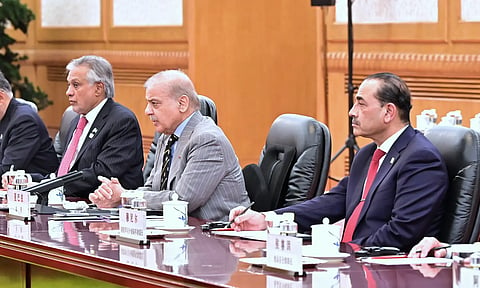
Dubai: Pakistan Prime Minister Shehbaz Sharif has urged closer strategic coordination between Pakistan and China to promote regional peace and expand economic cooperation, as the two countries signed multiple agreements and memorandums of understanding during high-level talks in Beijing.
The discussions came during Sharif’s four-day official visit to China, where Pakistani and Chinese companies signed agreements and MoUs worth more than $7 billion across sectors including information technology, agriculture, energy, climate cooperation and industrial development.
‘Really be together’
Speaking during delegation-level talks with Chinese Premier Li Qiang at the Great Hall of the People, Sharif said Pakistan and China needed to “really be together” in efforts to restore stability in the Middle East amid ongoing regional tensions and the US-Israel conflict.
“The world is passing through a very critical moment,” Sharif said, warning that instability in the Gulf was affecting both regional and global economies.
Pakistan’s Chief of Defence Forces and Chief of Army Staff Asim Munir also attended the meeting after concluding a visit to Iran, where Pakistan has been engaged in diplomatic efforts aimed at reducing tensions between Tehran and Washington.
Sincere role
Sharif said Pakistan had played a “very sincere role” in mediating between the United States and Iran, adding that Munir had held extensive engagements with both Iranian and American leaderships.
“We hope and pray that peace will be restored forever,” the premier said, while thanking Chinese President Xi Jinping for Beijing’s support for regional peace initiatives and ceasefire efforts.
The visit also focused heavily on expanding economic ties under the China-Pakistan Economic Corridor (CPEC) framework and attracting Chinese investment into Pakistan’s industrial and technology sectors.
Win-win model
At a Pakistan-China Business-to-Business Investment Conference in Hangzhou, Sharif invited Chinese companies to relocate industries to Pakistan and establish joint ventures with local firms, calling the arrangement a “win-win model” for both countries.
He said rising labour costs in China had created opportunities for industries such as textiles, leather and manufacturing to shift operations to Pakistan, where production costs remained competitive.
“Chinese companies can bring plant and machinery, enter into joint ventures with Pakistani entrepreneurs, manufacture goods and export to third countries,” Sharif said.
Mineral reserves
The prime minister also highlighted Pakistan’s vast mineral reserves, agricultural potential and growing information technology sector, while promoting special economic zones designed to attract foreign investors.
He announced that Pakistan was developing a 6,000-acre special economic zone in Karachi with modern infrastructure and one-window operations aimed specifically at facilitating Chinese businesses.
“We are looking for expertise, experience and investments and not loans, not aid, not handouts,” Sharif said, stressing Pakistan’s focus on sustainable economic partnerships.
MoUs
Among the major agreements signed during the visit was a $1.12 billion deal between China’s Haolu Engineering and Technology Company Limited and Pakistan’s Fauji Fertilizer Company for fertiliser production.
Another $100 million MoU was signed between IBI Beijing United Information Technology Company and RIC for cooperation in agrochemicals, agricultural machinery and the establishment of a regional office in Multan.
According to Pakistani officials, more than 200 agreements and MoUs worth over $20 billion have been signed during a series of Pakistan-China business conferences held in recent months.
Separately, Pakistan and China signed 15 additional cooperation documents covering trade, investment, agriculture, climate change, education, media, science and technology, as well as people-to-people exchanges.
The agreements included cooperation on environmental protection, counterterrorism equipment, documentary co-production, human resource development and agricultural exports, including protocols for dried fruits, nuts and maize exports to China.
CPEC
Both sides also agreed to accelerate the next phase of CPEC, focusing on industrialisation, digital transformation, clean energy, agriculture and advanced technologies such as artificial intelligence and space cooperation.
Sharif said the selection of Pakistani astronauts for China’s space station programme reflected the growing strategic depth of bilateral ties.
The Pakistani premier described the relationship between Islamabad and Beijing as an “iron-clad friendship” rooted in mutual trust and decades of cooperation, as both countries mark 75 years of diplomatic relations this year.