25 million Pakistani children still out of school: Report
Report blames poor governance, low funding and weak implementation for deepening crisis
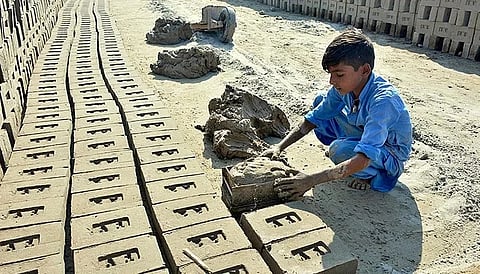
Dubai: More than 25 million children remain out of school in Pakistan more than two years after the country declared a National Education Emergency, with a major policy review concluding that weak governance, poor funding and repeated failures in implementation continue to deny millions their constitutional right to education.
The comprehensive review, prepared by Pakistan’s Civil Services Academy (CSA), says the country’s education crisis is no longer caused by a lack of policies but by the state’s inability to implement them effectively. Despite detailed provincial roadmaps and constitutional guarantees of free and compulsory education under Article 25-A, progress has remained slow.
According to the report, quoted by Geo News, between 25.1 million and 26 million school-age children are currently out of school, making Pakistan home to the world’s second-largest out-of-school population, according to UNICEF assessments cited in the study.
The report says decades of rapid population growth, poverty, weak institutions and consistently low public investment in education have steadily expanded the number of children excluded from classrooms.
Provincial disparities
Punjab has the largest burden in absolute numbers, with 9.6 million to 10.4 million children out of school. Of these, 6.4 million have never enrolled, while 3.16 million dropped out, indicating that retaining students has become as serious a challenge as enrolling them.
The report says rural Punjab continues to lag behind urban areas, with South Punjab emerging as the worst affected region. Rajanpur records an out-of-school rate of 48 per cent, followed by Dera Ghazi Khan (46 per cent) and Muzaffargarh (45 per cent). It estimates Punjab needs 35,000 additional middle and secondary classrooms to meet demand.
Report highlights
25.1-26 million children remain out of school
Pakistan has the world’s second-largest out-of-school population
Punjab: Up to 10.4 million children out of school
Sindh: 7.4 million out of school, including 4.1 million girls
KP: Around 4.9 million children out of school
Balochistan: 45% of children remain outside schools
Education spending remains below 1% of GDP
Report calls for a National Student Registry, governance reforms and higher investment
Sindh’s crisis is described as structurally different. While many children enrol in primary school, a severe shortage of middle and secondary schools causes massive dropouts. The province has 7.4 million out-of-school children, including 4.1 million girls, with floods in recent years further damaging thousands of schools.
Khyber Pakhtunkhwa has around 4.9 million out-of-school children, largely because of difficult terrain, security challenges and a shortage of female teachers, particularly in the merged districts.
Balochistan remains the country’s most structurally disadvantaged province. Although the out-of-school rate has fallen from 69 per cent in 2023 to 45 per cent in 2025, many schools remain non-functional and basic facilities are lacking. Nearly 80 per cent of schools lack electricity, while girls account for 78 per cent of out-of-school children in the province.
Funding remains a major obstacle
The report highlights chronically low spending on education as a key reason for the crisis.
Pakistan’s education expenditure remains well below international benchmarks, while much of provincial education budgets is spent on salaries rather than improving schools. Sindh allocates nearly 90 per cent of its education budget to salaries and administration, while Balochistan spends 81 per cent on the same heads.
The review warns that simply increasing funding will not solve the crisis unless governance and accountability are also strengthened.
Key recommendations
The CSA report recommends creating a National Student Registry linked to Nadra’s B-Form database to enable real-time tracking of enrolment, attendance and dropouts across Pakistan.
It also calls for integrating formal and non-formal education databases, expanding double-shift schools in densely populated areas, strengthening climate-resilient school infrastructure and introducing performance-based funding tied to enrolment and learning outcomes rather than administrative expenditure. The report further recommends financial incentives to attract more female teachers to remote districts.
Education experts quoted in the report argue that Pakistan has repeatedly declared education emergencies without following them up with meaningful reforms.
Education economist Dr Faisal Bari says education spending has fallen to below one per cent of GDP, far below the 4 per cent benchmark recommended by the United Nations. He also points out that of every 100 children entering school, only eight to 10 eventually reach university, highlighting the country’s severe dropout problem.
The report concludes that unless Pakistan undertakes structural reforms in governance, financing and accountability, the National Education Emergency risks remaining little more than a symbolic declaration while millions of children continue to be denied an education.


