Mob fury stands in way of resolving power crisis
Theft, default on payments and abuse by residents a worry
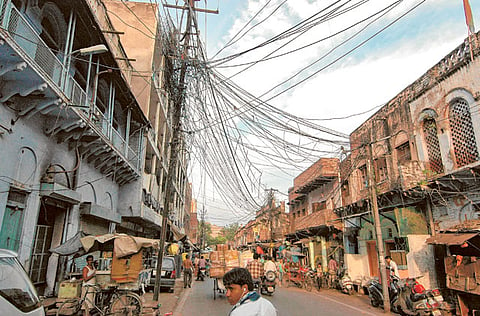
New Delhi: It is rough being an employee of Torrent Power Ltd in the Indian city of Agra. Furious residents regularly take staff of the power distributor hostage or beat them up, stone-throwing mobs besiege the firm’s high-walled compound, and one official recently had to be hospitalised after he was hit in the head with a brick.
On some days there are more than 10 protests staged around the city against Torrent, which won the franchise to supply power to Agra in 2009. When it took over, rampant theft and a failure by authorities to crack down on defaulters meant that 70 per cent of electricity consumed in the city was not paid for.
But Torrent’s efforts to make customers pay have triggered a city-wide backlash and a storm of claims that it over-charges, uses heavy-handed tactics against defaulters and deliberately curbs the number of hours of electricity a day to save money.
“Torrent is cheating people and that has made them angry,” said Ram Shankar, the member of parliament for Agra, who says he receives up to 15 complaints a day from constituents unhappy about the penalties. “If they don’t attend to people, they will be beaten up.”
The company’s defence — that it inherited a ramshackle network suffering from years of under-investment and that the blackouts are beyond its control — has fallen on deaf ears.
Torrent’s woes in Agra, home to the country’s most famous monument, the Taj Mahal, illustrate how India’s efforts to modernise its economy are often thwarted by local politics that feed on fear of change.
It is also a cautionary tale for the Indian government, which has unveiled a bailout plan for debt-ridden electricity distribution companies — most of which are owned by states — and made it a condition for them to look at adopting the distribution franchise model to help slash massive losses.
Torrent’s experience highlights the perils for companies hoping to benefit from the privatisation drive, as well as the challenges facing India as it grapples with chronic energy shortages that stand in the way of its ambitions to become a global economic power.
The electricity distribution companies are at the heart of the power crisis and were blamed for one of the world’s worst blackouts in late July, when three of India’s five transmission grids collapsed, cutting electricity to states where 670 million people live — more than half the country’s population.
The companies have racked up losses of more than $46 billion (Dh169 billion) because of unrestrained power theft, leakage from a poorly maintained network and state governments’ reluctance to raise tariffs to meet higher generation costs. Politicians fear a revolt by voters, many of whom view free electricity as a right.
If tariffs had risen in line with other household expenses over the five years to March 2010, the distributors would have turned a profit of 100 billion rupees instead of an aggregate loss of Rs873 billion over the same period, according to CRISIL, the India unit of rating agency Standard & Poor’s.
Getting support
Privatisation, in particular the franchise model, is seen by many as key to solving the crisis. But as Torrent’s experience in Agra shows, it is hugely risky and a hard way to make money.
To succeed means upending a deep-rooted culture of non-payment and getting the support of populist-leaning state governments, according to dozens of government officials, company owners, politicians and industry analysts interviewed by Reuters.
Private power companies that dare to venture in face a complex web of political patronage and deep-rooted corruption involving shady middlemen who organise illegal hookups to power-lines, pay government officials to settle bills for smaller amounts and, for a fee, will keep creaky transformers running.
“To bring about privatisation requires enormous political will,” said Torrent Director Murli Ranganathan during a Reuters visit to the company’s office complex in Agra. “Without political will, without administrative support you will not be able to convert this model into success.” On the face of it, media-shy Torrent seems to be acutely aware of the political environment in which it operates.
It was the biggest single corporate donor to the Congress party and the Bharatiya Janata Party between 2003-2011, according to an analysis of named donations to political parties by the Association for Democratic Reforms (ADR), a non-governmental group that campaigns for transparency in politics.
Torrent Power, which has a market capitalisation of $1.5 billion, is headquartered in Gujarat state and is perceived by opposition politicians there as being close to Chief Minister Narendra Modi, a BJP leader who is viewed as a strong contender to become the next prime minister.
Ranganathan sounded frustrated that things were not going according to plan in Agra, in Uttar Pradesh state, and said he was pushing the local government to set up special police stations and courts dedicated to prosecuting electricity theft.
Similar set-ups in the states of Gujarat and Maharashtra had proven successful, he said.
“Once people understand the fruits of privatisation ... they are going to latch onto it,” said Ranganathan.


