Women run in droves, but path narrows
The increase in the number of female candidates tilts largely toward Democrats
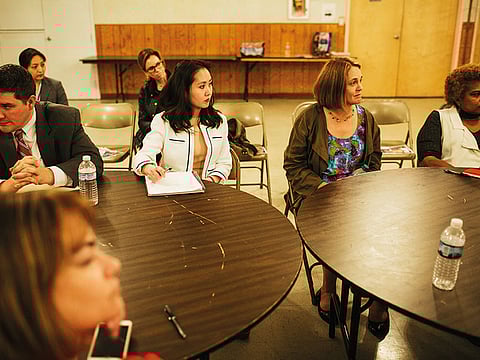
ARDMORE, Pa. — Just as the women’s marches and #MeToo helped define 2017, the surging numbers of female candidates have defined the midterm races now underway. Yet for all that, the November elections may not produce a similar surge in the number of women in Congress.
More than half the female candidates for House and Senate seats are challenging incumbents, who historically almost always win; there were far more wide-open races in 1992’s so-called Year of the Woman, which doubled the number of women in Congress. A large percentage of the women now running for open seats are in districts that favour the other party. And many female candidates are clustered in the same districts, meaning many will be eliminated in this spring and summer’s primaries.
Last Tuesday’s primary elections in Ohio, West Virginia, Indiana and North Carolina help illustrate the steep path. Two women ran for the Senate, both were long shots, and both lost. In House races, 27 women won — more than half. But 16 will challenge incumbents in November, 15 of them in districts firmly favouring their opponents.
The increase in the number of female candidates tilts largely toward Democrats — at the start of this year, the number of Democratic women seeking House seats was up 146 per cent from the same point in 2016; among Republicans, it was up 35 per cent. And many of the women have less experience in government and politics than those who ran for Congress in the past.
“While we are encouraged by the energy and the enthusiasm and the engagement of women, I think we also at the same time have to be cognizant of the fact that many of these women, even when they win their primary, will be running very tough races in November,” said Debbie Walsh, director of the Center for American Women and Politics at Rutgers University.
“We are not going to see, in one cycle, an end to the underrepresentation of women in American politics that we’ve seen for 250 years,” she said. “The concern is we need this energy and engagement to be here for the long haul. This is a marathon, not a sprint.”
The race here in Pennsylvania’s newly drawn 5th Congressional District, which includes South Philadelphia and the mostly affluent bedroom communities of Delaware County, shows both the energy of women in the midterms and why this election may not be a repeat of 1992.
Six women are running in the Democratic primary this Tuesday — more than in any other congressional district in the country. The local political news of the past year has increased the urgency among many party officials and voters to elect a woman. The incumbent in the seat, Rep. Patrick Meehan, announced in January that he would not seek re-election after revelations that he used taxpayer money to settle a sexual harassment complaint brought by a former aide. A state legislator who had been considered a front-runner for the seat abandoned his run after former staff members accused him of inappropriate touching and sexual jokes. And a state legislator representing much of the district has refused calls to resign after another lawmaker, a former girlfriend, obtained a restraining order against him, accusing him of assault.
There are no women in Pennsylvania’s 20-member congressional delegation. And the state Legislature ranks among the bottom for representation of women, hitting 19 per cent this year.
“Afghanistan is 19 per cent,” said Mary Gay Scanlon, one of the Democrats in the congressional race, milling between potential voters at a meet-and-greet at the home of a Democratic committeewoman on a recent Saturday morning.
But party officials worry that the six female candidates, who are largely aligned on the issues, will split the vote and hand the nomination to one of the two well-funded male candidates — one a longtime state legislator, the other a labour-backed former deputy mayor of Philadelphia.
With days to go in the race, one of the women, Molly Sheehan, said last week that the state legislator, Greg Vitali, had asked her to drop out and endorse him. Sheehan, a bioengineer at the University of Pennsylvania who has outraised Vitali and has the support of several resistance groups, argued that he would not have made a similar request of a man. (He said he had.)
Even those who dismiss the notion that women vote only for women and men for men say that with 10 candidates in the race, someone could win with a relatively small percentage of the vote. At a hard-fought Delaware County endorsement meeting recently — about 500 committee members voting in four rounds — no candidate secured the 55 per cent to win.
Republicans, meanwhile, have endorsed a woman, Pearl Kim, a daughter of South Korean immigrants and a former county prosecutor and deputy state attorney general who could appeal to the well-educated women who have long been considered swing voters in the suburbs of Philadelphia.
“I honestly feel the men who stepped in are out of line,” said Rachel Amdur, vice chairwoman of the Haverford Democratic Committee, which has stayed neutral in the race. “This is what women do, women recognise it’s not their year all the time. Men do not.”
“The drivers of the Democrats are women,” she said. “It makes me crazy that when it comes to voting, people say, ‘Oh, we’ve got to have the man.’”
Nationally, 422 women are still in the running for House seats, according to the Centre for American Women and Politics, including some women who have not officially filed.
Of those House candidates, 55 per cent are challenging incumbents, and 29 per cent are running for open seats. In the Senate, 49 women are running — 55 per cent as challengers and 18 per cent for open seats.
Women are starting from a deficit when it comes to representation in the House because an unusually high number of incumbent women are retiring or leaving to run for other offices — 13, or a little over 15 per cent of the 84 women now serving. Adding in the death of Louise Slaughter, D-New York, at least 15 new female candidates will have to be elected to beat the current number of women in office; that many have not been elected since 2012.
But there has also been a similar surge in the number of men running — meaning that women still make up less than a quarter of all candidates running for the House of Representatives, up just slightly from the last election cycle.
Those who warn about a wave of women’s losses in November say they do so to temper expectations, not to discourage women from seeking office.
“I think we have to celebrate the stories of women who have put themselves out there,” said Erin Loos Cutraro, founder of She Should Run, a non-partisan group aimed at getting more female candidates. “And be prepared that a number of them will lose and also remind people that is not the end of the story, it is the beginning of the story.”


