What is an executive order? Can Trump’s orders be overturned?
Some of his orders deliver on promises, others like withdrawal from WHO were unexpected
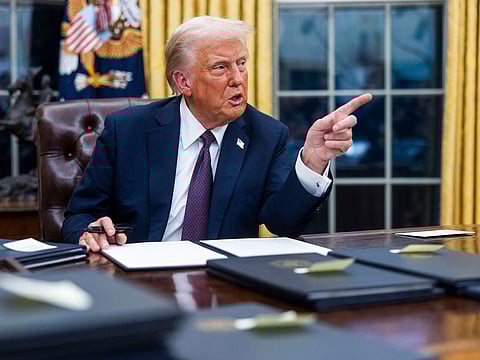
Dubai: On the first day of his new term, President Donald Trump signed executive orders ranging from climate to immigration, along with sweeping pardons for many of those who stormed the capital on January 6, 2021.
Some of his orders delivered on promises he made during the 2024 campaign. Others, like a withdrawal from the World Health Organization (WHO), had not been expected.
What is an executive order?
One of the most common presidential documents in the US government is an executive order.
They are numbered sequentially, with more than 14,000 having been issued since George Washington took office in 1789.
An executive order is a signed, written, and published directive from the President of the United States that manages operations of the federal government.
They are not legislation as they require no approval from Congress, and Congress is not able to simply overturn them.
Why do president’s issue them?
The reasons can range from wars to domestic crisis. In February 1942, President Franklin D Roosevelt signed an executive order that led to the creation of detention centres for about 120,000 Japanese Americans.
In 1952 President Harry Truman issued an order that put the steel industry under the control of the government in an attempt to avoid a strike.
On his first day in office on 20 January, 2021, Biden signed an order beginning the process of re-joining the 2015 Paris climate agreement, from which his predecessor Trump formally withdrew.
Who can overturn an executive order?
Only a sitting US President can overturn an existing executive order by issuing another executive order to that effect.
Produced by the executive branch of the US government, executive orders can be seen as controversial legal documents as they are in effect “instant law”.
Can a court rule on an executive order?
An executive order has to work within the confines of the law, with, in theory, each one “reviewed by the Office of Legal Counsel for form and legality”. This does not always happen.
If an order is deemed to stray outside the boundaries of what is acceptable, it can be subject to a legal review.
Courts may strike down executive orders not only on the grounds that the president lacked authority to issue them but also in cases where the order is found to be unconstitutional in substance.


