What happens next in Canada and who will replace Trudeau?
Here’s a look at the scenarios after Trudeau’s resignation
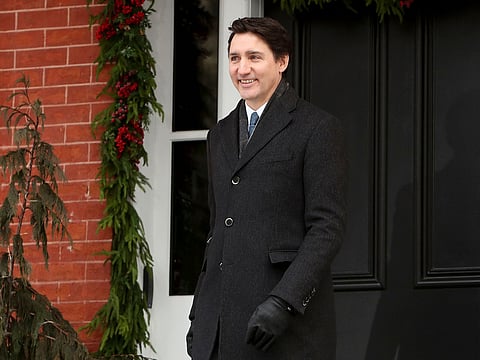
Dubai: Canada’s Prime Minister Justin Trudeau resigned on Monday after more than nine years in power.
He bowed out due to sagging approval numbers and a rebellion within his political party.
Trudeau, 53, currently the longest-serving leader of any Group of 7 country, will remain prime minister until a new leader is selected.
Here’s a look at what happens next and who is likely to replace him.
Who is Justin Trudeau?
Justin Trudeau, son of former PM Pierre Trudeau, became Canada’s prime minister in 2015 at the age of 43, after his Liberal Party won a strong parliamentary majority.
Trudeau was savvy with social media and enjoyed a long political honeymoon after his election. In 2017, Trudeau came under pressure to stand up to Donald Trump, the newly elected US president. As Trump restricted immigration, Trudeau restated Canada’s openness to asylum seekers, proclaiming, “Diversity is our strength.”
During his time in office, Trudeau prioritised climate change and reconciliation with Indigenous people.
In 2019, the Liberals maintained their hold on power with Trudeau as their leader, but by a narrower margin, and they failed to secure a majority in Parliament.
During the pandemic in 2020, Trudeau became the first Group of 7 leader to isolate himself, after his wife, Sophie Trudeau, tested positive for Covid-19.
Voters returned him to office in 2021, but the Liberals failed again to win a majority in parliament. Trudeau has since faced intense criticism from the Conservative opposition for some of his pandemic and recovery policies. He announced his resignation on Monday.
What happens next?
Trudeau will stay on as prime minister and head of the ruling Liberal party for now. In Canada, party leaders are chosen by special leadership conventions that can take months to organise.
Will an election be held soon?
No. Trudeau announced that parliament - which had been due to resume work on January 27 - would instead be prorogued, or suspended, until March 24.
What does it mean to prorogue Parliament?
Prorogation ends the current session of Parliament without dissolving it, which essentially halts all parliamentary business. The Governor General, the official head of state as King Charles’ representative, takes the action to prorogue Parliament, at the request of the Prime Minister.
While Parliament is prorogued, the activities of the legislative branch are paused, but the rest of the government continues to function.
Can the opposition bring down the government now?
Opposition parties who had originally planned to unveil no-confidence motions to bring Trudeau’s minority government down will have to wait until May as the government controls the agenda for most of each session.
If all the opposition parties vote together on the motion, the Liberals will be defeated and a new election called.
As a result, a new election is unlikely to be held before May at the earliest.
Parliament is scheduled to start its summer break no later than June 20 and if the Liberals are still in power by then, an election would be held as scheduled at the end of October.
How else could the Liberals be removed from power?
Under the original parliamentary calendar, the House of Commons elected chamber had been due to vote on spending measures in late March. This would trigger a confidence vote.
It is unclear whether that vote would still be scheduled for late March. Also, if this is the case, it is not sure whether the opposition parties would vote to bring down the Liberals. The Conservatives, who are favoured to win the next election, and the left-leaning, small New Democratic Party have both made clear they want to defeat Trudeau on a formal motion of no-confidence that they themselves have presented.
The Liberals could also be brought down over their annual budget, which would most likely be unveiled in April.
By when should the party choose a new leader?
The party is likely to announce a shortened contest designed to ensure that Trudeau’s replacement is in office as soon as possible.
When Trudeau won the Liberal leadership in April 2013, the contest lasted five months. In 2006, it lasted almost eight months.
Trudeau said he had asked the party to start the process of choosing a new leader.
Would a new leader help the Liberals avoid defeat?
Polls strongly indicate that the Liberals will lose the election, no matter who the leader is. But the scale of the defeat could change if Trudeau is not in charge.
Who are the leaders in the fray to replace Trudeau?
Chrystia Freeland
No member of the cabinet was as tightly connected to Trudeau as Freeland, 56, who spent her entire term in high-profile posts - trade minister, foreign affairs minister and finance minister. She was also deputy prime minister. She enjoys higher name recognition among voters than most other potential candidates.
Mark Carney
Mark Carney grew up in Alberta and was educated at Harvard and Oxford - just like Chrystia Freeland. In fact, he’s the godfather of her son.
Carney, 59, has never run for political office. But he has become a player in Liberal Party politics.
Dominic LeBlanc
LeBlanc is a parliamentary veteran first elected in 2000. His ties to the Trudeau family go back to childhood: in the 1970s, LeBlanc’s father was a minister in the cabinet of Pierre Trudeau. He has become Trudeau’s closest remaining ally in cabinet, a fact underscored by his sudden promotion to finance minister after Freeland’s resignation.
Melanie Joly
After starting her career as a lawyer and a stint in public relations, Joly plunged into Quebec politics, running for mayor of Montreal in 2013. After stints in other minor cabinet posts, she was promoted to foreign minister in October 2021 after Trudeau’s third election win.
Francois-Philippe Champagne
Champagne became trade minister in 2017 and joined Freeland in tangling with the first Trump administration on tariffs. That earned him a stint as foreign minister from 2019 to 2021. He’s now minister of innovation, science and industry.
Anita Anand
Anita Anand jumped into politics in 2019 and represents the wealthy Toronto suburb of Oakville. Trudeau appointed her minister of public services and procurement, becoming the first Hindu cabinet minister in Canadian history. Anand was thrust into the spotlight during the coronavirus pandemic as the government scrambled to get masks, protective equipment and vaccines. In October 2021 she was made defence minister and in 2023, Anand was made president of the Treasury Board.


