Trump’s top economic aide to resign after tariff dispute
Cohn will join a string of recent departures by senior White House officials, including Trump’s communications director and a powerful staff secretary
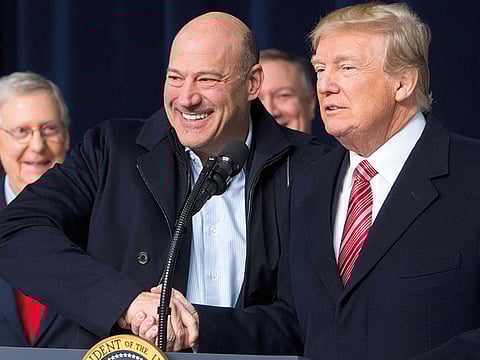
Washington: Gary D. Cohn, President Donald Trump’s top economic adviser, said on Tuesday that he would resign, becoming the latest in a series of high-profile departures from the Trump administration.
White House officials insisted that there was no single factor behind the departure of Cohn, who heads the National Economic Council. But his decision to leave came as he seemed poised to lose an internal struggle over Trump’s plan to impose large tariffs on steel and aluminium imports. Cohn had warned last week that he might resign if Trump followed through with the tariffs, which Cohn had lobbied against internally.
“Gary has been my chief economic adviser and did a superb job in driving our agenda, helping to deliver historic tax cuts and reforms and unleashing the American economy once again,” Trump said in a statement to The New York Times. “He is a rare talent, and I thank him for his dedicated service to the American people.”
High-level White House departures
Cohn is expected to leave in the coming weeks. He will join a string of recent departures by senior White House officials, including Trump’s communications director and a powerful staff secretary.
Yet the departure of Cohn, a free-trade-oriented Democrat who fended off a number of nationalist-minded policies during his year in the Trump administration, could have a ripple effect on the president’s economic decisions and on the financial industry.
It leaves Trump surrounded primarily by advisers with strong protectionist views who advocate the types of aggressive trade measures, like tariffs, that Trump campaigned on but that Cohn fought inside the White House. Cohn was viewed by Republican lawmakers as the steady hand who could prevent Trump from engaging in activities that could trigger a trade war.
Markets rattled
Even the mere threat, last August, that Cohn might leave sent the financial markets tumbling. On Tuesday, news of Cohn’s announcement rattled markets, and trading in futures pointed to a decline in the US stock market when it opened on Wednesday.
In a statement, Cohn said he had been pleased to work on “pro-growth economic policies to benefit the American people, in particular the passage of historic tax reform.” White House officials said that Cohn was leaving on cordial terms with the president and that they planned to discuss policy even after his departure.
Cohn’s departure comes as the White House has been buffeted by turnover, uncertainty and internal divisions and as the president lashes out at the special counsel investigation that seems to be bearing down on his team.
A host of top aides have been streaming out the White House door or are considering a departure. Rob Porter, the White House staff secretary and a member of the inner circle, resigned after spousal abuse allegations. Hope Hicks, the president’s communications director and confidante, announced that she would leave soon. In recent days, the president has lost a speech writer, an associate attorney general and the North Korea negotiator.
Others are perpetually seen as on the way out. John F. Kelly, the chief of staff, at one point broached resigning over the handling of Porter’s case. Lt. Gen. H.R. McMaster, the national security adviser, has been reported to be preparing to leave. And many officials wonder if Jared Kushner, the president’s son-in-law and senior adviser, will stay now that he has lost his top-secret security clearance; the departure of Cohn further shrinks the number of allies Kushner and his wife, Ivanka Trump, have in the White House.
More than 1 in 3 top White House officials left by the end of Trump’s first year and fewer than half of the 12 positions closest to the president are still occupied by the same people as when he came into office, according to a Brookings Institution study.
‘Revolving door’
Cohn’s departure will bring the turnover number to 43 per cent, according to updated figures compiled by Kathryn Dunn Tenpas of the Brookings Institution.
For all the swings of the West Wing revolving door during the last year, Cohn’s decision to leave struck a different chord for people. Cohn is among the most senior officials to resign to date.
Trump’s announcement last week that he would levy tariffs on aluminium and steel imports was the most immediate catalyst for Cohn’s departure, according to people familiar with his thinking. A longtime proponent of free trade, Cohn believed the decision could jeopardise economic growth.
The president, urged to consider the risks of losing Cohn by several advisers, appeared unconcerned, insisting that he could live without his economic adviser as he makes a more aggressive return to the nationalist policies that helped sweep him into office as the 2018 midterm elections approach.
On Tuesday, before Cohn’s announcement, Trump had dismissed talk of chaos in his White House on Tuesday while acknowledging that he deliberately fostered a fractious atmosphere. “I like conflict,” he said at a news conference with the visiting prime minister of Sweden. “I like having two people with different points of view. And I certainly have that. And then I make a decision. But I like watching it. I like seeing it. And I think it’s the best way to go.”
But he insisted that he had no trouble recruiting or retaining people to work for him, despite widespread reluctance among Republicans to join his staff.
“Believe me, everybody wants to work in the White House,” he said. “They all want a piece of the Oval Office. They want a piece of the West Wing.”
People close to Cohn said that he had planned to stay for roughly a year, and that he had accomplished a number of things he cared about, including the $1.5 trillion tax cut.
Unlikely addition
A one-time silver trader who eventually became the president of Goldman Sachs, Cohn was an unlikely addition to the administration. A lifelong Democrat known for having progressive social views, he had no political expertise and barely knew Trump. But during an unconventional job interview, Trump was impressed with Cohn’s knowledge of economics and the markets, say people who were briefed on the discussion.
As his chief economic adviser, Cohn quickly ingratiated himself to the president. He gave blunt, practical advice, say people familiar with their interactions, and built a team of experts on issues like infrastructure and taxes. At one point, he was part of a moderate-minded coalition of staffers — including Kushner and Ivanka Trump, also an adviser — who pushed for the preservation of workplace rights for gay, lesbian, bisexual and transgender people. He also pushed Trump to remain in the Paris climate accord, a battle he ultimately lost.
He argued frequently over Trump’s “America First” approach to trade, jousting most recently with the White House aide Peter Navarro and Commerce Secretary Wilbur Ross over the harm he believed a set of nationalist economic policies would generate.


