3I/ATLAS: December 19 is closest approach
On Friday (Dec 19), the cosmic tourist makes its closest approach to Earth
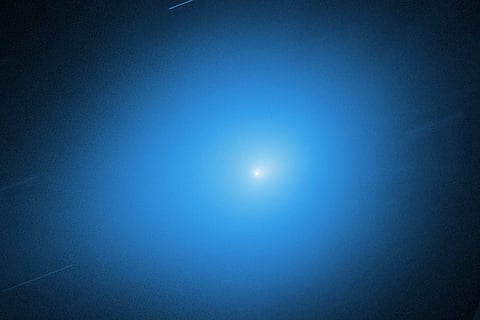
December just got an upgrade — and it’s not holiday traffic or year-end parties.
It’s 3I/ATLAS, a visitor from another star system, casually cruising through our solar neighbourhood like it owns the place.
On December 19, 3I/ATLAS makes its closest approach to Earth, marking one of the most intriguing astronomical events of the year.
This isn’t your average dirty snowball.
It’s only the third confirmed interstellar object ever detected, following the headline-stealing ‘Oumuamua (2017) and 2I/Borisov (2019).
Discovered by NASA’s ATLAS survey — basically Earth’s planetary early-warning system — this object is on a one-way trip through our solar system. No return ticket. No souvenirs. Just science.
Quick timeline: Interstellar drive-by
Discovery:
Late 2025, by NASA’s ATLAS system, scanning the skies for threats — and occasionally, cosmic surprises.
December 19 – Closest Approach:
3I/ATLAS passes within 170 million miles (274 million km) of Earth.
That’s more than 700 times the Earth–Moon distance — close by space standards, utterly safe by human ones.
December (Now–Late Month):
NASA and international observatories throw everything at it — telescopes, spectroscopy, trajectory analysis — because interstellar visitors don’t hang around.
Post-December:
It "slingshots" past the Sun and exits the solar system forever, leaving behind data and unanswered questions.
Why scientists are excited (and slightly nervous)
Interstellar objects are rare, fast, and frustratingly brief.
Each one is a sample from another solar system, offering clues about how planets, comets, and chemistry form elsewhere in the galaxy.
It's an interstellar visitor, so its speed is extremely high, and it's expected to exit the solar system at roughly the same speed it entered, though its trajectory and speed are affected by the Sun's gravity and outgassing.
But here’s where things get spicy.
Astrophysicist Avi Loeb of Harvard — famous for challenging assumptions about ‘Oumuamua — has pointed out that past interstellar objects showed anomalies that didn’t fully match expectations:
Unexpected acceleration without visible cometary tails
Unusual shapes or reflectivity
Motion that didn’t behave exactly like a standard comet
Loev has highlighted a number of anomalies.
Nasa dismisses 3I/ATLAS as a comet.
Loeb isn’t saying “It’s aliens” — but he is saying science should stay curious, not dismissive.
If 3I/ATLAS shows similar odd behaviour, it could reignite debates about whether some interstellar objects are natural oddities… or something more exotic.
At minimum, it’s a stress test for our understanding of physics beyond the solar system.
How (and if) you can see it
Best time:
Pre-dawn hours, now through late December.
Where to look:
Low in the east-northeast, just below Regulus, the bright star in Leo.
Gear:
You’ll need a serious telescope — at least 30 cm (12 inches).Binoculars won’t cut it.
Dark skies matte
New Moon nights are your best shot. Or better yet, tag along with a local observatory or astronomy club.
As 3I/ATLAS vanishes back into interstellar space, it leaves us with priceless data — and maybe a few uncomfortable questions.
Because every time something from outside our solar system drops by, it reminds us of one thing: we need to pay attention.


