Paddle into a wonderland in Thailand
Go kayaking in Thailand and catch the true beauty of the Andaman coast
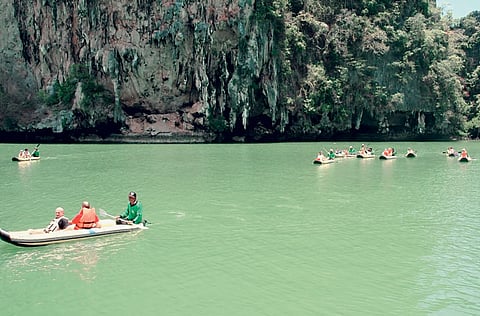
Lying back in the kayak, I tried to follow my guide's instructions to make myself as horizontal as possible while he propelled our two-man boat into the mouth of the sea cave and through a tunnel.
Just a couple of feet above my face, dozens of small, greyish bundles hung like macabre Christmas decorations. I shrank down further. At last we came out into a circular lagoon of blue-green water, surrounded on all sides by high cliffs, vines and vegetation clinging to the vertical habitat.
Legacy in limestone
There can be no better way to explore the emerald bay on the western Andaman coast of Thailand than by kayak. More than 160 limestone islands litter its breadth, characterised by cliffs rising from the sea and, in some cases, hongs (hidden lagoons) at their centres.
The area has been dramatically influenced by tourism. My guide Olay said hundreds of tourists visit the beach daily and the bay's most famous "paradise" spots — Phuket in the west, Krabi on the mainland in the east and Phi Phi island further south — have come to symbolise the ruinous capacities of tourism, with refuse, sewage and pollution problems and big hotels jostling for space. Yet, if you travel by kayak, it is possible to find an unspoilt side to Phang Nga. The Californian John Gray was the first to bring commercial sea kayaking to the bay back in 1989. Accompanying me and 20 other tourists on the Hong by Starlight excursion, he said he is trying to get the industry to "green up".
The excursion's selling point is that each customer has their own guide to paddle their sit-on-top kayak as they explore the stunning lagoons.
Ideally one would explore the bay independently but local operators won't rent kayaks to tourists without a guide (due to dangerous currents and tides), so I had booked an extended camping and kayaking "mini expedition". While the rest of the punters headed towards the dazzle of Phuket, our breakaway party — with leader Olay, Welsh guide Martin and assistant Pung — paddled out into the darkness.
We set up camp on a stretch of beach backed by the cliffs on Koh Penak and parked our kayaks in front of our tents. We sat around the fire, listening to Martin's tales. Phosphorescence glittering in the sea drew us in for a late-night swim and we floated on our backs, looking up at the stars, flipping over to create our own underwater constellations.
Fresh start
Walking out on the sand to watch a violet-and-rose-red sunrise is a luxury Phuket's most expensive resorts can never match. As long-tail boats cast the day's first nets, around me, the island woke up. Insects buzzed, freshly filled rock pools fizzed and I saw a metre-long black monitor lizard slither into the sea from the rocks. We set off after breakfast — fresh pancakes and eggs — each paddling our own kayak, following the tide east into the bay. We made stops to examine red anemones and explore Hong Island and a "diamond cave". In the main channel, pleasure boats chugged past, loaded with tourists bound for Koh Ping Kan — the setting for Scaramanga's lair in The Man With the Golden Gun. How those people were missing out.
Riding the tide back to camp, exhausted after seven hours of kayaking, we returned to a meal cooked by chef Toy on a makeshift kitchen set on some stones, of tom kha gai coconut soup, curry, noodles and sweet-and-sour jackfish, cockles and chillies.
At "Tarzan beach", we swung on vines from rocks into the sea, saw shoals of anchovies and several cigar fish and explored Hlam Tang, the largest hong yet, negotiating a maze of mangroves to a cavern full of dripping stalactites. Later, Toy cooked green curry — the best I have had in Thailand. Snorkelling later to a long, sandy spit on Koh Pak Beer, I floated above massive sea urchins, giant clams and parrotfish and almost stepped on a stingray in the shallows.
Koh Yao Noi, the bay's second-largest island next to its neighbour, Koh Yao Yoi, was my drop-off point. With its tiny villages, beach huts and rubber farms, it looked traditional, despite the smattering of top-range hotels. But as my boat pulled up at the lawns of the Koyao Island Resort, I knew this would never match the magic of a tent on a deserted strip of sand.


