Memoirs from a trip to Japan
Andrew Richardson takes in the sights by exploring futuristic Tokyo
Marvelling at the stunning beauty of Tokyo's Imperial Palace Gardens, it was difficult to imagine Japan as a nation that was ravaged by natural disaster last year. The gardens in Tokyo's Chiyoda area were created almost 150 years ago and hark back to a different era. They encompass the former Edo Castle and comprise some of the world's most beautiful gardens. Sightseers were craned over dizzyingly beautiful pools and floral displays, trying to capture images of lilies and rare plants. An atmosphere of calm was all-pervasive. It really felt as though we were at the most peaceful place on earth.
And yet, just over a year ago, the normally popular Imperial Palace Gardens were deserted. The terrible tsunami and earthquake that struck northeast Japan in March 2011 wiped out the nation's tourist industry almost instantaneously. Visitors from around the world cancelled trips to the Far East and numbers plummeted by more than 60 per cent. The Tohoku disaster, one of the five most-powerful earthquakes in the past century, left 20,000 dead and many more homeless. It cost Japan more than $300 billion (Dh1.1 trillion).
Remarkably, Japan's tourist industry has sprung back. The number of visitors is rising as discerning travellers rush to cash-in on bargain deals at high-end hotels and restaurants. There has never been a better time to visit. Japan is such a well-organised nation that there are no risks to travellers, provided they steer clear of the north and the area surrounding the Fukushima power plant. The World Travel and Tourism Council has noted the efforts made by the nation's tourist industry. The council's president and chief executive David Scowsill says, "As the world's third-largest travel and tourism economy, the recovery of Japan is one of the most compelling issues facing the industry anywhere in the world."
Japan is a great place for visitors; The people are friendly and polite, and there are many local organisations that provide help and assistance to visitors who might not understand the language, culture or food. Still, it will take time for Japan's visitor numbers to reach record heights once more - but that simply means that destinations like Tokyo and Kyoto are no longer teeming with tourists. Smart travellers are making the most of it. I was staying at the Park Hyatt, in Shinjuku, the setting for the cult Bill Murray and Scarlett Johansson film Lost In Translation. The view from my room on the 45th floor was awe-inspiring. By day, the city hummed as millions of workers filled the streets below. Huge pockets of green denoting the city's multitude of parks dotted the landscape like an impressionist painting. At night, Tokyo dazzled, red and blazing-white lights illuminating the sky.
The hotel was in a league of its own, with phenomenal staff who catered to my every need. Top-notch dining was on offer in the New York Grill, with views of the city, while the spa, gym and pool were sensational.
During my three days in Japan's capital, I explored many sights. In Shinjuku, I wove a path between the district's towering skyscrapers to find gargantuan electronics stores, futuristic buildings, thousands of shops, hundreds of arcades and some of the country's wildest nightlife.
Chiyoda is notable for being the site of the Imperial Palace where tourists can visit one of the world's most gorgeous gardens.
The sheer size, frenetic pace and mass of neon light and loud music made Tokyo seem bewildering, though surprisingly it was no more expensive than London, Paris or New York. Using taxis and a perfectly efficient metro system I visited incredible sights like the Tokyo Tower, Rainbow Bridge - so called because of the different-coloured lights that illuminate it - and the National Diet Building. The Tokyo National Museum was the perfect place to find out more about traditional Japanese art and I was beguiled by the lovingly detailed images. Their transcendental beauty was evocative of a golden age.
A change of pace
All too soon, it was time to depart from the sprawling metropolis of Tokyo via bullet train to Kyoto. The pace of life in the former imperial capital of Japan could not have been more different. For three days I enjoyed the uniquely Eastern culture. Kyoto is filled with hundreds of temples and shrines. My hotel was the ultra-comfortable Hyatt Regency Kyoto, located in the traditional and secluded area of Higashiyama Shichijo. It was luxurious and cosy, an ideal place to recover from the mania of Tokyo. My room overlooked a delightful Japanese garden, all rocks, trees and water, and a heron sat on a balcony just metres from my room, observing the koi carp below. The hotel was the perfect base from which to explore fascinating sights like the bamboo forest of Arashiyama, the golden temple Kinkaku-ji and Zen temples.
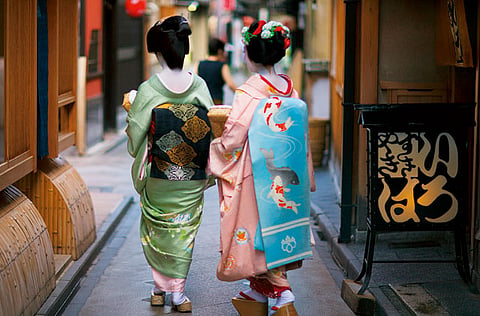
Japan is renowned for its stunning gardens, a fascination dating back to the Heian period when Kyoto was overflowing with these beauties. I also sought out close encounters of the cultural kind and headed into the Gion district to learn about Geisha. Kyoto was the location for Arthur Golden's novel Memoirs of a Geisha and continues to provide a base for practitioners of the ancient art. The district also has phenomenal sushi restaurants. I enjoyed a kaiseki dinner, which is a traditional Japanese multi-course meal. Each element had been beautifully arranged, almost as though by an artist.
The sakizuke, or, appetiser, was similar to an amuse-bouche, dancing on my tongue while the mukozuke, a dish of seasonal sashimi, was sensational. In all, we managed to eat our way through 11 courses, with the takiawase, or vegetables served with tofu, proving to be another highlight. Also delicious was the tome-wan, a delicious miso-based soup.
Gion was an absolute treat. An area that is unsurprisingly revered by locals and visitors alike, it was developed in the Middle Ages and features two communities: Gion Kobu and Gion Higashi. The area a National Historical Preservation District and much has been done to preserve its beauty. Above the roads, electricity and telephone cables are safely out of reach in the event of an earthquake.
Lest we forget
I had arranged a week-long bullet train pass and so I spent one day travelling to Hiroshima, where I visited the Peace Memorial Park.
There is probably not a more poignant memorial on the planet. Folded paper cranes were all around in memory of lost lives. It proved a deeply moving experience.
I spent a peaceful 30 minutes at the Atomic Bomb Dome at the Hiroshima Peace Memorial Park trying to comprehend what it must have been like for people when the atomic bomb exploded on August 6, 1945 at 8.15am. It was an eerie and moving experience. The park contained many trees that had somehow survived the disaster, though their trunks were scarred with black debris.
Hiroshima taught me how quick we are to recover from atrocity. Elsewhere, the city had risen almost phoenix-like, with a huge number of buildings, neon lights, museums, shops and tourist destinations. In many ways, it was reminiscent of the way in which Japan has overcome the Tohoku tsunami and earthquake.
The country remains a culturally fascinating and beautiful destination for travellers. My lasting memory is not of the temples, shrines, palaces or the neon lights, it was of the people.
I've never before encountered a nation whose citizens are as graceful, polite, welcoming and kind. I can't wait to return.


