Jordan has a new hiking route, and you’re going to want to walk it
Map a revealing path through the length of the country less than four hours from the UAE
You may also like: The ultimate 2018 travel bucket list
You may also like: 10 of the best apps for independent travellers
After a hot and weary 11 miles of walking, we arrived at our campsite for the night where we watched the sun dip behind the mountain peaks and shared a supper of chicken and rice flavoured with cardamom. The post-prandial entertainment was provided by our guides, who treated us to an impromptu song-and-dance routine around the campfire. Exhausted, I slipped off early to my tent. With no light pollution, the clear desert skies were seared with stars, and with the almost biblical sound of panpipes wafting over from the fire, sleep came quickly.
The closer we got to Petra, the more clues we unearthed. We stopped to inspect a wine press cut from the famous red rock, still bearing traces of its original plaster coating and one of 47 discovered here. With only 20 per cent of the archaeological site yet excavated, there could be many more. A short, sharp scramble up the side of a wadi took us into Little Petra - the Nabatean caravan station situated a short distance outside the old city centre. Still lined with rock-cut facades, this is where traders on the Spice and Silk Roads would rest their camels and pay the taxes that made Petra rich. From here we were whisked to our desert camp, the hillside beyond decorated with lanterns, where I sunk gratefully into my comfortable bed.
And then, almost without realising it, we were in Petra itself. A climb of 200 rock-cut steps led up to the so-called Monastery, named after the crosses carved inside in Byzantine times. Surrounded by its towering peaks we could see how the city remained hidden from Western eyes for so many centuries, until rediscovered by the Swiss explorer Johann Burckhardt in 1812. Descending 950 more steps – and via a few vertiginous ledges – to the bottom we saw the first signs of Petra’s mass tourism, something that had eluded us for the past three days. There was a real sense of pilgrimage entering Petra on foot. Yes, there were the inevitable crowds, but we soon dived off into the narrow, secretive Wadi Al Mudhlim (“Dark Wadi”), all swirls of red, pink and white rock, bypassing the famous Treasury entirely. My hotel and a hot shower beckoned, and Petra’s masterpiece could wait.
Traveller’s checks
Travel highlights
Ajloun and the North
Wadis and Crusader Castles
Petra
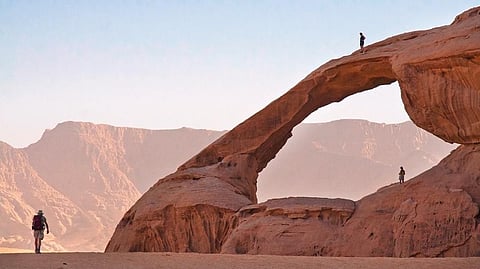
The final stretch of the trail takes you through the desert wilderness of Wadi Rum with its red sands and dramatic rock formations. The trail ends at the Gulf of Aqaba, on the Red Sea.
Telegraph Group Limited London 2018


