The Kurator’s Paris Couture Week, AW27 round-up
Dior, Chanel & Schiaparelli led a season where artistry and imagination took centre stage
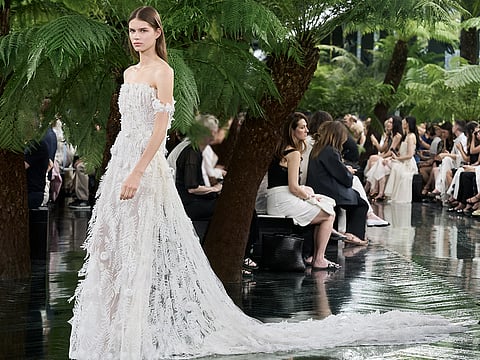
Every couture week produces its share of hand-wringing - the same tired questions about who's still buying, whether the discipline has any business existing in a world this anxious, whether it's all just theatre for a shrinking room. This week, in the middle of a Paris heatwave that had already bent one menswear schedule out of shape, nobody seemed especially interested in having that conversation. Instead, half a dozen designers, working independently and mostly new to their houses, arrived at something closer to a shared instinct: that couture's only real function left is to be irrational on purpose. Not eccentric for its own sake, but strange with intent - sculptural, sentimental, occasionally surreal, always in open defiance of the industry's current appetite for safety. It made for the most interesting week of shows Paris has offered in some time.
Dior
Jonathan Anderson's second couture outing for Dior was the week's most fantastically thorough, offering, and its most confident. Where his January debut announced a vision, this one executed a thesis: that couture and sculpture are, at bottom, the same discipline - flat material coaxed, through knotting, pleating, moulding, into something that stands up in three dimensions. Lynda Benglis was his text, and Anderson read it closely rather than illustrating it literally, translating her poured, twisted, muscular forms into hand-plissé, draping and knot-work that never once tipped into pastiche.
The India thread was the collection's soul rather than its decoration - antique 18th-century chintz fragments worked into the Petit Dîner and mini Lady Dior bags, a nod to Benglis's own long relationship with Ahmedabad, itself folded into a meditation on the contrast between that city's abundance and the aridity of Benglis's Santa Fe. It is the kind of research-heavy, footnoted couture that could read as academic in lesser hands. In Anderson's, it read as generous. He is, three seasons in, doing exactly what a great artistic director should: making the house's history argue with something outside itself.
That the show landed three days after Anderson dressed Taylor Swift for her wedding to Travis Kelce - a gown nobody has yet seen - was, of course, the story half of Paris actually wanted. Anderson, wisely, refused to give it to them, closing instead with a hand-pleated chiffon bridal look trimmed in feathered dandelions. A second wedding dress in one week, and still the more private of the two.
Chanel
Matthieu Blazy's second Chanel couture collection argued through intimacy. "Gaby and the Beanstalk" took its cue from a book of fairy tales Blazy found in Gabrielle Chanel's own apartment - and rather than illustrating Jack and the Beanstalk or Goldilocks literally, he let their logic seep into the construction: guipure lace standing in for magic beanstalks, minaudières shaped like sleeping bears, whimsy tucked into linings and pockets like the private jokes children leave for each other.
The genius of this collection was its refusal to be a costume party. Underneath the pea-pod heels and golden-egg embellishments sat the most technically serious tailoring Blazy has shown at Chanel yet - chiffon suits reprised and sharpened, tweed reworked with the kind of textural depth only le19M's ateliers can deliver. Blazy has understood something about this house that eluded some of his predecessors: Chanel couture was always meant to reward the woman who leans in close enough to notice. That he closed the show not with a bridal gown, breaking sixty years of couture convention, but with a Little Black Dress - Coco's own signature, worn by a woman who never married - was the season's sharpest closing statement.
Schiaparelli
Daniel Roseberry's "The Call of the Void" arrived with an unusually candid designer's note, admitting he'd tried and failed to repeat the formula that made last season's "The Agony and the Ecstasy" a triumph - and found, in that failure, something more interesting than certainty. The result: a collection built on synthetic materials rarely afforded couture's dignity - latex, silicone, painted sheets sculpted and cast rather than sewn. A silicone bustier hand-sculpted and painted milky blue. Crinoline rendered in weightless sculpted tubes. Kinetic latex tentacles scrolling from the shoulder.
The house's signature jacket, demoted for the occasion to accessory status, tells you everything about where Roseberry's head is right now: not interested in repeating Schiaparelli's greatest hits, interested in what Elsa herself would have called making the familiar strange again. It is not a subtle collection. It was never going to be. But its lobster-pink-and-gold palette, its octopus-tentacle jewellery, its sea-anemone chokers, cohered into something truly odd and genuinely couture - proof that surrealism, done properly, still has teeth.
Armani Privé
Armani Privé's "Boudoir" made its case through withholding - seduction built on what stayed hidden rather than what was shown. The premise – dressing as a private ritual, a woman's intimate negotiation with herself rather than a performance for others - produced a collection built on the tension between concealment and reveal, the masculine jacket softened by degrees into sculptural evening opulence. Silhouettes stayed precise even as they turned fluid, disciplined even as they experimented, tracking a clear arc from tailored day pieces toward gowns with real sculptural weight. Shimmering highlights sat against velvety matte textures throughout, blurring day and evening until the two were barely distinguishable. Animalier print crept in only as a whisper - softened, barely-there, mostly legible through the embroidery rather than announced outright. The palette read as black from ten feet away and only revealed itself, up close, as an iridescent weave of green, brown, amaranth red and deep blue. Iridescent stone embellishments caught the light with the same restraint as everything else, never overstating themselves.
Stéphane Rolland
Rolland's collection at L'Olympia - staged, pointedly, as a charity show for the Fondation des Hôpitaux - was the week's most emotionally direct offering, and its most moving. Marking forty years since Dalida's death, Rolland resisted the temptation to costume her, choosing instead to portray the woman underneath the icon: her Cairo birth, her Mediterranean roots, her reinvention in Paris, the vulnerability that sat alongside her legend. The show opened in a nearly celestial white - sculptural gowns and sweeping capes that seemed to float rather than walk - before deepening, chapter by chapter, into crimson, black and silver, mirroring the emotional arc of one of her own songs. Rolland's architecture was, for once, softened at the edges. It suited him.
Georges Hobeika
The Hobeikas' collection, "The Visitor" - named for James McCrae's poem Instructions Before Visiting Earth - was a meditation on noticing the overlooked. It resisted illustrating its source material directly, letting a sense of wonder emerge instead through sculptural tailoring and dense embroidery. The show opened not with spectacle but with restraint: a heavily beaded little black dress, its hem dripping with tiny beads, a sheer tulle wrap at the waist doing the work of a peplum. From there, the 1920s crept in at the edges - one gown cascading with dense flapper-era beadwork, another in liquid silver that rippled like poured mercury with every step. Column gowns did quiet, expensive things: one fully gilded, another a metallic halter with a mother-of-pearl orchid resting at the bust, and a single deep-green strapless fishtail gown, stripped of embellishment entirely, that let sculptural simplicity do all the talking. Couture's love of spectacle returned for the pannier gowns - an ivory lace ballgown with dramatically widened hips, dusted in crystals, and a powder-blue counterpart with a structured satin bodice and scalloped crystal embroidery. Blue, in fact, ran through the whole collection, from soft grey-blue to deep sapphire to a midnight so dark it bordered on black. The jewellery was the collection's cool triumph - beetles and oversized snails in silver and gold, standing in for the florals couture usually reaches for, a reminder that the Hobeikas' instinct for craft has always lived closer to the ground than the spectacle.
Elie Saab
"The Ball of Untamed Dreams" gave the week its most theatrical evening, a masquerade of shifting colour - lilac dissolving to silver, deep blue softening to blush - and surrealist touches worthy of the title's Magritte-and-Dalí references. A sheer sweep of pearl-strewn opaline organza did a fair impression of a Magritte cloud; a magenta silk fishtail bloomed into something closer to a Dalí rose. Elsewhere the collection reached for calla lilies, twilit skies and midnight swans as its unofficial cast of characters, fabric draped and twisted until it forgot it was fabric at all. Goddess gowns in pastel gave way to wine-red velvet and black winged column dresses, embellished corsets and dramatic trains doing the heavy lifting on the power-dressing front, while sharply cut tuxedos - for both the women and the men in the room - kept the evening tethered to something more knowing than pure fantasy. Sculpted headpieces and otherworldly masks turned accessories into their own small works of art. It closed, as Saab's shows do, with a bride rendered in molten iridescence and champagne-gold - real glamour, delivered without irony.


