The Khan reopens as Damascus’ cultural heartbeat
A historic landmark blends heritage, art and resilience for a new era
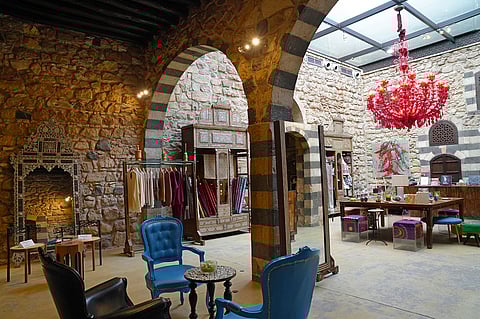
The Khan, standing proudly on the legendary Straight Street—one of the world’s oldest continuously inhabited urban arteries—is more than a destination. It is a declaration of resilience, a hymn to heritage and a living canvas for art and craft. Its rebirth in 2025 marks not just the reopening of a landmark but the revival of a dream that began nearly two decades ago under another name: Villa Moda Damascus.
Get updated faster and for FREE: Download the Gulf News app now - simply click here.
When Villa Moda opened in 2006, it was a revelation. The concept was audacious: -global luxury brands housed within a meticulously restored 17th-century caravanserai. Gucci, Dior, Prada and Saint Laurent found a home beneath soaring arches and Damascene stripes, their couture silhouettes framed by hand-carved mashrabiyas and antique wooden tables. A dramatic red Murano chandelier blazed like a flame above the stone floors, casting a glow that seemed to fuse Milanese glamour with Levantine poetry. Visitors wandered through spice-scented souks, past pistachio roasters and tailors, before entering a world of couture, a juxtaposition so theatrical it felt like stepping through a portal. For Damascenes, Villa Moda was more than a boutique; it was a symbol of cultural confidence, a statement that their city belonged on the global map of style and sophistication. International critics hailed it as a masterstroke, praising its soaring arches and museum-quality restoration, admiring the boldness of placing couture in an ancient souk, calling it a marriage of elegance and history. Villa Moda was not just a store; it was a phenomenon, a cultural landmark that redefined the Middle East’s relationship with luxury.
Then came silence. When the civil war intensified in 2013, Villa Moda was forced to slow the project until it entered a full freeze in 2018. As Syria endured unimaginable hardship, the building was not abandoned but preserved. Its founders, husband and wife duo Amjad Malki and Sandra Hakim, safeguarded the structure, protected artisan networks and waited for a moment when revival would be meaningful and responsible. That moment has arrived. The landmark reopens honouring its historic roots while signalling a new mission: to transform from a temple of luxury retail into a multidimensional cultural institution. “The revival this summer felt less like a reopening and more like a rebirth,” Amjad explains. “We returned with a sense of responsibility to continue what was interrupted by the war. It is an act of hope, pride and faith that this city—and its people—will weather every storm. Reviving The Khan is our way of saying that culture endures, beauty survives and Damascus still has countless stories left to tell.”
A sanctuary for heritage crafts, a gallery for contemporary art and a social anchor for Damascus, The Khan’s courtyards hum with creativity, echoing with conversations between artisans and artists, curators and collectors. Here, master craftspeople revive traditions that teetered on the brink of extinction: Damascene silk brocade shimmering like moonlight on water, mother-of-pearl glinting against carved walnut, glass hand-blown into shapes that catch and fracture the Damascus sun. Laurel soap, metalwork and textiles—each a fragment of Syria’s soul—are celebrated, documented and elevated to global recognition. These are not mere objects; they are vessels of memory, carrying centuries of technique and storytelling.
“The response has been overwhelmingly positive and deeply moving. People have embraced The Khan as a symbol of resilience and a reminder that creativity is still alive in Damascus. The feedback has come from all directions,” Sandra shares. “Artisans, artists, long-time residents, young visitors and people who lived through the last 14 years of conflict. Many told us they needed to see something like this again: a beacon of hope and a place that celebrates what is still good, still beautiful and still uniquely ours.”
Alongside the heritage heartbeat, The Khan embraces the future through a professionally curated contemporary art gallery. “From a purely financial perspective, opening an art gallery at this moment in Syria is undoubtedly a challenge. People have many urgent priorities before art. But if you see it from the perspective of cultural responsibility, the decision becomes obvious,” Amjad explains. “Local artists desperately need an active, credible gallery connected to the international art world. For us, this space is a contribution to cultural continuity. And on a personal level, is an act of quiet defiance—an insistence that art continues, even when everything else tries to silence it.”
Its walls showcase painters, sculptors and digital visionaries whose work reflects the complexity and dynamism of a region in transformation. Conceptual installations converse with traditional craft, creating a dialogue between past and present, permanence and flux. For emerging Syrian artists, The Khan offers not just visibility but validation—a platform to shape narratives beyond borders.
Yet The Khan’s significance transcends aesthetics. It is a catalyst for cultural and economic revival, providing employment, sustaining families and reigniting pride in a city scarred yet unbroken. “Supporting livelihoods and restoring pride were essential reasons behind reviving The Khan,” Amjad says. “The immediate impact is on our team, artisans, designers and artists but the ripple effect extends much further: increased footfall brings life back to neighbouring shops, cafés, antique dealers and the wider community. Seeing people return, engage, and feel hopeful again is incredibly emotional.”
The architecture itself remains a masterpiece: striped stonework, soaring arches and courtyards that open like verses of poetry. Every detail speaks of continuity and care, the rhythm of Damascene design preserved yet reinterpreted for a new era. The Khan does not impose modernity upon heritage; it allows the two to coexist, creating a space that feels both timeless and thrillingly contemporary.
What began as Villa Moda, a phenomenon that married Milan and Paris with Damascus, has evolved into something infinitely more meaningful. The Khan is not a revival; it is a renaissance. A place where artisans and artists stand shoulder to shoulder, where heritage is not a relic but a living force, luminous and unyielding. It is a place where the hum of looms and the hush of galleries converge, where the scent of laurel soap mingles with the sharpness of metalwork, and where every object speaks of continuity. In a world that often forgets the fragility of heritage, The Khan stands as a reminder that beauty is not a luxury; it is a a force that binds communities and shapes identities.
“Craft is the language of our ancestors. Art is the voice of our present. Together, they give people dignity, purpose and connection,” Sandra explains. “They remind us of who we are, where we come from, and what is still worth protecting.”
As Damascus reclaims its cultural heartbeat, The Khan becomes its pulse, echoing through ancient stone. For visitors, it is an experience that transcends commerce—a journey into the soul of a city that has endured, adapted and emerged radiant. And for the world beyond, The Khan is an invitation: to witness, to celebrate and to believe in the enduring power of art, craft and heritage.


