No ‘dead zones’: Philippines rolls out direct-to-cell tech — is your phone ready?
First in Asean: Check if your phone can hook up direct to satellites for calls, text, data
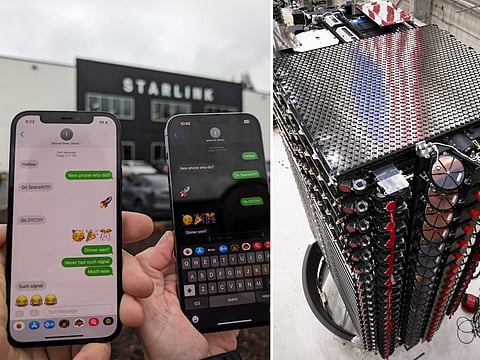
Manila: In a leap for connectivity, the Department of Information and Communications Technology (DICT) here has unveiled a groundbreaking direct-to-satellite smartphone service.
It's dubbed as the first among the Association of Southeast Asian Nations (Asean), an 11-member regional bloc.
The initiative, highlighted in a government announcement about a partnership between Globe Telecom and Starlink, promises to eliminate mobile “dead zones” (or "dead spots") across the tropical archipelago by enabling ordinary LTE phones to connect directly to satellites for calls, texts, and data — no cell towers required.
D2C service: Is your phone ready?
Starlink’s Direct2Cell (D2C) service uses a constellation of more than 650 low-Earth orbit satellites, functioning as “cell towers in space”.
DTC service uses specialized low-Earth orbit satellites equipped with advanced eNodeB modems, acting as cell sites in space to provide LTE connectivity directly to unmodified mobile phones.
This technology enables SMS, text, and voice services in remote areas by using large, high-sensitivity phased array antennas to bridge the gap between satellites and standard user devices.
Key components
The basic building blocks of Starlink’s Direct-to-Cell include "cell tower in space" tech, involving second-generation Starlink satellites equipped with advanced electronics, allowing them to emulate a terrestrial cell tower and communicate directly using 4G/LTE protocols.
Advanced phased-array antennas and laser inter-satellite links allow seamless integration with existing mobile networks.
Users need only a clear view of the sky; no special hardware or apps are necessary.
First in Southeast Asia
This marks the Philippines as the first country in Southeast Asia — and the second in Asia — to deploy the technology commercially through a major operator.
The implications are profound.
For a nation of more than 7,640 islands, where rugged terrain, remote communities, and frequent typhoons (averaging 20 per year) have long hindered traditional infrastructure, this tech is a game-changer.
Globe, investing $1 billion and leveraging its 63.1 million subscribers, will extend coverage to mountainous regions, isolated islands, and disaster-prone areas.
This partnership will usher the Philippines into a new era of connectivity, especially for our unserved and underserved communities, and will be critical in times of disasters when communication can mean the difference between life and deathSecretary Henry Aguda, Philippine Department of Information and Communications Technology (DICT)
DICT Secretary Henry Aguda emphasized its life-saving potential: “This partnership will usher the Philippines into a new era of connectivity, especially for our unserved and underserved communities, and will be critical in times of disasters when communication can mean the difference between life and death."
Aguda said the country will continue to support and welcome investments that expand access and ensure that no Filipino is left behind in the digital age.
Initial testing and proof-of-concept rollouts are slated for the first half of 2026, focusing on unserved regions.
Benefits include improved education, healthcare access, e-commerce, and emergency response. Farmers, fishers, and students in far-flung barangays could finally participate fully in the digital economy.
Challenges
Challenges remain.
Critics worry about reinforcing the telecom “duopoly” (Globe and Smart), potential pricing impacts, and reliance on foreign satellite technology.
Starlink services are also available to customers in the Philippines, without the need to sign up with a local telco.
Privacy and data sovereignty questions also arise with any space-based system.
The Philippines recently introduced legislation allowing full foreign ownership of companies key sectors.
The Philippine Public Service Act (Commonwealth Act No. 146), as amended by RA 11659 in 2022, liberalises the economy, specifically by allowing up to 100% foreign ownership in key sectors like telecommunications, shipping, and railways.
It limits the 60-40 foreign equity restriction only to designated “public utilities” (e.g., electricity distribution) to foster investment and improve service quality.
The enthusiasm with D2C tech, however, is palpable: the partnership signals a commitment to digital inclusion, ensuring no Filipino is left offline.
As Starlink’s network grows, the Philippines stands at the frontier of satellite-mobile innovation.
What was once science fiction — reliable signal from the stars — now edges closer to everyday reality, bridging the archipelago’s persistent digital divide.


