I love tennis too much to stop playing - Sharapova
Maria Sharapova's passion for Wimbledon strong as ever
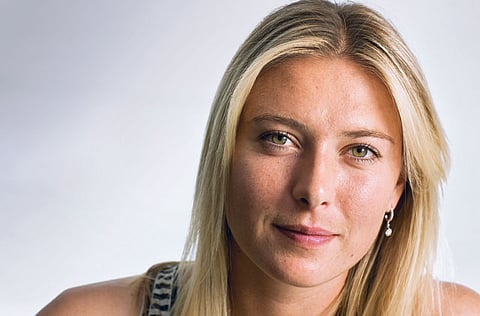
London: "I had so many ways I could have got out," Maria Sharapova says intently, her eyes opening wide as she remembers the choice she faced last year. Instead of returning to the grinding routine of professional tennis, she could have escaped forever.
"I had so many excuses I could have made that it would have been easy to walk away. I could have said that no one else in tennis has ever come back from a serious rotator-cuff injury to their shoulder. I could have said I've made enough money to last me the rest of my life. I could have said I've done this and done that."
Sharapova has already won Wimbledon, and two other grand slams, and been No 1 in the world. She has also ended up as the most lucratively endorsed woman athlete in the world, after receiving a record $80 million contract from Nike this year.
Her life, however, has rarely been easy. And so Sharapova pauses for breath as, with Wimbledon less than a week away, she considers both the injury that ruined her last 18 months on the Sony Ericsson WTA tour and a tumultuous career that began when she left the Russian port of Sochi for Miami as a seven-year-old girl. She did not see her mother for the next two years.
"My family and I built my whole career from scratch," she says in a meaningful reminder that her father, Yuri, was so determined to shape her success that he moved her from Russia to America in 1994.
Love for sport
"It wasn't like I had a famous boyfriend who made my career. I didn't have a magazine that made my career. So I could have chosen to stop playing because we did it ourselves. But I love the sport too much to wake up and say I no longer want to do it. I missed it. It got to the point where I would look at books and pictures of some great moments I had on court just to remember what it felt like."
The temptation with Sharapova is to picture her as the beautiful young girl who won Wimbledon at the age of 17, with such verve and joy, or to dismiss her as a moneyed celebrity who has moved away from the court to the red carpet. But, listening to her talk with such intimacy, it becomes easier to think of her as being defined most by those early years in the US when she was so isolated from everything she had known.
"I always reflect on it, on a daily basis. No matter how many wins and losses I have it helps to know that I have a home I can go to now. After I injured my elbow at Palm Springs [in March] I had to have another month off. But I went to see my parents in Florida for a whole week and we had these long conversations. I know my roots and I cannot forget the journey I made."
She punctuates her engaging conversation with girlish laughter and breathless exclamations. Yet the difficult nature of her childhood is stark. "I didn't see my mum for two years. Back then there were no cell phones and, oh my goodness, no email! All I had was a pen and some paper, and so I wrote letters that would arrive back home a month later." Sharapova only spoke to her mother once every six months on the phone, but she tries to brush aside the trauma that must have induced in her at Nick Bollettieri's Academy.
Menial jobs
"I was young and happy. I was in Florida, in the sunshine, learning a new language and playing tennis. But it was very difficult for my mum to lose her husband and daughter."
At the age of 23, and being so open about her desire to have children one day, Sharapova has begun to understand all that her mother, Yelena, endured as she waited for an American visa. "It was very tough for her. She was about 27 when I left for America with my dad. I'm not far off that age myself now and so I can imagine what it must have been like for her."
It was also painful for Sharapova. Her father had to find work, often in menial jobs like dish-washing a few hours away, and so she had no option but to board at the Academy. "It felt as if I was walking through puddles and I was never really sure when I was going to reach dry land."
On a gentle afternoon in the English sunshine, Sharapova sounds as if she has returned to a darker place in her childhood. "I was much younger than the other girls at the Academy. I was teased a lot by them. I was never a part of their groups."
Sharapova's voice trails away as she looks up. "That's the way it was. It was really tough but it was also a good learning experience. It matured me in many different ways. I think I came out of it much stronger."
There is an undoubted truth to Sharapova's claim. "I didn't have much time to socialise but there's no doubt I had my share of tough days when you don't quite know why you feel so bad," she says.
"Why didn't I play as well? Why did I lose when I should've won? But those lows are important. If everything was going smoothly you would never build your character." That same inner strength helped Sharapova to overcome her more recent adversity.
Did you know?
- Maria's nickname is Masha.
- She has a dog named Dolce.
- She is good friends with fellow player Maria Kirilenko, despite not getting along with other female Russian tennis players.
- She enjoys Russian music over any other form.
- She favours Russian food, but also enjoys Italian bread.
- She enjoys reading books and her favourites are Sherlock Holmes and Pippi Longstocking.


