Sergei Bubka’s quantum leap
Legendary pole vaulter bidding for International Olympic Committee presidency
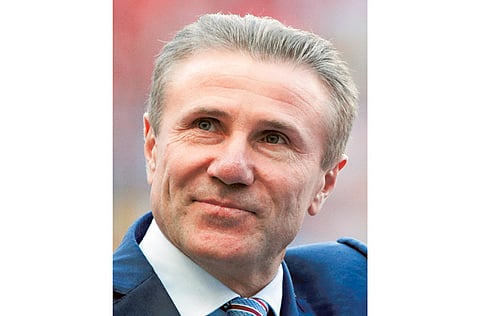
Moscow: It is strange to see Sergei Bubka — the man who broke 35 world records — as an underdog.
Yet here Bubka finds himself, still brimming with energy and ambition at age 49 and now fighting the odds and the political currents as he tries to make the leap from star pole-vaulter to president of the International Olympic Committee.
Although the outgoing president, Jacques Rogge, was an Olympian in yachting, the IOC has never had a global sports star as its head. In a celebrity-obsessed era that could provide advantages in terms of leverage and reach, Bubka, to his credit, is not attempting to make the leap from player to league president uniquely on his pole-vaulting record.
He has done his due diligence, sat through myriad conferences and held numerous posts in sports administration since he retired as an athlete in 2001. At the moment he is president of Ukraine’s National Olympic Committee, a member of the IOC’s influential executive board and a vice-president of the International Association of Athletics Federations, the governing body for track and field.
He is by far the youngest of the six IOC presidential candidates, which include the IOC vice-presidents Thomas Bach, a 59-year-old from Germany, and Ser Miang Ng, a 64-year-old from Singapore.
“We have good six candidates; they are my colleagues, my friends,” Bubka said in an interview in the library of a palatial Moscow hotel this week. “The most important is not age. The most important is experience. I have big and huge experience now.”
Bubka said he received no pay for any of his sports administration work, relying on income from his private businesses based in Ukraine, which are now run largely by family members.
The IOC election will be September 10 in Buenos Aires, but the outcome is being shaped in places like Moscow, where Rogge and most of the candidates have made an appearance for the world track and field championships, and where Bubka is front and center.
For Bubka, the world’s best pole-vaulter for more than a decade, track and field was and remains his power base. And Moscow was his capital city when Bubka was winning his titles and breaking records for the Soviet Union.
With his connections and clout, he has been the IAAF’s chief delegate to the Moscow organising committee. And it has not been the most gratifying start, with huge chunks of empty seats in Luzhniki Stadium creating the impression that 12 million Muscovites have much better things to do in late summer than watch the world’s second most important athletics competition.
It is not as if Russians are spoiled for high-level track and field. The last global championships in Moscow were the 1980 Olympics. Bubka sounds slightly defensive, but then he was the one who sought the assurances on attendance and was told that 85 percent of the available tickets had been sold.
“We cannot link this and say this is because the sport is not popular and it’s not interesting,” he said of the crowds. “Moscow is different. For that reason, we work all these months and discuss with them what is important.”
The atmosphere and fan count improved considerably Tuesday night as Russian star Yelena Isinbayeva took gold in the women’s pole vault and then did cartwheels and back flips down the track to celebrate.
Bubka is an Isinbayeva fan: “For women’s pole vault, she brought another era,” he said.
The admiration is mutual.
“Sergei was a role model,” she said. “He shows anything is possible in life and sports if you believe in yourself and chase a goal without straying from your path.”
Bubka won six consecutive world championships and broke barriers in both the metric system and imperial units, becoming the first man to go over 6 meters and the first, and still the only, man to clear 20 feet. His world records of 6.15 meters indoors and 6.14 outdoors have not been seriously threatened. But he had his competitive disappointments, particularly at the Olympics, where he was rarely at his finest.
He has his frustrations in his new line of work, too. His path to one of the posts that he has long coveted, the presidency of the IAAF, now appears blocked by Sebastian Coe, a former middle-distance star from Britain.
Coe was the charismatic head of the organizing committee for the successful London Olympics. Athletics were the true, sold-out centerpiece of those Games, and Coe is the overwhelming favourite to take the top IAAF job when Lamine Diack steps down in 2015.
Like most of the IOC candidates, Bubka is focused on strengthening the Olympics’ ties to the screen-centric younger generation. He is worried that the average age of global Summer Olympic viewers, according to his data, is 50. His campaign platform includes a proposal to create a global youth council, picked through national Olympic committees, to generate input.
Bubka has had other pressing concerns. The younger of his two sons, Sergei Bubka Jr., a professional tennis player, fell three stories from a Paris apartment in November, sustaining severe injuries. He has only recently resumed training.
“I would like to say thanks God that he is alive because it was a very serious, serious accident,” Bubka said. “But it happened, and it’s good that he’s motivated to be back.”
Back in Moscow, where he once competed, Bubka is struck by the transformation — the buildings, the enterprise. There is also renewed East-West tension — cancelled summits, protest over Russian anti-gay legislation — although nothing to compare with the Cold War in which Bubka came of age. Still, Bubka said the legislation would have no negative impact on those involved in the first Winter Olympics in Russia, the 2014 Games in Sochi.
“I’m confident Sochi will be a great success; there will be no discrimination to anyone: to athletes, official or spectators,” he said. “This is clear. This is Olympic charter, and the IOC communicates with the authorities of Russia and they confirm to us there will be no question at all. Of course, this is a Games for people, for athletes, and we will not punish the athletes.”
Bubka had to delay his Olympic debut because of the Soviet bloc’s retaliatory boycott of the 1984 Games in Los Angeles. He is intent on avoiding another one.
“I missed my first chance in ‘84 to become Olympic champion and I know the feelings,” he said. “I know that normally only a maximum of 15 per cent of the athletes survive from one games to another and have a chance to compete a second time. I’m lucky. I became Olympic champion in ‘88. But I don’t want that anyone will have these feelings.”
If he beats the odds and the currents and wins in September, he will be the president there to welcome the Olympians when they arrive in Sochi.


